[Insight & Opinion] The Fifth Republic's Democratic Justice Party and the 2026 Democratic Party of Korea
The President's "Do as I Say, Not as I Do" on Justice
Appointments Marked by Micromanagement and a Lack of Expertise
Both "Together" and "Democracy" Have Disappeared

"Hypocrisy and double standards undermine the credibility of any cause he claims to champion. When Chun Doo-hwan, the most unjust of them all, proclaimed the creation of a just society, the very words 'justice' and 'a just society' were tainted."
This is part of a post President Lee Jae-myung published on X (formerly Twitter) on Nov. 2, 2026, under the title "The Creation of a Just Society Proclaimed by the Architect of a Coup and Massacre." The post criticized the president's leadership, arguing that the ruling bloc's words and actions did not align and that its moral slogans were not backed by action. It is a valid point. It immediately brought to mind the controversy over whether the president's own words and actions are consistent. As the president himself pointed out, statements that impose on others standards one does not uphold oneself are unlikely to be persuasive.
Unfortunately, many of the major controversies surrounding President Lee involve situations in which he contradicts his own past remarks. For example, he has drawn criticism for appointing a large number of close associates to senior posts, regardless of their suitability, based on ties formed when they represented defendants in the Daejang-dong case and during his time as mayor of Seongnam. During the Choi Soon-sil state affairs manipulation scandal, didn't he criticize the appointment of close associates as a form of state affairs manipulation, saying, "If you give each of your close associates a post, you end up with another Choi Soon-sil"?
Yoo Si-min and others criticized President Lee for failing to remain loyal to his political camp and trying to broaden his appeal, but that was not what was happening. This was not a case of neglecting his camp while seeking unity by broadening his appeal. Rather, it was the result of narrowing the pool of talent to his close associates. This is far removed from a personnel policy that draws broadly on the nation's talent to foster national unity. Appointing close associates without regard to their expertise also undermines the expertise of the government agencies concerned.
He appointed a lawyer with no diplomatic experience as ambassador to the United Nations (UN), placing him on the front line of Korean diplomacy. The lawyer's connection to him stemmed from representing defendants in the Daejang-dong case. In National Assembly audits and elsewhere, the appointee has not shown any unexpected ability or made a notable contribution. Moreover, this is a particularly challenging time, with Korean diplomacy facing arduous tasks. In addition, former Daejang-dong defense lawyers have entered the National Assembly, where they routinely defend the president on the Legislation and Judiciary Committee. This raises serious potential conflicts of interest, yet the administration seems unconcerned by the controversy. Amid the debate over the "Special Counsel Act on Fabricated Indictments," the president appointed the head of the Defense Acquisition Program Administration from the Seongnam circle as justice minister, even though the Ministry of Justice is the government agency responsible for matters related to indictments. The appointment of close associates, combined with the president's hands-on leadership, has fueled concerns about the privatization of power.
As a presidential candidate, Lee won applause when he bluntly said that the president should be equal to ordinary citizens and that anyone suspected of a crime could be subjected to a forced investigation. But after he became president, his party took the lead in changing institutions related to the president's own legal liability and launching a special counsel investigation. The opposition and critics have even argued that the move is unconstitutional, calling it an attempt to evade legal accountability by wielding power.

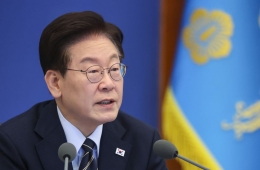
President Lee Jae-myung exchanges greetings with Democratic Party lawmaker Seo Young-kyo after delivering a policy speech on the government’s 2027 budget bill in the National Assembly plenary chamber on Nov. 2, 2026. Photo by Yoon Dong-ju
View original imagePresident Lee invoked the Fifth Republic's Democratic Justice Party as an example of hypocrisy that served unjust power and tainted a cause. Yet today's Democratic Party of Korea, which claims the mantle of the pro-democracy movement and has "Democratic" in its name, does not speak of democracy or a just cause at all. It calls itself the democratic camp, but has become an anti-democratic hegemonic force. Look at its record, including the recent "Special Counsel Act on Fabricated Indictments." What is striking is that almost no one in the Democratic Party has raised concerns about this situation. Even in the vote on the latest special counsel bill, only two or three members dissented and abstained, while all 167 ruling-party lawmakers voted in favor.
Today's Democratic Party of Korea remains a vast cartel of power and self-interest, with no connection to the words "together" or "democratic" in its name. Is this a transformation of political civilization? Those who have consistently demanded accountability for particularly anti-democratic and anti-nationalist episodes in history, insisting that collaborators be punished, are now themselves at the center of the controversy.
Hot Picks Today
 "Two Spend 500,000 Won in a Flash, Yet Wait Two Hours?" ... 'Dreamland' Shunned by Kids and Foreign Tourists
- The Era of Getting 200 Million Won After 30 Years Is Over... A Japanese Bank's "Perpetual Department Head" Who Just Clocked In Cries Out
- Spain Hit by Its Worst Tragedy... Lee Kangin, Moreno and Real Madrid Join Soccer World in Mourning
- They Said, “Make It Your Home for Life” - Then Suddenly Kicked 200 Passengers Off... What Happened to the Around-the-World Cruise?
- "130 Rice Bowls Sold Out in a Day"... 'Unfiltered Face' Adds 8 Million Won to Night Market Sales: China's Bungeunwoo
Kim Man-heum, former head of the National Assembly Research Service
© The Asia Business Daily. All rights reserved. Unauthorized AI training and use prohibited.