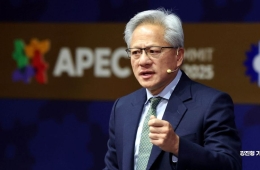
[Editorial] Prepare Before the Jensen Huang Controversy Escalates into an AI Technology Security Crisis.

Allegations that Jensen Huang, CEO of Nvidia, was targeted by Chinese intelligence agencies are shaking not only the global artificial intelligence (AI) industry but also the U.S.-China technology rivalry and the international security landscape. This is not something we can dismiss as someone else’s problem. The government and industry must go back to square one and reassess the technology security framework for the AI supply chain, from high-bandwidth memory (HBM) exports to computing services at domestic AI data centers. If they fail to do so, South Korea could find itself held back despite having secured a leading position in HBM.
As CEO Huang acknowledged an extramarital relationship, Nvidia launched an independent investigation, and both Republicans and Democrats in the U.S. Congress stepped up the pressure. This is why we must prepare for the possibility of tighter, bipartisan technology controls. If this coincides with calls for stricter data center regulations that have intensified in the wake of the midterm elections, Korean companies will have to contend with both slowing demand and restrictions on transactions. Their status as suppliers accounting for more than 80% of the global HBM market could make them targets rather than shield them.
Attempts to circumvent regulations have already reached our doorstep. A number of Chinese representatives have approached Korean companies seeking HBM supplies. Even if third-country distributors are used to make the transactions appear legitimate, problems arise if the ultimate destination is a party subject to controls. This could deal a serious blow not only to companies but also to the country's reputation.
The same applies to data centers. We understand that third-country capital, including from Singapore, has made repeated inquiries about investing in and using domestic data centers being developed as three mega-projects. Attracting foreign capital is welcome, but the situation is different if the beneficial owners are companies subject to export controls. Even if the servers are located in South Korea, a controlled company could use their computing power remotely, creating a channel to circumvent regulations.
Hot Picks Today
 "Two Spend 500,000 Won in a Flash, Yet Wait Two Hours?" ... 'Dreamland' Shunned by Kids and Foreign Tourists
- The Era of Getting 200 Million Won After 30 Years Is Over... A Japanese Bank's "Perpetual Department Head" Who Just Clocked In Cries Out
- Spain Hit by Its Worst Tragedy... Lee Kangin, Moreno and Real Madrid Join Soccer World in Mourning
- They Said, “Make It Your Home for Life” - Then Suddenly Kicked 200 Passengers Off... What Happened to the Around-the-World Cruise?
- "130 Rice Bowls Sold Out in a Day"... 'Unfiltered Face' Adds 8 Million Won to Night Market Sales: China's Bungeunwoo
Industry must strengthen due diligence on HBM end users, and the government must promptly establish standards for verifying the source of investment capital and customers’ remote access rights. The Blue House should coordinate a whole-of-government response, while the Ministry of Science and ICT, the Ministry of Trade, Industry and Energy, and the Ministry of Foreign Affairs should jointly assess the impact on exports and AI investment. It is also necessary to consult with the United States and clarify the scope of the regulations. The government’s technology diplomacy challenge in an era of technological rivalry is to close loopholes without stifling legitimate exports and investment.
© The Asia Business Daily. All rights reserved. Unauthorized AI training and use prohibited.