"Doctor Couple Faked Resignation to Pose as Low-Income Applicants"... 'Winning Is Like the Lottery': 354 Illegal Apartment Subscription Cases Uncovered
Land Ministry, OPC Conduct Joint Probe of 25,000 Households in Seoul and Popular Apartment Complexes
Authorities uncovered a large number of cases of fraudulent residence registration, including people who moved their registered addresses to qualify for housing subscriptions and those who falsely inflated the number of dependents in their households.
The Ministry of Land, Infrastructure and Transport and the Real Estate Supervision Task Force of the Office for Government Policy Coordination said on November 10 that, after investigating suspected cases of illegal apartment subscriptions from the second half of 2025 through March 2026, they had identified 354 suspicious cases among some 25,000 households. Those caught included people who falsely claimed to be unmarried and people who quit their jobs to apply for apartment subscriptions.
The investigation covered 43 complexes in total, including all complexes in regulated areas such as Seoul and areas outside those zones that had attracted strong demand. The government examined the residential arrangements of applicants' dependents by checking, among other things, parents' use of medical facilities, children's workplaces, and household members' rental records. It also increased the number of on-site inspectors and extended the inspection period for each complex. The Ministry of Land, Infrastructure and Transport said, "The number of cases uncovered rose significantly as we strengthened our investigative techniques and conducted more thorough inspections," adding, "We will refer all the cases to the police for investigation."

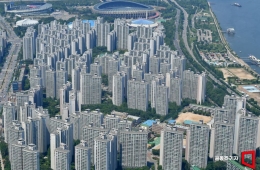
Apartments and houses in a residential complex in Songpa-gu, Seoul. Photo by Kang Jinhyung.
View original imageFraudulent residence registration accounted for the majority of cases, with 334. Applicants falsely registered their addresses to qualify as residents of the subscription area or as members of a household without a home, or to increase their points for dependents. In one case, a woman living in an apartment in Seoul falsely registered her address at her father-in-law's home in the same complex, then included him as a dependent and won a place in the general supply through the points-based system. In another case, a man with a wife and children falsely registered his address at his mother's home in Yeosu and his mother-in-law's home in Gwangju, Gyeonggi Province, as his own. His false registration was uncovered through his National Health Insurance long-term care benefit records.
Another person, who married a homeowner and had children, went four years without registering the marriage and applied for an apartment subscription to retain eligibility as a household without a home. The person won a place in the general supply through a lottery. Authorities uncovered 18 cases of people falsely claiming to be unmarried. In another case, a dual-income doctor couple sought to meet the low-income eligibility requirement for a subscription. One spouse falsely quit just before the announcement of the housing recruitment notice, then returned to work after it was issued, and the couple won a place in the special supply for newlyweds, which gives priority to applicants based on income.
Hot Picks Today
 "Two Spend 500,000 Won in a Flash, Yet Wait Two Hours?" ... 'Dreamland' Shunned by Kids and Foreign Tourists
- The Era of Getting 200 Million Won After 30 Years Is Over... A Japanese Bank's "Perpetual Department Head" Who Just Clocked In Cries Out
- Spain Hit by Its Worst Tragedy... Lee Kangin, Moreno and Real Madrid Join Soccer World in Mourning
- They Said, “Make It Your Home for Life” - Then Suddenly Kicked 200 Passengers Off... What Happened to the Around-the-World Cruise?
- "130 Rice Bowls Sold Out in a Day"... 'Unfiltered Face' Adds 8 Million Won to Night Market Sales: China's Bungeunwoo
Those found to have illegally obtained a subscription face penalties including criminal punishment of up to three years in prison or a fine of up to 30 million won, as well as cancellation of the contract, forfeiture of the deposit, and a 10-year restriction on eligibility to apply for housing subscriptions. Choi Byeonggil, head of the Housing Fund Division at the Ministry of Land, Infrastructure and Transport, said, "Although they were not uncovered in this inspection, we plan to continue prioritizing investigations into the falsification of subscription eligibility, including marital status, pregnancy, and disability."
© The Asia Business Daily. All rights reserved. Unauthorized AI training and use prohibited.