[BOK Focus] 'U.S. Blue Wave' Spurs AI Investment Concerns... Key to Changes in South Korea's Terminal Rate Path
AI concerns could materialize if financing conditions change
However, the prevailing view is that this is unlikely
Amid forecasts of another rate hike in November and a terminal rate of 3.50%
A scenario also sees the "rate-hike cycle
The fallout from the Democrats' sweeping victory in the U.S. midterm elections, dubbed the "blue wave," has spread to concerns over investment in artificial intelligence (AI). Both growth and inflation, key factors shaping the Bank of Korea's tight monetary policy stance, are directly and indirectly affected by semiconductor exports, making it a major concern whether worries about AI investment will actually affect the real economy. Markets still see a high likelihood that the Bank of Korea will raise its benchmark interest rate this month, but have begun weighing different scenarios for the rate outlook thereafter. Analysts say that if a sharp shift in the political landscape triggers an unexpected early decline in semiconductor prices, forecasts for next year's terminal rate, which have currently converged at 3.50%, could also change.

For Now, Concerns Remain Just Concerns; 25-Basis-Point Rate Hike This Month Seen as Likely
Attention is focused first on the message from Bank of Korea Governor Shin Hyun-song after this month's benchmark rate decision and the release of revised economic forecasts. At the time of last month's rate decision, a substantial upward revision to South Korea's economic growth forecasts for this year and next, as well as adjustments to next year's consumer price and core inflation forecasts, had led markets to expect an additional 0.25-percentage-point rate hike in November and a terminal rate of at least 3.50%. Subsequent data reinforced these expectations, including a surprise 1.0% quarter-on-quarter increase in real gross domestic product (GDP) in the third quarter of 2026 and a current account surplus of $61.46 billion in September, setting another all-time high. The outlook for South Korea's economic growth remains solid. According to the Korea Center for International Finance, the average growth forecast for South Korea this year from eight major foreign investment banks (IBs) at the end of last month was 3.7%. The current account surplus is expected to reach 19.4% of GDP, thanks to the semiconductor boom. Markets expect South Korea's current account surplus to rise to around $500 billion this year, even after taking into account year-end dividend payments to foreign stock investors, estimated at around $12 billion.
However, concerns over tighter regulation of AI data centers, triggered by the Democrats' victory in the U.S. midterm elections early this month, have caused financial instability, significantly shaking domestic and overseas stock markets. While negative scenarios for semiconductors have emerged in the wake of the blue wave, the prevailing view is that they are unlikely to materialize. Jung Yongtaek, an economist at IBK Investment & Securities, said, "If AI investment enters a period of adjustment or contracts, the cause would be changes in financing conditions, not a decline in AI demand," adding, "Worsening credit conditions are a factor that accelerates a slowdown in GDP." Moon Daun, a researcher at Korea Investment & Securities, said, "Next year, too, doubts and confidence, as well as anxiety and expectations, will coexist in an uneasy environment as AI innovation reaches a turning point that could reshape the long-term growth trajectory." She added, "Risks related to delayed AI profitability remain, but I expect financially strong companies to absorb the crisis facing marginal firms through a winner-take-all structure, containing the fallout." The pace of capital expenditure growth among AI-related companies is expected to slow, but total investment by major AI companies is forecast to exceed $800 billion, up from this year. Markets therefore expect the current monetary policy stance to remain unaffected for now. Governor Shin has also repeatedly stressed that, when assessing the real economy, it is more important to monitor actual memory prices than share price trends for memory-related companies.

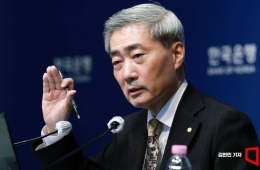
Bank of Korea Governor Shin Hyun-song speaks at a press conference following the Monetary Policy Board meeting to determine monetary policy direction at the Bank of Korea in Jung-gu, Seoul, on the 22nd of last month.
View original image"If Semiconductor Concerns Become Reality..." Rate-Hiking Cycle Could End After This Month
However, alternative scenarios are gradually emerging to account for the potential impact of semiconductor prices turning down earlier than expected. Kim Jinwook, chief economist at Citi, said, "Despite the recent decline in the KOSPI, we maintain our forecast that the Bank of Korea will raise its benchmark rate by 25 basis points (1 basis point = 0.01 percentage point) this month and by another 25 basis points in February next year, bringing the terminal rate to 3.5%. Semiconductor export growth year over year is expected to be 22% in 2025, followed by an estimated 203% in 2026 and 53% in 2027." However, he added, "If spot memory prices and semiconductor exports unexpectedly plunge between the fourth quarter of this year and the first quarter of next year, the Bank of Korea could raise its benchmark rate by 25 basis points to 3.25% at the Monetary Policy Board meeting in November, then pause or delay further rate hikes." The forecast assumes that semiconductor exports will unexpectedly contract by 2% next year and 14% in 2028, as the decline in semiconductor export prices outpaces growth in export volumes. Under this scenario, real GDP growth would slow rapidly to 2.6% next year and 1.5% in 2028, potentially leaving growth momentum stagnant in the second half of next year.
Hot Picks Today
 "Two Spend 500,000 Won in a Flash, Yet Wait Two Hours?" ... 'Dreamland' Shunned by Kids and Foreign Tourists
- The Era of Getting 200 Million Won After 30 Years Is Over... A Japanese Bank's "Perpetual Department Head" Who Just Clocked In Cries Out
- Spain Hit by Its Worst Tragedy... Lee Kangin, Moreno and Real Madrid Join Soccer World in Mourning
- They Said, “Make It Your Home for Life” - Then Suddenly Kicked 200 Passengers Off... What Happened to the Around-the-World Cruise?
- "130 Rice Bowls Sold Out in a Day"... 'Unfiltered Face' Adds 8 Million Won to Night Market Sales: China's Bungeunwoo
The increased downside risk to private consumption in the fourth quarter of this year is another variable. If recent stock market corrections offset valuation gains, weakening year-end consumption of durable goods such as automobiles and electronics, and also negatively affecting output in service industries such as finance, this could make further monetary tightening more difficult. The Bank of Korea, however, expects investment and consumption to expand from next year onward, supported by semiconductor-led growth. At a press conference following last month's rate decision, Governor Shin also judged that the consumption adjustment caused by the stock market decline at the time would be temporary. Markets also expect stock dividend payments starting in the fourth quarter of this year, performance bonuses from major semiconductor companies in the first quarter of next year, and an expansion of government transfer spending in the first half of next year to support private consumption.
© The Asia Business Daily. All rights reserved. Unauthorized AI training and use prohibited.