Jensen Huang Scandal Wipes $400 Billion Off Market Cap... Talk of CEO Exit Emerges
Board Launches Independent Probe Amid Chinese Espionage Allegations
U.S. Congress Also Presses for Answers
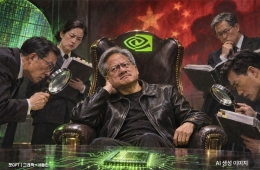
Jensen Huang, chief executive officer (CEO) of Nvidia, is facing a management crisis as a scandal over an alleged affair has widened to include suspicions of Chinese espionage. Nvidia, the world's largest artificial intelligence (AI) chipmaker, is now under pressure. The company's board has launched an independent investigation, and even the possibility of Huang stepping down is being discussed. With the U.S. Congress also seeking to establish the facts, some analysts say Huang's influence could weaken, given his close ties with the Trump Administration.
According to Bloomberg and CNBC, among other foreign media outlets, Nvidia shares plunged by as much as 8.8% intraday on the New York Stock Exchange on November 9 (local time). At one point, about $400 billion (approximately 580 trillion won) was wiped off the company's market capitalization. The shares had already plunged last week amid concerns that AI regulations would be tightened after the Democrats' midterm election victory, and the scandal involving Huang added to the negative pressure.

The controversy intensified after Huang admitted to having an affair in an email sent to employees on November 8. "I was unfaithful to my wife. My actions hurt my wife and children," he wrote. "There is no excuse for what I did. I am deeply sorry."
The woman, Alice Huang, is a former executive at Megaspeed, a Singapore-based Nvidia customer. Megaspeed is also suspected of violating U.S. export controls by bringing Nvidia's advanced AI chips into China. U.S. intelligence agencies suspect that Alice Huang was recruited by China's Ministry of State Security (MSS) to gather information on the CEO.
In response, Nvidia's board has formed an investigative committee made up of independent directors and will work with outside legal experts to investigate whether Huang was targeted for intelligence gathering by a foreign intelligence agency. The board said, however, that it has so far found no basis to believe that U.S. national security or Nvidia's confidential information has been compromised.
The incident has also cast uncertainty over Huang's position. Bloomberg reported that the possibility of Huang stepping down would once have been difficult to imagine, but has now emerged as a risk factor investors need to consider.
The concern is that Nvidia is overly dependent on Huang's leadership. The company has a distinctive management structure in which as many as 60 executives report directly to him. Huang has led Nvidia for 33 years since co-founding the company in 1993, and no formal succession plan has been made public.
Bernstein analyst Stacy Rasgon said, "Nvidia is not an ordinary company, and Jensen Huang is not an ordinary CEO. He is Nvidia," adding, "This incident highlights the substantial key-person risk Nvidia faces."
Congressional Pressure to Investigate Mounts... Nvidia's Position Also Under Threat

Pressure from U.S. politicians for an investigation also appears to be mounting. With the Democrats' midterm election victory giving them control of both chambers of Congress, scrutiny is expected to intensify over Huang's ties to Chinese companies and Nvidia's policy on semiconductor exports to China.
House Democratic leader Hakeem Jeffries, widely seen as the likely next Speaker of the House, told CBS on November 9 that the incident was "a matter of considerable concern." Democratic Senator Chris Coons, who is being considered for the role of the next chair of the Senate Foreign Relations Committee, also stressed that "Congress will investigate and find answers."
Republicans have also called for an investigation. House Republican leaders have asked Huang to attend a closed-door briefing this month and explain the allegations of Chinese intelligence gathering.
In particular, future congressional investigations are expected to focus on when the Trump Administration became aware of the alleged links between Huang and Chinese intelligence agencies, and how Nvidia influenced U.S. policy on semiconductor exports to China.
Huang has previously argued that U.S. advanced AI chips should be supplied to Chinese companies and called for export controls to be eased. His argument was that allowing Chinese companies to use U.S. technology would help curb the development of China's own AI technology.
Analysts say the incident could also weaken Nvidia's position as it pushes to ease restrictions on semiconductor exports to China. Bloomberg Economics forecast that provisions on tracking the location of AI chips, remote access, and export controls could become points of contention during negotiations over the fiscal 2027 National Defense Authorization Act (NDAA).
President Trump has defended Huang despite the allegations. The previous day, he told reporters that Huang was "a great person" who had "done incredible things for our country."
Hot Picks Today
 "Two Spend 500,000 Won in a Flash, Yet Wait Two Hours?" ... 'Dreamland' Shunned by Kids and Foreign Tourists
- The Era of Getting 200 Million Won After 30 Years Is Over... A Japanese Bank's "Perpetual Department Head" Who Just Clocked In Cries Out
- Spain Hit by Its Worst Tragedy... Lee Kangin, Moreno and Real Madrid Join Soccer World in Mourning
- They Said, “Make It Your Home for Life” - Then Suddenly Kicked 200 Passengers Off... What Happened to the Around-the-World Cruise?
- "130 Rice Bowls Sold Out in a Day"... 'Unfiltered Face' Adds 8 Million Won to Night Market Sales: China's Bungeunwoo
Nvidia has also said it continues to have confidence in Huang. The board said it trusts Huang and the management team even as it launched the investigation, while the company emphasized that Huang would continue serving as CEO without interruption.
© The Asia Business Daily. All rights reserved. Unauthorized AI training and use prohibited.