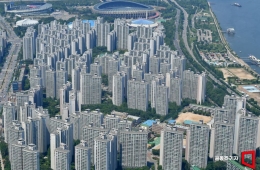
Apartment Move-In Outlook Rebounds for First Time in Four Months; Capital Region Falls, Gap with Provinces Narrows
Higher loan interest burden... Seoul and the capital region "cool sharply"
Expectations rise for relocation of central government agencies to Sejong
The nationwide apartment move-in outlook index turned upward in November for the first time in four months. However, the indexes for the Seoul metropolitan area, including Seoul, all fell amid the burden of interest rates and an increase in homes for sale, sharply narrowing the gap between the capital region and provincial areas.

According to a survey of housing providers conducted on November 10 by the Korea Housing Institute, the nationwide apartment move-in outlook index stood at 85.3 this month, up 2.7 points. By region, the index fell 8.6 points in the capital region, while it rose 5 points in metropolitan cities and provincial areas.
The index measures whether people who have purchased apartments expect to be able to pay the remaining balance and move in as planned. A reading above 100 means more respondents have a positive outlook on the move-in market, while a reading below 100 indicates the opposite.
The nationwide index turned upward for the first time in four months but remained near the average of 85.8 over the past year. The gap between the capital region and provincial areas, which widened last month, narrowed sharply from 18.5 points to 5.3 points this month.
In the capital region, the index fell across the board: by 14.1 points in Seoul, 8.7 points in Gyeonggi Province, and 3 points in Incheon.
The Korea Housing Institute said, "In Seoul, the number of apartments for sale has increased by about 30% since early August, when the tax reform plan was announced, amid concerns over the burden of holding taxes. Meanwhile, the pace of apartment price increases, which had continued for 86 consecutive weeks, has also slowed. Although the Bank of Korea decided on October 22 to hold its base rate steady, it left open the possibility of further hikes after consecutive increases in July and August. Concerns about loan interest payments have consequently grown, prompting an adjustment to the move-in outlook, which rose sharply last month."
Among metropolitan cities, the index rose by 16.6 points in Busan, 15.3 points in Sejong, 7 points in Daejeon, and 5.1 points in Gwangju. By contrast, it fell by 9.1 points in Ulsan and 4.6 points in Daegu.
The Korea Housing Institute said, "The increases in Busan and Gwangju appear to reflect a base effect following steep declines last month. In particular, Gwangju is expected to face less short-term pressure from housing supply, as no additional apartments are scheduled for move-in in November following move-ins at a large-scale complex in October."
It added, "The increases in Daejeon and Sejong appear to reflect expectations of new demand following the government's November 13 announcement last month of a plan to relocate 44 central government agencies from the capital region to Sejong. Ulsan, on the other hand, saw a decline as the expected move-in supply of about 2,000 homes in November—the largest monthly total this year, accounting for about 48% of the annual supply—added to short-term supply pressures."
Among provincial areas, the index rose in North Gyeongsang Province by 21.5 points, North Chungcheong Province by 13.8 points, and Jeju by 13 points. It fell in South Jeolla Province by 6.1 points, North Jeolla Province by 4.1 points, and South Gyeongsang Province by 3.1 points.
The Korea Housing Institute said, "Provincial areas also generally saw increases due to a base effect following steep declines last month. North Jeolla Province, however, recorded a decline as supply pressures weighed on the index: about 2,400 homes are scheduled for move-in there in November, the highest monthly total so far this year." It added, "Although South Jeolla Province's index fell, the combined index for South Jeolla and Gwangju remained nearly unchanged, slipping from 80.5 to 80. This suggests that the market is still absorbing supply following large-scale move-ins in Jangseong last month."
About 11,000 apartments are expected to be ready for move-in nationwide this month, down about 30% from the previous month and about 49% from the same period last year. In Seoul, the total is just 488 homes.
Hot Picks Today
 "Two Spend 500,000 Won in a Flash, Yet Wait Two Hours?" ... 'Dreamland' Shunned by Kids and Foreign Tourists
- The Era of Getting 200 Million Won After 30 Years Is Over... A Japanese Bank's "Perpetual Department Head" Who Just Clocked In Cries Out
- Spain Hit by Its Worst Tragedy... Lee Kangin, Moreno and Real Madrid Join Soccer World in Mourning
- They Said, “Make It Your Home for Life” - Then Suddenly Kicked 200 Passengers Off... What Happened to the Around-the-World Cruise?
- "130 Rice Bowls Sold Out in a Day"... 'Unfiltered Face' Adds 8 Million Won to Night Market Sales: China's Bungeunwoo
The Korea Housing Institute said, "High mortgage rates are limiting individual homebuyers' borrowing capacity. However, some positive effects are also expected as a decline in future move-in supply eases the burden of finding tenants and gives banks more room to provide loans for remaining balances."
© The Asia Business Daily. All rights reserved. Unauthorized AI training and use prohibited.