NVIDIA: "Autonomous Driving Nears Commercialization... General-Purpose Humanoids Are Not There Yet"
Deepu Talla at Media Roundtable
"Autonomous Vehicles and Logistics Robots Are in the Early Adoption Stage"
"Accuracy in General-Purpose Models Is the Biggest Bottleneck"
NVIDIA said some physical AI technologies, including autonomous vehicles and logistics robots, have entered the early stages of commercialization. By contrast, it said general-purpose humanoid robots capable of performing a wide range of tasks, including household chores, still face significant technological limitations.
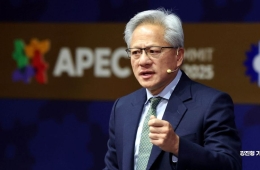
Deepu Talla, NVIDIA's Vice President of Robotics and Edge AI, said at the Physical AI Media Roundtable held at COEX in Gangnam-gu, Seoul, on Nov. 9, "Physical AI and robots must overcome five challenges before they can be used at a scale of millions or tens of millions. The biggest challenge right now is achieving sufficient accuracy in general-purpose models that can perform multiple tasks."

Deepu Talla, Nvidia’s vice president of robotics and edge AI, answers questions from reporters at the Physical AI Media Roundtable held at COEX in Gangnam-gu, Seoul, on the 9th. Photo by Jang Bokyeong
View original imageThe five requirements Talla outlined are intelligence and accuracy, reliability, safety, cost-effectiveness, and human-friendliness. Robots must be able not only to understand and perform a variety of tasks, but also to deliver consistent results even when repeating the same task. "If a robot succeeds on its first attempt, it should be able to succeed in exactly the same way when it tries the same task again 10 minutes later," he emphasized.
He identified achieving versatility as the biggest technological bottleneck. Existing industrial AI models are designed to perform specific tasks in set environments, and often fail to operate properly when task conditions change. These limitations are even more pronounced in unstructured environments, such as manufacturing facilities and stores, where people and objects are constantly moving.
Talla compared the technological progress of physical AI to a 100-meter race. He explained that while an Olympic gold medal requires a time in the nine-second range, runners must first finish within 10 seconds to qualify for the heats. "Over the past year, some physical AI applications can be said to have reached the 10-second range," he said. "That means they are approaching a level at which early commercialization is possible, not that they are fully developed enough to win a gold medal."
He cited autonomous driving as a leading example. "I recently drove autonomous vehicles, including Tesla models, and the technology has advanced to the point where I could drive comfortably for around three to five hours," Talla said. "Still, it needs much more training, since the vehicles must work in different cities and be supported by relevant regulations."
Autonomous mobile robots (AMRs), which transport goods from one point to another in warehouses and factories, were also identified as a field ready for early commercialization. Talla said he had encountered AMRs in warehouses and factories about 10 times as often recently as in the previous year. He also said that "pick and place" tasks, in which one or two robotic arms pick up objects and set them down elsewhere on manufacturing floors, as well as video analysis technology, are nearing the threshold for commercialization.
General-purpose humanoid robots, however, are a different matter. "The robot's brain has not yet advanced enough to move its fingers with precision," Talla said. "There is still a great deal of research to be done."
To overcome these technological limitations, NVIDIA is advancing simulation technology, which trains robots in virtual environments, as well as synthetic data technology. Repeatedly testing robots in real factories or warehouses is costly and can pose risks of accidents or equipment damage. In contrast, digital-twin virtual environments can recreate a variety of scenarios simultaneously and allow robots' responses to be tested repeatedly.
"Using simulation is much faster and safer than testing robots in real-world environments," Talla said. "It also makes it possible to conduct multiple tests in parallel and generate data." NVIDIA supports these training environments through Cosmos, an AI model platform that helps AI understand the physical world, and Isaac, a robotics development framework.
Providing AI models as open models is also part of NVIDIA's strategy to accelerate technological progress. NVIDIA makes model weights, training data, and training methods available so companies can add their own data and develop models tailored to their needs. Talla said, "This allows companies to save computing costs and time compared with developing models from scratch."
Hot Picks Today
 "Two Spend 500,000 Won in a Flash, Yet Wait Two Hours?" ... 'Dreamland' Shunned by Kids and Foreign Tourists
- The Era of Getting 200 Million Won After 30 Years Is Over... A Japanese Bank's "Perpetual Department Head" Who Just Clocked In Cries Out
- Spain Hit by Its Worst Tragedy... Lee Kangin, Moreno and Real Madrid Join Soccer World in Mourning
- They Said, “Make It Your Home for Life” - Then Suddenly Kicked 200 Passengers Off... What Happened to the Around-the-World Cruise?
- "130 Rice Bowls Sold Out in a Day"... 'Unfiltered Face' Adds 8 Million Won to Night Market Sales: China's Bungeunwoo
"Physical AI is a problem that is difficult for any one company to solve alone," he said. "Many issues, including accuracy and reliability, remain unresolved. By providing open models, we are working to find solutions together more quickly."
© The Asia Business Daily. All rights reserved. Unauthorized AI training and use prohibited.