Homegrown Quantum Computing Advances... Qubit Information Retention Time Doubles Target
Superconducting qubit coherence time exceeds 100 microseconds
Advances in quantum repeaters and heart magnetic-field sensors also unveiled
South Korean researchers have succeeded in extending the information retention time of superconducting qubits, a key component of quantum computers, to roughly twice the original target. They also achieved an accuracy rate of around 99% for entangling operations between two qubits. With technological advances also emerging in quantum communications and medical quantum sensors, the government’s research and development program in quantum science and technology is gaining momentum.

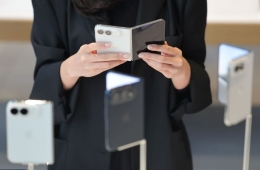
File photo for illustrative purposes. On July 2, visitors to Quantum Korea 2026 at DDP in Dongdaemun-gu, Seoul, look at a model of a superconducting 50-qubit quantum computer developed by the Korea Research Institute of Standards and Science. Photo by Yoon Dongju.
View original imageThe Ministry of Science and ICT held the annual meeting of the Quantum Science and Technology Flagship Project at Hotel Onoma in Daejeon on November 10. The event shared major achievements from the year since research began in October 2025.
The most notable achievements came in quantum computing. Researchers secured a coherence time of more than 100 microseconds (μs, one-millionth of a second) for superconducting qubits—roughly twice the 2027 target of 50 microseconds. Coherence time is the period for which a qubit can retain quantum information; the longer it is, the more favorable it is for stable quantum computation. Researchers also confirmed an accuracy rate of around 99% for entangling operations between two qubits.
In quantum communications, the event will highlight patent applications related to solid-state and all-photon quantum repeater technologies needed to build long-distance quantum networks, as well as quantum light conversion devices. In quantum sensing, researchers developed a compact sensor that measures changes in the magnetic field of the heart by using microscopic defects inside diamonds. The sensor, which operates at room temperature, could eventually be used in equipment for diagnosing heart disease.
The Quantum Science and Technology Flagship Project is a government research and development program that will invest approximately 360.4 billion won from 2025 through 2029. It supports a total of 26 projects—seven in quantum computing, six in quantum communications, and 13 in quantum sensing—and aims to develop, by 2029, a superconducting quantum processor with around 100 qubits that incorporates error-correction technology.
Hot Picks Today
 "Two Spend 500,000 Won in a Flash, Yet Wait Two Hours?" ... 'Dreamland' Shunned by Kids and Foreign Tourists
- The Era of Getting 200 Million Won After 30 Years Is Over... A Japanese Bank's "Perpetual Department Head" Who Just Clocked In Cries Out
- Spain Hit by Its Worst Tragedy... Lee Kangin, Moreno and Real Madrid Join Soccer World in Mourning
- They Said, “Make It Your Home for Life” - Then Suddenly Kicked 200 Passengers Off... What Happened to the Around-the-World Cruise?
- "130 Rice Bowls Sold Out in a Day"... 'Unfiltered Face' Adds 8 Million Won to Night Market Sales: China's Bungeunwoo
Yoon Kyung-sook, Director General for Basic and Original Research Policy at the Ministry of Science and ICT, said, “The Quantum Science and Technology Flagship Project is a key research and development program for securing our country’s competitiveness in quantum technology. We will actively support efforts to foster collaboration among researchers and accelerate the creation of innovative research results.”
© The Asia Business Daily. All rights reserved. Unauthorized AI training and use prohibited.