Youth Employment Insurance Subscribers Fall for 50th Straight Month; Overall Subscribers Up 286,000
Labor Market Trends Based on October Employment Administration Statistics
The total number of employment insurance subscribers continued to grow at a modest pace last month, but the number of subscribers aged 29 and under fell for the 50th consecutive month, marking the longest decline on record.
According to the results of the Ministry of Employment and Labor’s “Labor Market Trends Based on October Employment Administration Statistics,” released on November 9, the total number of regular employment insurance subscribers last month stood at 15,974,000, up 286,000 (1.8%) from the same period a year earlier. This marked the 10th consecutive month, starting in January this year, that the year-on-year increase exceeded 250,000.

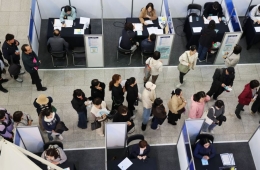
The KB Goodjob Job Fair was held at COEX in Gangnam-gu, Seoul, on April 27. Many job seekers at the fair check the job postings board. April 27, 2026. Photo by Yoon Dongju.
View original imageBy contrast, the number of subscribers aged 29 and under stood at just 2,203,000, down 54,000 from October last year. The number of subscribers in this age group declined for the 50th consecutive month, the longest such downturn on record. Meanwhile, subscriber numbers rose in every other age group: by 91,000 among people in their 30s, 5,000 among those in their 40s, 41,000 among those in their 50s, and 204,000 among those aged 60 and older.
Last month, the number of regular employment insurance subscribers aged 34 and under stood at 4,184,000, down 15,000 (0.4%) from a year earlier, marking the 32nd consecutive month of decline. The ministry said that the number of subscribers aged 30 to 34, excluding those aged 29 and under, was estimated at about 1.98 million.
By gender, the number of male subscribers rose by 99,000 year on year to 8,705,000, while the number of female subscribers increased by 187,000 to 7,269,000, recording a much higher growth rate. Cho Won-sik, head of the Ministry of Employment and Labor’s Future Employment Analysis Division, explained the sharp rise in female subscribers, saying, “The increase in demand for female workers, particularly in health and social welfare, as well as the growing participation of women in their 30s in the workforce, contributed to the rise.”
By industry, services, up 276,000, and manufacturing, up 14,000, drove the overall increase in subscribers. Within services, subscriber numbers rose in major sectors, including health and social welfare, up 120,000; accommodation and food services, up 49,000; and business services, up 23,000.
Within manufacturing, subscriber numbers increased in machinery and equipment, up 7,500; other transportation equipment, up 7,300; and electronics and telecommunications, up 6,400. By contrast, numbers fell in textile products, down 3,200; chemical products, down 2,700; and nonmetallic minerals, down 2,400. The number of construction industry subscribers fell by 5,000 from a year earlier, extending the decline to 39 consecutive months. However, the rate of decline gradually eased, with decreases of 7,000 in August, 6,000 in September, and 5,000 in October.
Last month, 81,000 people newly applied for job-seeking benefits (unemployment benefits), up 6,000 (7.5%) from a year earlier. The number of benefit recipients stood at 571,000, down 4,000 (0.7%) from October last year, while total benefit payments fell by KRW 46.8 billion (4.5%) to KRW 1.0025 trillion.
Hot Picks Today
 "Two Spend 500,000 Won in a Flash, Yet Wait Two Hours?" ... 'Dreamland' Shunned by Kids and Foreign Tourists
- The Era of Getting 200 Million Won After 30 Years Is Over... A Japanese Bank's "Perpetual Department Head" Who Just Clocked In Cries Out
- Spain Hit by Its Worst Tragedy... Lee Kangin, Moreno and Real Madrid Join Soccer World in Mourning
- They Said, “Make It Your Home for Life” - Then Suddenly Kicked 200 Passengers Off... What Happened to the Around-the-World Cruise?
- "130 Rice Bowls Sold Out in a Day"... 'Unfiltered Face' Adds 8 Million Won to Night Market Sales: China's Bungeunwoo
The number of new job openings posted through the integrated employment services platform “Employment24” reached 165,000, up 23,000 (16.2%) year on year, while the number of new job seekers rose by 25,000 (7.4%) to 360,000. The number of foreign workers automatically enrolled under the Employment Permit System (E-9 and H-2 visas) was 274,000, up 12,000 from October last year.
© The Asia Business Daily. All rights reserved. Unauthorized AI training and use prohibited.