[Editorial] Korea's Old-Age Dependency Burden Set to Top OECD; Urgent Need to Cut Mandatory Spending and Improve Fiscal Efficiency

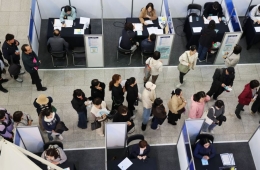
Job seekers line up for employment counseling at the 2026 Incheon Mid-Career and Women's Job Fair, held on the 3rd at the Central Hall of Incheon City Hall in Namdong-gu, Incheon. Yonhap News Agency
View original imageSouth Korea's old-age dependency ratio, which measures the number of older people per 100 people of working age, is projected to reach 68.4 in 2045, the highest among OECD member countries. By 2070, it is expected to rise to 103.3, or 3.3 times this year's figure of 31.3. The number of children entering elementary school next year is projected to fall below 300,000 for the first time since statistics were compiled. The main age group entering school, children born in 2020, numbers 272,337. Births also totaled just 254,341 last year.
The fiscal burden is growing heavier. The government projects that statutory spending on welfare will reach 257 trillion won in 2030, up 30.8% from this year. According to the National Assembly Budget Office's 2025 long-term outlook, mandatory spending will rise as a share of total fiscal expenditure, from 54.4% in 2025 to 64.3% in 2072.
Policies to restore the birthrate need to be strengthened. Rather than relying on cash support, it would be preferable to address the practical barriers to having and raising children by supporting parental leave and replacement workers at small and midsize companies, and providing childcare and after-school care that align with parents' work schedules.
We must also prepare for the possibility that the birthrate will not recover. The government has spent large sums over the years to raise the birthrate, but the results have fallen short of expectations. The low birthrate is driven not only by economic issues but also by cultural factors, including workplace practices and the social conditions surrounding family life, making it difficult to reverse.
For this reason, mandatory spending must be reduced and public finances restructured. Spending on expanded child-rearing support needs to be made more efficient, as does the rapidly growing expenditure on medical care, long-term care, and caregiving driven by population aging. Redundant programs run by government ministries and local governments, along with ineffective support measures, should be overhauled, and resources concentrated on essential services. It is also important to link medical care, long-term care, and community care to reduce unnecessary long-term hospital stays and duplicate spending.
Hot Picks Today
 "Two Spend 500,000 Won in a Flash, Yet Wait Two Hours?" ... 'Dreamland' Shunned by Kids and Foreign Tourists
- The Era of Getting 200 Million Won After 30 Years Is Over... A Japanese Bank's "Perpetual Department Head" Who Just Clocked In Cries Out
- Spain Hit by Its Worst Tragedy... Lee Kangin, Moreno and Real Madrid Join Soccer World in Mourning
- They Said, “Make It Your Home for Life” - Then Suddenly Kicked 200 Passengers Off... What Happened to the Around-the-World Cruise?
- "130 Rice Bowls Sold Out in a Day"... 'Unfiltered Face' Adds 8 Million Won to Night Market Sales: China's Bungeunwoo
Declining student numbers and changing regional needs should be factored into education funding and facilities planning. Underused public facilities should also be repurposed as care hubs. Efforts to restore the birthrate must go hand in hand with restructuring spending to reflect demographic changes, so that the cost of delayed action does not fall on future generations in the form of taxes and debt.
© The Asia Business Daily. All rights reserved. Unauthorized AI training and use prohibited.