Seoul Democratic Party lawmakers: "Urban Renewal Act stalled for 8 months... Must pass it at this plenary session"
Shortening redevelopment and reconstruction procedures and improving project feasibility
Ruling and opposition parties disagree over floor area ratio incentives for public urban renewal projects
Kim Youngbae: "Oh Sehoon, urge the People Power Party to pass the bill"
Seoul lawmakers from the Democratic Party of Korea on the 9th urged the People Power Party to swiftly pass an amendment to the Act on the Improvement of Urban Areas and Residential Environments, which includes measures to shorten the time required for redevelopment and reconstruction projects.
Democratic Party lawmakers from the Seoul City Party held a press conference at the National Assembly's Communication Center that morning, saying, "The amendment to the Urban Renewal Act passed the Land, Infrastructure and Transport Committee and the Legislation and Judiciary Committee last February, but has yet to clear the plenary session hurdle more than eight months later." They added, "We will ensure it is passed at the upcoming plenary session."

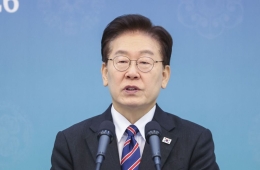
(Seoul=Yonhap News) Rep. Kim Young-bae, chair of the Seoul City chapter of the Democratic Party of Korea, holds a press conference at the National Assembly Communication Hall on Nov. 9, calling for the passage of amendments to the Urban Renewal Act. From left: Reps. Oh Gi-hyeong, Lee Yong-seon, Nam In-soon, Kim Young-bae and Kim Nam-geun. Nov. 9, 2026. xyz@yna.co.kr (End)
View original imageThe key provisions of the amendment would allow project implementation plans and management and disposition plans to be approved at a single general meeting, while also allowing their approval procedures to proceed simultaneously. It would also allow the formulation of master plans and improvement plans to proceed in parallel, shortening the duration of urban renewal projects by two to three years.
The amendment would also link the price of rental housing acquired by the public sector to the basic construction cost, rather than the existing standard construction cost, and provide support for verification and mediation in the event of construction cost disputes. It also includes a three-year temporary special measure allowing eligible public redevelopment and reconstruction projects a floor area ratio of up to 1.3 times the legal limit.
The bill's passage has been delayed partly because the ruling and opposition parties disagree over whether the floor area ratio incentive for public urban renewal projects should also apply to private-sector projects.
Democratic Party lawmaker Kim Nam-geun told reporters after the press conference, "The People Power Party is demanding that if public redevelopment projects are allowed a floor area ratio of 1.3 times the limit, private-sector projects should be granted the same." He added, "Just when it seems we are finding some common ground in negotiations, they make new demands, preventing an agreement."
He continued, "At many urban renewal project sites in Seoul, projects have been putting off integrated reviews or project implementation plans for seven or eight months while waiting for the law to be amended." He said, "The progress of urban renewal projects involving tens of thousands of housing units in Seoul is being delayed."
However, regarding whether the bill would be pushed through without agreement, Kim said, "Discussions are still underway, and we intend to proceed once an agreement is reached." He explained, "Pushing it through without agreement is not our principle."
Rep. Kim Young-bae, chair of the Democratic Party's Seoul City Party, called on Seoul Mayor Oh Se-hoon to cooperate in passing the bill. Kim said, "Mayor Oh has also said he will begin construction on 310,000 housing units by 2031." He added, "Even today, please attend the People Power Party's general meeting of lawmakers and urge them to pass the Urban Renewal Act within the next few days."
Rep. O Gi-hyeong, chair of the Seoul City Party's Special Committee on Housing Supply Policy, said, "The Urban Renewal Act is a system that supports not only public-sector urban renewal projects but also private-sector ones." He stressed, "There is no reason for the opposition party to oppose it or obstruct its passage."
Meanwhile, Seoul lawmakers are calling for the government to supplement its real estate tax reform plan alongside efforts to expand housing supply. At a high-level meeting between the government and ruling party the previous day, Han Jeong-ae, the Democratic Party's secretary-general, conveyed the view that the comprehensive real estate tax assessment criteria should not distinguish between single-home owners who live in their homes and those who do not.
Hot Picks Today
 "Two Spend 500,000 Won in a Flash, Yet Wait Two Hours?" ... 'Dreamland' Shunned by Kids and Foreign Tourists
- The Era of Getting 200 Million Won After 30 Years Is Over... A Japanese Bank's "Perpetual Department Head" Who Just Clocked In Cries Out
- Spain Hit by Its Worst Tragedy... Lee Kangin, Moreno and Real Madrid Join Soccer World in Mourning
- They Said, “Make It Your Home for Life” - Then Suddenly Kicked 200 Passengers Off... What Happened to the Around-the-World Cruise?
- "130 Rice Bowls Sold Out in a Day"... 'Unfiltered Face' Adds 8 Million Won to Night Market Sales: China's Bungeunwoo
In a separate question-and-answer session that day, Rep. Kim Young-bae said, "I understand that two views have been raised within the party: that single-home owners should be given stronger protection and that measures to address the monthly and long-term rental markets should also be 마련ed." He added, "The Seoul City Party will also coordinate its views this week and discuss how to reflect them in the review of the tax legislation."
© The Asia Business Daily. All rights reserved. Unauthorized AI training and use prohibited.