Low-Wage Worker Support Rate Cut from 80% to 60%... Fears Grow That Safety Net for Vulnerable Groups Is Retreating [A Closer Look at the Labor Budget ①]
Durunuri budget cut from 944 billion won to 717 billion won
20% support for industrial accident and health insurance... only labor service providers receive both benefits
National Assembly Budget Office: "Reconsider the scale of the support-rate cut
Lee Jinwoo (34, a pseudonym), who works at a metalworking company with fewer than five employees in Guro-gu, Seoul, is in his second year on the job and earns 2.3 million won a month. Starting next year, he will receive less support for his social insurance premiums. This is because the government has decided to cut the support rates for employment insurance and the National Pension under the Durunuri program from 80% to 60%. The program eases the burden of insurance premiums on low-income workers and small business owners. Although the government has newly introduced 20% support for industrial accident compensation insurance and health insurance, Lee, a regular employee, is also excluded from health insurance support.

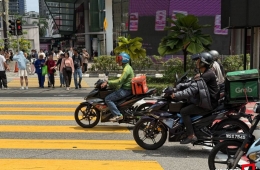
The COVID-19 pandemic accelerated demand for delivery, while the gig economy (online platform work) spread rapidly. Delivery services flourished in Southeast Asia, where motorcycles are widely used, and continue to play a key role in economic activity. We are no longer the only nation known for delivery. (Kuala Lumpur, Malaysia) Photo by Kang Jinhyung
View original imageEmployment and pension support slashed from 80% to 60%
According to the National Assembly Budget Office's report, "Analysis of the 2027 Budget Proposal by Committee," released on November 9, the Ministry of Employment and Labor has budgeted 717.324 billion won for the Durunuri program next year, down 226.941 billion won, or 24.0%, from this year's 944.265 billion won, including a supplementary budget. The program provides up to 36 months of support for part of the social insurance premiums paid by newly enrolled workers at businesses with fewer than 10 employees who earn less than 2.7 million won a month on average, artists and service providers earning less than 2.7 million won a month, and the employers who hire them.
Hot Picks Today
 "Two Spend 500,000 Won in a Flash, Yet Wait Two Hours?" ... 'Dreamland' Shunned by Kids and Foreign Tourists
- The Era of Getting 200 Million Won After 30 Years Is Over... A Japanese Bank's "Perpetual Department Head" Who Just Clocked In Cries Out
- Spain Hit by Its Worst Tragedy... Lee Kangin, Moreno and Real Madrid Join Soccer World in Mourning
- They Said, “Make It Your Home for Life” - Then Suddenly Kicked 200 Passengers Off... What Happened to the Around-the-World Cruise?
- "130 Rice Bowls Sold Out in a Day"... 'Unfiltered Face' Adds 8 Million Won to Night Market Sales: China's Bungeunwoo
The government will cut the support rate for employment insurance and National Pension premiums from 80% to 60%. It will also provide 20% support for industrial accident compensation insurance to low-wage workers and, uniquely, 20% support for both industrial accident compensation insurance and health insurance to service providers. With the adjusted support rates, annual social insurance support per person will fall by 14.1%, or 420,000 won, for regular low-income workers, from 2.97 million won to 2.55 million won. Support will drop by 23.7%, or 330,000 won, for daily workers, from 1.39 million won to 1.06 million won, and by 19.7%, or 310,000 won, for artists, from 1.57 million won to 1.26 million won. By contrast, support for service providers, including workers in special types of employment, will rise by 19.6%, or 270,000 won, from 1.38 million won to 1.65 million won. As a result, regular workers, daily workers and artists are now entirely excluded from health insurance support. For regular workers, the reduction in employment insurance and pension support far outweighs the newly added benefit for industrial accident compensation insurance, leaving them with a net decrease in total support.

Support falls despite new 20% subsidies for industrial accident and health insurance
The government says the decision reflects policy considerations, including the substantial financial burden of health insurance and the different structures for paying premiums across types of work. The Ministry of Employment and Labor says that, as of 2025, enrollment rates for employment insurance (84.8%) and the National Pension (89.4%) had reached relatively high levels. It also says 80% support is excessive when compared with similar programs run by other ministries, such as the Ministry of Health and Welfare's 50% support for regional health insurance subscribers and the Ministry of SMEs and Startups' 50-80% support for small business owners. Park Ilhoon, the Ministry of Employment and Labor's Director General for Employment Services Policy, said, "Given the limited budget, the program was designed to prioritize health insurance support for service providers, who face a much heavier burden from insurance premiums and have a more urgent need for assistance." He added, "There are practical constraints, as expanding health insurance support to all regular workers would require astronomical levels of public funding." The government said it had taken into account that regular employees pay relatively less because their employers cover half of their health insurance premiums, while service providers are classified as regional subscribers and must pay the entire premium themselves.

"Reconsider the impact of a sudden 20-percentage-point cut"
However, the pace and scale of the cuts to existing support are expected to spark debate. The Durunuri program is a major social safety net designed to encourage low-wage workers to enroll in social insurance, and reducing support could make it harder for workers at small businesses to maintain their coverage. In 2025, the program's execution rate reached 96.2% for regular employees and 110.2% for service providers. The program is considered to have demonstrated demand, as eligibility is limited to low-income, vulnerable groups with assets of less than 600 million won and annual income of less than 43 million won, and budget execution has been high. Citing these points, the National Assembly Budget Office said the size of the rate adjustment should be reconsidered. While lowering the existing support rates may be unavoidable given the expansion of social insurance support to include industrial accident compensation and health insurance, cutting them by 20 percentage points at once would have a significant impact on vulnerable groups, it said. It also proposed raising the support rates for the newly introduced industrial accident compensation and health insurance subsidies from the current 20% to 60%.
© The Asia Business Daily. All rights reserved. Unauthorized AI training and use prohibited.