[Editorial] Firefighting Funding Debate... Must Not Be a One-Off Fix

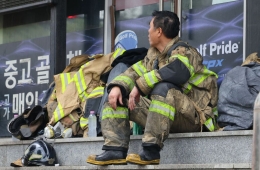
Firefighters exhausted from battling a fire at a Coupang logistics center in Seoknam-dong, Seohae-gu, Incheon, take a break on July 20. Yonhap News
View original imageThe ruling party and the government have decided to consider providing local governments with around 2 trillion won in funding for firefighting. Lim Gwang-hyun, chief of the Presidential Office’s policy coordination team, said they would provide additional support for next year’s budget for firefighting equipment and facilities and consult with the National Assembly on using the Future Response Fund and the local education tax allocated from tobacco consumption tax. The pan-governmental Fiscal Decentralization Task Force (TF) will also be reactivated to develop fundamental measures to secure stable funding and expand local government finances.
This is a welcome move, as it signals a serious effort to address the structural problems in firefighting finances. Firefighters became national government employees in 2020, but most firefighting duties and their financial burden remain with local governments. This structure can lead to disparities in working conditions, equipment and facilities depending on the financial circumstances of each local government.
Immediate support should first be made concrete. The ruling party and the government have agreed to include in the National Assembly’s budget review the funding needed to expand firefighting equipment, training facilities and a healthcare system tailored to firefighters. However, the specific amount of the proposed 2 trillion won in support and how it will be financed have not been finalized. The eligible recipients and spending plans must be clearly defined to ensure that funding is allocated first to areas with the greatest needs.
Funding options also require careful consideration. The planned Future Response Fund could meet urgent firefighting needs, but it is uncertain whether a fund based on volatile excess tax revenue can also serve as a source of sustained funding. The ruling party and the government also remain divided over a proposal to redirect the local education tax allocated from tobacco consumption tax, which is set to expire at the end of this year, to firefighting. While expanding firefighting funding, they must also take into account other local government spending needs and the sustainability of tax revenue.
Hot Picks Today
 "Two Spend 500,000 Won in a Flash, Yet Wait Two Hours?" ... 'Dreamland' Shunned by Kids and Foreign Tourists
- The Era of Getting 200 Million Won After 30 Years Is Over... A Japanese Bank's "Perpetual Department Head" Who Just Clocked In Cries Out
- Spain Hit by Its Worst Tragedy... Lee Kangin, Moreno and Real Madrid Join Soccer World in Mourning
- They Said, “Make It Your Home for Life” - Then Suddenly Kicked 200 Passengers Off... What Happened to the Around-the-World Cruise?
- "130 Rice Bowls Sold Out in a Day"... 'Unfiltered Face' Adds 8 Million Won to Night Market Sales: China's Bungeunwoo
The more important task is to redefine the fiscal responsibilities of the national and local governments. The first step should be to correct the current arrangement, in which responsibility for firefighting duties is separated from responsibility for funding them. The Fiscal Decentralization Task Force should distinguish between the responsibilities of the national and local governments and propose corresponding criteria for sharing costs, along with measures to secure stable revenue. Principles for national funding that account for regional firefighting needs and local fiscal conditions are also necessary. The system must be changed to prevent the same problems from recurring, rather than merely easing the immediate financial strain.
© The Asia Business Daily. All rights reserved. Unauthorized AI training and use prohibited.