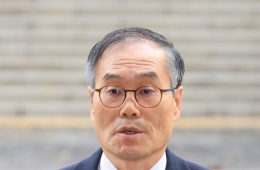
Chey Tae-won: “The KOSPI Will Eventually Turn Out ‘This Way’...” Warning Resurfaces Amid Stock Market Rout
Samsung and SK hynix Plunge in Wake of U.S. Midterm Elections
Chey Tae-won’s Remark, “This Roller-Coaster Ride Will Continue,” Draws Renewed Attention
The U.S. Democratic Party’s landslide victory in the midterm elections, dubbed a “blue wave,” has battered U.S. stocks and sent the KOSPI reeling. Against this backdrop, remarks by SK Group Chairman Chey Tae-won, who recently warned of volatility in the stock market, are drawing renewed attention. Investors are focused on his assessment that excess liquidity and an influx of funds into specific industries, such as artificial intelligence (AI) and semiconductors, could heighten market instability.

The KOSPI is displayed on a screen at the dealing room of Hana Bank's headquarters in Jung District, Seoul, on the 6th. The index fell more than 8% early in the session, triggering a circuit breaker. Yonhap News
View original imageAt a special lecture on “The AI Era: Changes in the Global Economic Paradigm and Korea’s Vision,” held on November 5 at Kim Jongseop Hall in Seoul National University’s College of Social Sciences in Gwanak-gu, Seoul, Chey warned an audience of about 450 students about extreme volatility in the stock market. The lecture was organized by Seoul National University’s Department of Economics as part of its “Freedom and the Market” series.
In response to a student’s question about how the U.S. midterm election results could affect SK hynix and other semiconductor affiliates, Chey said, “We keep seeing situations in which the market reacts violently even to a single midterm election.” He stressed, “You have to keep in mind that this roller-coaster ride will continue.”
After Democrats won gubernatorial races in U.S. states such as Texas and Georgia, where data centers are concentrated, concerns emerged that regulations on AI infrastructure could be tightened. On November 4, local time, Nvidia and the Philadelphia Semiconductor Index fell about 3.1% each in the U.S. stock market. South Korean stocks were also hit, with Samsung Electronics and SK hynix plunging 7.57% and 9.46%, respectively.
Commenting on the market’s reaction at the time, Chey said, “Judging by the sharp drop in stock prices today, the market seems to have assessed that the midterm election results were not very favorable for semiconductors.” He added, “I thought, ‘So this is how many people are expressing their anxiety.’”
Warning About Excess Liquidity and Funds Concentrated in Specific Industries
Chey pointed to the excess liquidity injected into markets in the wake of the 2008 Lehman Brothers crisis and the COVID-19 pandemic as the reason stock markets now swing sharply in response to even minor signals.
“Too much money has already been pumped into the market,” he said. “People heard that AI could make money, so too much money flowed into it. Here in Korea, people heard semiconductor stocks were rising, so they rushed in and bought them all at once.” He continued, “When a correction comes, it creates turmoil, and the more prices have risen, the further they can fall.” He stressed that the roller-coaster market could continue.

SK Group Chairman Chey Tae-won speaks on “Changes in the Global Economic Paradigm in the Age of Artificial Intelligence (AI) and Korea’s Vision” at a special lecture titled “Freedom and Markets,” hosted by Seoul National University’s Department of Economics at Kim Jongseop Hall on the first floor of the College of Social Sciences in Gwanak-gu, Seoul, on the 5th. Yonhap News
View original imageAI Investment Race Sends Corporate Costs Soaring... SK and Samsung Investments Alone Near 5 Quadrillion Won
Chey explained that not only have asset markets overheated, but the stakes in the AI investment race that companies must enter to survive have also grown to an unprecedented scale.
Referring to the “Three Mega Projects” announced by SK Group in June, Chey admitted, “At the time, I wondered, ‘Is it really okay to announce this?’ The investment figure we said we would announce then was 2.1 quadrillion won.” He continued, “Samsung talked about an even bigger figure, and when the two companies said they would invest nearly 5 quadrillion won, I wondered whether that was a realistic plan. In the past, even an investment of 200 trillion won was considered enormous, but now the figure is more than 10 times that. The nature of the game has completely changed, and the scale and concept of money have become very different.”
He also highlighted the reality that companies have little choice but to pour astronomical sums into investment amid the U.S.-China competition for AI dominance. Speaking about the fierce investment race among U.S. tech giants, Chey said, “I can’t be the first one to die, can I? I have to stay alive to keep participating in this game.” He added, “The whole world is in this game. We have no way to catch up unless we make bets like this, too.”
“The Breakdown of Global Production Networks and South Korea’s Double Burden”... Chey Tae-won’s Four Proposed Solutions
Chey said the South Korean economy faces structural crises both at home and abroad. His analysis is that, while low growth and rising debt have weakened the economy’s internal foundations, the separation of U.S. and Chinese supply chains and the restructuring of global production networks have also left the country facing a double burden: U.S. demands for investment and China’s technological advances.
Hot Picks Today
 "Two Spend 500,000 Won in a Flash, Yet Wait Two Hours?" ... 'Dreamland' Shunned by Kids and Foreign Tourists
- The Era of Getting 200 Million Won After 30 Years Is Over... A Japanese Bank's "Perpetual Department Head" Who Just Clocked In Cries Out
- Spain Hit by Its Worst Tragedy... Lee Kangin, Moreno and Real Madrid Join Soccer World in Mourning
- They Said, “Make It Your Home for Life” - Then Suddenly Kicked 200 Passengers Off... What Happened to the Around-the-World Cruise?
- "130 Rice Bowls Sold Out in a Day"... 'Unfiltered Face' Adds 8 Million Won to Night Market Sales: China's Bungeunwoo
In his special lecture at Seoul National University, he proposed four ways to break through the challenges facing the South Korean economy: “new capitalism,” under which companies receive economic rewards for solving social problems; becoming an “AI-native country” by strengthening the country’s competitiveness in energy, semiconductors and data centers; a “Korea-Japan economic partnership” linking the $2 trillion South Korean economy with Japan’s $4 trillion economy; and a “growth incentive system” to promote corporate growth.
© The Asia Business Daily. All rights reserved. Unauthorized AI training and use prohibited.