Lee Speeds Up Appointments of Justice, Tax and Police Chiefs; Only Prosecutor General Remains
Justice Minister nominee Lee Yongcheol and National Tax Service chief nominee Ahn Deoksu picked
Interior and Safety Minister recommends Kim Jongcheol for police chief
Prosecutor general recommendation committee postponed
Lee Jeonghyeon, Park Cheo
President Lee Jae Myung is moving swiftly to reshape the leadership of agencies responsible for law enforcement and oversight, after nominating candidates for minister of justice and commissioner of the National Tax Service and stepping up efforts to select a new commissioner general of the Korean National Police Agency. As the repercussions of abolishing the Prosecutors' Office and separating investigative and prosecutorial powers continue, the appointments are seen as a move to establish the new criminal justice system and press ahead with a sweeping overhaul of the organizations wielding state power.
However, with the schedule for the committee tasked with recommending candidates for prosecutor general—the final piece of the puzzle—postponed, and controversy emerging over the background of the justice minister nominee, confirmation hearings and subsequent appointments are expected to become new variables in the administration of state affairs.

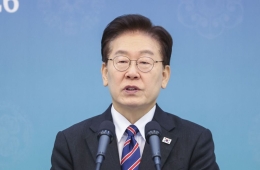
President Lee Jae Myung speaks at a meeting with senior secretaries and aides at Cheong Wa Dae on Nov. 5, 2026. Yonhap News Agency.
View original imageAccording to political and legal circles on the 9th, President Lee nominated Defense Acquisition Program Administration Commissioner Lee Yongcheol as candidate for minister of justice and Seoul Regional Tax Office Commissioner Ahn Deoksu as candidate for commissioner of the National Tax Service on the 6th. Minister of the Interior and Safety Yoon Hojung, with the consent of the National Police Commission, proposed Kim Jongcheol, deputy commissioner general of the Korean National Police Agency and acting commissioner general, as a candidate for commissioner general. The nomination of a justice minister comes as an opportunity to fill a vacancy that has lasted more than 70 days since former minister Jeong Seongho left office, while the police chief position has been vacant for nearly two years since the Dec. 3, 2024, emergency martial law crisis. All three nominees must undergo confirmation hearings in the National Assembly.
The focus of the appointments is on reforming the criminal justice system. Nominee Lee, a former member of Lawyers for a Democratic Society, served as senior presidential secretary for civil affairs and as presidential secretary for legal affairs under the Roh Moo-hyun administration, where he worked on prosecutorial reform. He also has ties to President Lee, having served on the transition committee when Lee was elected mayor of Seongnam. Observers say President Lee is seeking to minimize controversy by entrusting the final stages of the transition to the new criminal justice system to a close associate with legal expertise and reform experience.
Shortly after his nomination, Lee said, "I will complete prosecutorial reform without a hitch and work to swiftly establish the new criminal justice system." However, allegations surrounding Seongnam City and the Daejang-dong development project in the past are expected to become points of contention at his confirmation hearing. The presidential office said it had taken the allegations into account during the vetting process, while maintaining that the details would be addressed at the hearing. Debate is also expected over the independence and political neutrality of the administration of justice, amid controversy over the possible withdrawal of indictments in cases involving President Lee.
The appointments to the National Tax Service and the Korean National Police Agency place emphasis on organizational stability and stronger enforcement. Nominee Ahn, a career tax official who has served as director general of the National Tax Service's Investigation Bureau and Tax Collection and Legal Affairs Bureau, is considered well suited to strengthen the response to malicious tax evasion and asset concealment. Nominee Kim has held a range of key positions within the police. His immediate challenges include restoring public trust in the police, which was damaged by the emergency martial law crisis, strengthening investigative capabilities, and establishing a system to oversee the expanded powers of the police.

Employees arrive for work at the Seoul Central District Public Prosecution Office in Seocho-gu, Seoul, on Oct. 2, as the prosecution office, which held both investigative and prosecutorial powers, closed after 78 years under the Lee Jaemyung administration's prosecution reform. The Public Prosecution Office and Serious Crimes Investigation Agency officially launched the same day. 2026.10.2. Photo by Kang Jinhyeong
View original imageAttention now turns to the selection of a prosecutor general. The position, vacant for a year and four months since July last year, will be the inaugural leadership post at the Public Prosecution Office, which was launched last month. The committee tasked with recommending candidates, initially scheduled to meet next week, has been postponed in consideration of members' schedules and the nomination of a candidate for minister of justice. As plans are made to hold the meeting this month, acting Prosecutor General Lee Jeonghyeon, Seoul Central District Public Prosecution Office Chief Park Cheolwoo, and former Chuncheon District Prosecutors' Office Chief Ye Semin are among those being mentioned as potential candidates.
The selection of a prosecutor general is expected to be a watershed moment in determining the direction of the restructured Public Prosecution Office. The role carries the major responsibilities of ensuring cooperation and adjusting authority among agencies following the separation of investigative and prosecutorial powers, maintaining prosecutions in major cases, and addressing turmoil within the organization. In particular, the key question is whether the office can maintain the effectiveness of reform while keeping its distance from political controversy surrounding cases involving the president.
People inside and outside the presidential office say the appointments are significant because they represent not merely an end to long-standing vacancies, but a step toward completing the Lee administration's system for operating agencies responsible for law enforcement and oversight. A presidential office official said, "Once appointments are completed for the head of the Public Prosecution Office, following those for the Ministry of Justice, the police and the National Tax Service, the broad framework for reshaping state agencies will be in place," adding, "For now, the goal is to have the nominees undergo final vetting at their confirmation hearings."
Hot Picks Today
 "Two Spend 500,000 Won in a Flash, Yet Wait Two Hours?" ... 'Dreamland' Shunned by Kids and Foreign Tourists
- The Era of Getting 200 Million Won After 30 Years Is Over... A Japanese Bank's "Perpetual Department Head" Who Just Clocked In Cries Out
- Spain Hit by Its Worst Tragedy... Lee Kangin, Moreno and Real Madrid Join Soccer World in Mourning
- They Said, “Make It Your Home for Life” - Then Suddenly Kicked 200 Passengers Off... What Happened to the Around-the-World Cruise?
- "130 Rice Bowls Sold Out in a Day"... 'Unfiltered Face' Adds 8 Million Won to Night Market Sales: China's Bungeunwoo
Meanwhile, the presidential office is continuing appointments as part of a reshuffle of its second-term staff. According to the office, former senior secretary for state affairs Kim Jongwoo completed his final day on the job on the 7th, and Kim Taegeun, senior secretary for local development, took over and began work on the 8th. The office also appointed former Korea Housing and Urban Guarantee Corporation (HUG) President Choi Inho as senior presidential secretary for political affairs and former Samsung Electronics executive Lee Jisoo as senior secretary for national AI policy. Further appointments are expected soon for the currently vacant senior secretary for land and transport post, as well as the senior secretary for state records, senior secretary for gender equality and family affairs, senior secretary for local development, and senior secretary for digital communications. Jeong Jeongok, senior secretary for gender equality and family affairs, who faced allegations of farmland speculation, recently left the presidential office after her resignation was accepted, and Jo Hansang, senior secretary for public relations planning, offered to resign. Replacements are also continuing among administrative-level staff in the various senior secretary offices.
© The Asia Business Daily. All rights reserved. Unauthorized AI training and use prohibited.