"How Did It Get This Bad... I'm Afraid to Check My Account" KOSPI Plunges 11%: Can It Rebound? [Market ING]
This Week's Forecast KOSPI Range: 5,000-6,000
The KOSPI retreated to its lowest level in seven months amid the shock of a U.S. “Blue Wave.” This week, the index is expected to look for a rebound as investors assess U.S. inflation data and other indicators.

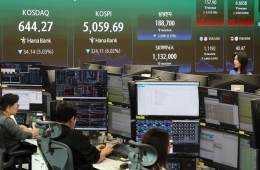
Last week, the KOSPI fell 11.71% and the KOSDAQ dropped 11.06%. The KOSPI plunged for two consecutive sessions after the U.S. midterm election results came in, and showed signs of unease when it fell below the 5,000-point mark intraday on Nov. 6 for the first time in nine months. “The KOSPI began to rebound after its sharp decline in October, but plunged again as the U.S. midterm elections heightened uncertainty over artificial intelligence (AI) investment,” said Lee Kyung-min, a researcher at Daishin Securities. “Downward pressure intensified as concerns persisted over the financing burden on big tech companies and the profitability of AI investment, while the Democratic Party’s sweeping victory in the midterms added concerns about tighter regulations on AI data centers.”
With the Democrats taking control of both chambers of Congress in the U.S. midterm elections—a Blue Wave—the Trump Administration will inevitably have less momentum to advance its policies. Key legislative initiatives, including additional tax cuts and expanded fiscal spending, are likely to face obstacles. “Expectations that fiscal expansion will be curbed are positive for stabilizing U.S. Treasury yields, but tariff policy and geopolitical uncertainty in the Middle East remain concerns,” the researcher said. “In particular, growing prospects that the Democrats may tighten regulations on AI data center construction have dampened investor sentiment across the AI value chain.”
Analysts expect sharp rises and falls to continue for the time being. “We will not be able to avoid a pattern of alternating sharp gains and losses for a while,” said Kim Min-gyu, a researcher at KB Securities. “During Trump’s first term in 2018, the market also corrected after the November midterms, as concerns over big tech regulation and a federal government shutdown coincided with a delayed rate hike by then-Federal Reserve (Fed) Chair Jerome Powell, despite slowing growth and easing inflation. This heightened market volatility through year-end. A meaningful rebound did not begin until the new year.”
Uncertainty over regulation is growing, but there are also hopes for stable inflation. “The Democrats’ control of both chambers could both increase and ease uncertainty. On the opposite side of regulation, easing inflationary pressure could help settle the issue,” Kim said. “James Talarico, the Democratic senator-elect from Texas, opposes halting data center construction but has stressed the need for tighter regulation. His calls to repeal tariffs and temporarily suspend the federal gas tax suggest that regulation itself is not the goal; rather, policy is focused on stabilizing prices.” He added, “Now that the Democrats, who had criticized a prolonged war without congressional approval, hold the majority, the lower likelihood that President Donald Trump will prolong the war is another positive factor that the market has yet to price in.”
“With calls for a swift end to the war in Iran gaining momentum among Democratic leaders, the war risk could ease compared with before,” said Na Jeong-hwan, a researcher at NH Investment & Securities. “If international oil prices fall and the recently surging U.S. Treasury yields stabilize at lower levels, concerns over AI companies’ financing and negative free cash flow (FCF) could also ease somewhat.” NH Investment & Securities forecast a KOSPI range of 5,000 to 6,000 points for this week.
Key events this week include the release of China’s October consumer price index (CPI) and producer price index (PPI) on Nov. 9, followed by the release of the U.S. October CPI and China’s October exports on Nov. 10. South Korea’s exports for Nov. 1-10 are due on Nov. 11, and the U.S. November PPI will be released on Nov. 13.
Companies will also continue to report earnings. In the United States, CoreWeave is scheduled to report earnings on Nov. 10, followed by Applied Materials on Nov. 12. In South Korea, LG, NAVER, Mirae Asset Securities and Samsung Life Insurance are among the companies scheduled to report third-quarter results on Nov. 12.
Hot Picks Today
 "Two Spend 500,000 Won in a Flash, Yet Wait Two Hours?" ... 'Dreamland' Shunned by Kids and Foreign Tourists
- The Era of Getting 200 Million Won After 30 Years Is Over... A Japanese Bank's "Perpetual Department Head" Who Just Clocked In Cries Out
- Spain Hit by Its Worst Tragedy... Lee Kangin, Moreno and Real Madrid Join Soccer World in Mourning
- They Said, “Make It Your Home for Life” - Then Suddenly Kicked 200 Passengers Off... What Happened to the Around-the-World Cruise?
- "130 Rice Bowls Sold Out in a Day"... 'Unfiltered Face' Adds 8 Million Won to Night Market Sales: China's Bungeunwoo
“CoreWeave’s third-quarter earnings report will be a key turning point in gauging whether investor sentiment toward AI investment is recovering,” Lee said. “If the company confirms that it is maintaining its AI investment plans and has sufficient financing capacity, that could help restore investor sentiment toward semiconductor investment. However, if its debt burden comes back into focus or its investment plans are scaled back, additional downward pressure could spread across the AI value chain.”
© The Asia Business Daily. All rights reserved. Unauthorized AI training and use prohibited.