Expert Who Correctly Predicted KOSPI's 'Fall Below 5,000' Three Months Ago: "Further Declines by Year-End Unlikely"
Warning of a KOSPI Fall Below 5,000
Cut Stock Allocation to Around 20% and Hold Cash
Forecasts at Least a Year of Range-Bound Trading if Leading Index Falls
AI Bubble and Margin Debt Risks... Warns of U.S. Market, Too
With the domestic stock market unable to escape a sharp sell-off and the KOSPI even falling below the 5,000 mark during trading on November 6, investors are revisiting the forecast made three months ago by Kim Youngik, an adjunct professor at Hanyang University's Institute for Future Talent Education, who warned that the index could fall below that level. Once mocked by some in the market for spreading bearish views, Professor Kim is now seeing investors pay renewed attention to his market analysis and advice to favor cash in their asset allocations as his warning comes true.

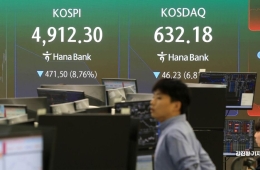
The KOSPI and other indices are displayed on a screen at Hana Bank’s headquarters dealing room in Jung-gu, Seoul, on the 6th. The KOSPI fell more than 8% early in the session, triggering a circuit breaker. Yonhap News
View original imageWarning signs raised three months ago: "Upward momentum has vanished"
On November 6, the KOSPI plunged more than 8% within three minutes of the opening, triggering a circuit breaker and sending the index below 5,000 for the first time in nine months. The previous day, it had also closed down 5.28% at 5,383.80.
Immediately after the market plunged, a post saying, "Kim Youngik is the winner in this stock market," spread rapidly across domestic investor communities. Circulating widely are a video of him saying, "This isn't the end. We need to prepare for further declines," when he appeared on an economic news program on October 20, and remarks he made on a YouTube channel last August, when he said the KOSPI had "completely lost its upward momentum" and raised the possibility of it falling below 5,000.
After predicting the 2008 global financial crisis and earning the nickname "Korea's Dr. Doom," Professor Kim has been warning of a possible correction in the domestic stock market in the second half of the year since July. At the time, on his YouTube channel, "Kim Youngik's Economics School," he pointed out that the KOSPI had surged 101% in the first half and forecast a downward correction in the second half, citing the decline in the news sentiment index since March. The index moves five months ahead of the composite leading indicator.
Last August, he appeared on the Chosun Ilbo YouTube channel and said that the KOSPI had "completely lost its upward momentum." Citing signs of a downturn, including slower growth in South Korean exports, he projected that the trend of lower highs and lower lows could continue through the first half of next year. He warned that the possibility of the KOSPI falling below 5,000 should not be ruled out. In October, he also put the KOSPI's bottom at 4,500 to 5,000.
"Correction through the first half of next year": Warning also issued on U.S. stocks
Recently, Professor Kim has focused not only on the domestic stock market but also on risk factors in the U.S. market. He believes a market correction could be prolonged if an investment bubble in U.S. big tech companies' artificial intelligence (AI) spending, stock margin debt at a historic high, and AI companies' fundraising problems converge.
He expects U.S. economic growth to slow to around 1.4% next year, and also pointed to past instances in which corporate earnings fell and stock prices corrected during periods of interest rate cuts prompted by an economic slowdown. He forecasts that the U.S. stock market could undergo a substantial correction from the fourth quarter of this year through the first half of next year.
"A 20-month decline when leading indicators fall": Emphasizing the importance of holding cash
Professor Kim's investment strategy prioritizes risk management and holding cash over aggressively buying at low prices. In a video posted to his YouTube channel on November 3, he said that, based on the trend in the composite leading indicator, the correction in the domestic stock market could continue for some time.
"Once the leading indicator falls, it declines for about 20 months," Professor Kim said, adding, "It may be difficult for stock prices to rise substantially even next year." He continued, "The market will likely remain in a range-bound correction for at least the next year. In this kind of environment, it is important to wait. Holding cash and waiting may also be a form of investing."
Accordingly, he proposed reducing the share of stocks in financial assets to around 20% when the composite leading indicator is falling, and holding the remainder in cash-like assets such as short-term bonds. Conversely, his asset allocation principle allows the share of stocks to be increased to as much as 60% when the composite leading indicator is rising.
He also stressed the importance of setting investment criteria in advance. When stock prices rise, investors can be swept up in optimism and buy at high prices; when they fall, fear can prompt them to sell at the bottom. Professor Kim said he checks economic indicators such as nominal gross domestic product (GDP), the money supply (M2), and average daily export value, and reviews his analytical models. He urged investors to establish their own criteria as well.
"What matters is having criteria," he said. "I hope investors will establish a set of criteria of their own." His comments were interpreted as meaning that investors should respond based on economic indicators and asset allocation principles rather than repeatedly buying and selling in reaction to short-term market swings.
Opportunity expected in the first half of next year: "A time to separate the wheat from the chaff"
However, immediately after the sharp market drop on November 6, Professor Kim also said that the likelihood of further declines in the short term was not high. In a post on his YouTube channel, he explained, "The schedule for new AI data center construction could be delayed because of the U.S. midterm elections, but we need to see how much the construction will be delayed and how much that will change the orders our companies receive."
He added, "Our stock market has often performed relatively well compared with the U.S. market when the dollar was weak," and said he did not believe the domestic market was likely to fall much further by year-end. However, he projected that market volatility could continue through the first half of next year.
Professor Kim expects differences in performance among companies, based on their results and competitiveness, to become more pronounced in next year's stock market. "Next year will be an era of uncertainty. Volatility will be high, and many companies will disappear, while those that survive will do even better," he said. "I think that kind of opportunity may come around the first half of next year. Next year will truly be a time to separate the wheat from the chaff."
Hot Picks Today
 "Two Spend 500,000 Won in a Flash, Yet Wait Two Hours?" ... 'Dreamland' Shunned by Kids and Foreign Tourists
- The Era of Getting 200 Million Won After 30 Years Is Over... A Japanese Bank's "Perpetual Department Head" Who Just Clocked In Cries Out
- Spain Hit by Its Worst Tragedy... Lee Kangin, Moreno and Real Madrid Join Soccer World in Mourning
- They Said, “Make It Your Home for Life” - Then Suddenly Kicked 200 Passengers Off... What Happened to the Around-the-World Cruise?
- "130 Rice Bowls Sold Out in a Day"... 'Unfiltered Face' Adds 8 Million Won to Night Market Sales: China's Bungeunwoo
However, Professor Kim's forecasts have not always been accurate. Last December, he predicted that the KOSPI would remain around 3,500 and that Samsung Electronics' share price would struggle to exceed 90,000 won, but the KOSPI surpassed 9,000 in June this year. At the time, investors joked, "Invest against Kim Youngik."
© The Asia Business Daily. All rights reserved. Unauthorized AI training and use prohibited.