KOSPI Falls Below 5,000 Intraday... Government Waives Securities Firms' Collateral Ratio Requirement for 3 Months
The government will waive securities firms' obligation to maintain collateral ratios on credit-backed loans for three months to prevent forced sales by individual investors amid a sharp drop in stock prices. The move comes as the government takes urgent steps to stabilize the market after global stock market volatility increased following the U.S. midterm elections and the KOSPI fell to the 5,000-point level.
On November 6, Lee Hyungil, Deputy Prime Minister and Minister of Finance and Economy, held a joint market situation review meeting (F4 meeting) at the Government Complex Seoul with relevant agencies, including the Financial Services Commission, the Financial Supervisory Service and the Bank of Korea, to discuss domestic and international financial market trends and response measures. The meeting was convened in response to a sharp decline in the domestic stock market amid turmoil in global financial markets following the U.S. midterm elections. The government and financial authorities also held an emergency market situation review meeting on November 5 to assess domestic and international stock markets, mounting responses for two consecutive days.

Lee Hyungil, Deputy Prime Minister and Minister of Finance and Economy, is presiding over an “Emergency Market Situation Review Meeting” at the Government Complex Seoul in Jongno-gu, Seoul, on the 6th. Ministry of Finance and Economy
View original imageParticipants said global stock market volatility was rising, with U.S. stocks also posting steep losses overnight, led by technology shares, following the previous day's declines in the domestic market. They assessed that recent stock price declines had been driven by a combination of factors: policy uncertainty surrounding the AI industry, including concerns about regulation of AI data centers, and weakening global investor sentiment.
However, they agreed that the domestic stock market was overreacting to external negative factors. They stressed that the fundamentals of the domestic economy remain solid, with economic growth projected in the mid-3% range this year, exports expected to reach $1 trillion, and corporate operating profits forecast to exceed 900 trillion won. They said excessive pessimism driven by undue anxiety should therefore be guarded against.
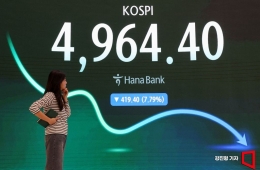
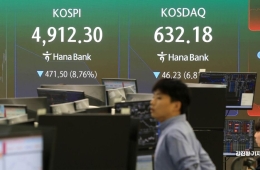
The KOSPI fell from 5,731 on October 30 to 5,384 on November 5, then plunged more than 8% within the first three minutes of trading on November 6, dropping below the 5,000-point level. As of 11 a.m. on November 6, it was continuing to trade around the 5,000-point level. In the U.S. market on November 5, the Dow Jones Industrial Average fell 3.44%, the S&P 500 fell 4.36%, and the Nasdaq fell 5.52%. The Philadelphia Semiconductor Index plunged 12.25%.
The government will first waive securities firms' obligation to maintain collateral ratios on credit-backed loans for three months starting November 9 to prevent excessive forced sales amid the sharp drop in stock prices. Securities firms are currently required to maintain a collateral ratio of at least 140% for credit-backed transactions. The temporary waiver is intended to prevent forced stock sales caused by investors' collateral shortfalls from adding to market volatility.
Hot Picks Today
 "Two Spend 500,000 Won in a Flash, Yet Wait Two Hours?" ... 'Dreamland' Shunned by Kids and Foreign Tourists
- The Era of Getting 200 Million Won After 30 Years Is Over... A Japanese Bank's "Perpetual Department Head" Who Just Clocked In Cries Out
- Spain Hit by Its Worst Tragedy... Lee Kangin, Moreno and Real Madrid Join Soccer World in Mourning
- They Said, “Make It Your Home for Life” - Then Suddenly Kicked 200 Passengers Off... What Happened to the Around-the-World Cruise?
- "130 Rice Bowls Sold Out in a Day"... 'Unfiltered Face' Adds 8 Million Won to Night Market Sales: China's Bungeunwoo
The government will also step up monitoring of the global semiconductor industry and policy developments in major countries. It will monitor domestic and international stock markets and capital flows in real time, and plans to take additional measures to stabilize the market if volatility rises further. It will also continue policy efforts to fundamentally improve the domestic capital market, including by enhancing corporate value and restoring confidence in the capital market.
© The Asia Business Daily. All rights reserved. Unauthorized AI training and use prohibited.