[Exclusive] "Neglected Preferred Shares"... Price Gap With Common Shares at Record High [Preferred Share Discount] 1
Discounts average 42%... 27 preferred shares trade at less than half the price
No voting rights, yet little dividend advantage over common shares
Companies' focus on buybacks and cancellations of common shares also a factor

The price gap between preferred and common shares in the South Korean stock market widened sharply this year, a survey found. Seven out of every 10 preferred shares traded below their common-share counterparts, and a growing number of preferred shares traded at less than half the price of their common shares.
Analysts say preferred shares are not being properly valued because buying has concentrated in common shares during the market rally, while companies have neglected preferred shares and shareholder-return policies remain weak. Some have also argued that companies should focus their shareholder-return policies on preferred shares in the future, including through share buybacks and cancellations.
Seven out of 10 preferred shares trade below common-share prices
Data submitted by the Korea Exchange to the office of Min Byung-deok of the Democratic Party of Korea showed that, as of Oct. 16, 76 of the 111 preferred shares listed on the domestic stock market were trading below their common-share counterparts. Preferred shares trading at a discount accounted for 68.5% of the total.
The share of preferred shares trading below their common-share counterparts has risen every year since related statistics were first compiled: from 54.6% in 2021 to 57.3% in 2022, 58.8% in 2023, 60.2% in 2024 and 62.2% in 2025. This year’s figure was the highest on record.
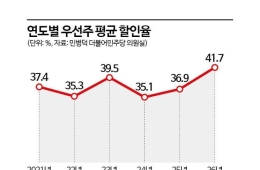
The discount on preferred shares relative to common shares also showed a clear upward trend. As of Oct. 16, the closing prices of the 76 preferred shares trading below their common-share counterparts were an average of 41.7% lower. The average annual discount rate for preferred shares trading below common shares was 37.4% in 2021, 35.3% in 2022, 39.5% in 2023, 35.1% in 2024 and 36.9% in 2025, before exceeding 40% for the first time this year. This was the widest gap since the Korea Exchange began compiling related statistics in 2021.
The number of preferred shares trading at around half the price of their common-share counterparts also reached a record 27 this year. The number of preferred shares priced at 50% or less of their common shares was 20 in 2021, 20 in 2022, 22 in 2023, 19 in 2024 and 17 in 2025. In 2021, 46 preferred shares, or 38.7% of the total, traded at a discount of 25% or more; this year, the number reached 56, or 50.5% of the total.

The number of preferred shares trading at discounts exceeding 70% jumped from four at the end of last year to 10 this year. They included Doosan Fuel Cell 1st Preferred (84.6%), Solus Advanced Materials 1st Preferred (82.0%), Daeduck Electronics 1st Preferred (81.9%), Doosan Fuel Cell 2nd Preferred B (80.0%) and Korea Circuit 2nd Preferred B (77.7%). The number trading at discounts of 60% or more more than doubled, rising from eight at the end of last year to 19 this year.
Of the 69 preferred shares trading at a discount at the end of last year, 50 saw their discounts widen further this year. In particular, 11 fell below half the price of their common-share counterparts: Doosan 2nd Preferred B, Doosan Preferred, LG Electronics Preferred, Mirae Asset Securities Preferred, DL E&C Preferred, Samsung SDI Preferred, Kumho Petrochemical Preferred, SK Innovation Preferred, Hyundai Engineering & Construction Preferred, DL Preferred and CJ Preferred.
Companies' neglect of preferred shares and weak shareholder-return policies cited as causes
As the South Korean stock market surged this year, led by large-cap KOSPI stocks, the price gap between large-cap common and preferred shares widened further. The discount rate for Samsung Electro-Mechanics Preferred grew to 65.6%, up 11.1 percentage points from 54.5% at the end of last year. The rate for LG Electronics Preferred increased from 47.2% to 63.2%, Samsung SDI Preferred from 40.4% to 59.9%, and Hyundai Motor Preferred from 30.5% to 47.1%. The gap is even clearer in actual prices. Samsung Electro-Mechanics common shares were priced at 1,188,000 won, compared with 409,000 won for its preferred shares. LG Electronics common shares were priced at 169,700 won, while its preferred shares were priced at 62,400 won.
The gap in share-price gains was also pronounced. Samsung SDI common shares rose 96.7% this year, while its preferred shares gained just 32.3%. For LG Electronics, the figures were 84.7% for common shares and 28.7% for preferred shares. Samsung Electro-Mechanics recorded gains of 365.9% and 252.6%, respectively. Hyundai Motor common shares rose 5.2%, while its preferred shares fell 20.0%. Of the 110 preferred shares that traded both at the end of last year and this year, 84 underperformed their common-share counterparts. The discounts are seen as having widened because common shares rose first and preferred shares failed to keep pace.
The five-year trends among large-cap stocks varied by company. For Samsung Electronics Preferred, the discount narrowed in the short term, from 25.6% at the end of last year to 22.4% this year, but remained substantially wider than the 9.1% recorded in 2021. The discount for Samsung Electro-Mechanics Preferred widened each year from 46.8% in 2021, while that for Hyundai Motor Preferred narrowed to 28.0% in 2024 before returning to 47.1% this year.

Discount rates also varied widely within the same corporate group. The price gaps between common and preferred shares were 22.4% for Samsung Electronics Preferred, 35.0% for Samsung Fire & Marine Insurance Preferred, 59.9% for Samsung SDI Preferred and 65.6% for Samsung Electro-Mechanics Preferred. Even preferred shares issued by the same company showed divergent trends. CJ Preferred traded at a 50.4% discount to its common shares, while CJ 4th Preferred (Convertible) was discounted by just 0.7%, making its price nearly equal to that of the common shares. There were also wide gaps between DL E&C Preferred (60.3%) and DL E&C 2nd Preferred (Convertible) (34.2%), and between Amorepacific Holdings Preferred (57.9%) and Amorepacific Holdings 3rd Preferred C (19.7%).
Experts cited the structural limitations of preferred shares and companies' passive shareholder-return policies as reasons for the deepening discounts. Older types of preferred shares in South Korea do not carry voting rights, but offer investors little in the way of additional dividend benefits compared with common shares. Although they are structured to pay a certain additional dividend on top of the common-share dividend, investors can hardly expect an additional dividend if no dividend is paid on common shares.
"Preferred shares trade at a discount because they do not have a substantive advantage over common shares in terms of either rights or dividends," said Yoo Geon-ho, a senior research fellow at Mirae Asset Securities. "Companies need to actively buy back and cancel older types of preferred shares."
Hot Picks Today
 "Two Spend 500,000 Won in a Flash, Yet Wait Two Hours?" ... 'Dreamland' Shunned by Kids and Foreign Tourists
- The Era of Getting 200 Million Won After 30 Years Is Over... A Japanese Bank's "Perpetual Department Head" Who Just Clocked In Cries Out
- Spain Hit by Its Worst Tragedy... Lee Kangin, Moreno and Real Madrid Join Soccer World in Mourning
- They Said, “Make It Your Home for Life” - Then Suddenly Kicked 200 Passengers Off... What Happened to the Around-the-World Cruise?
- "130 Rice Bowls Sold Out in a Day"... 'Unfiltered Face' Adds 8 Million Won to Night Market Sales: China's Bungeunwoo
Some have also argued that the government and political circles should use measures such as amendments to the Commercial Act to address companies' discriminatory treatment of preferred shares. "The discount on preferred shares is occurring because there is no structural buyer for them, while companies have a practice of buying back only common shares and neglecting preferred shares," said Kim Soo-hyun, head of the research center at DS Investment & Securities. "Regulations, including the Commercial Act, should be strengthened to prevent boards of directors from discriminating among shareholders based on the class of shares they hold."
© The Asia Business Daily. All rights reserved. Unauthorized AI training and use prohibited.