Amid Stock Market Plunge, Lee Hyungil: "We Will Proactively Prepare Necessary Measures to Prevent Overreaction"
Government Holds Meeting of Ministers on External Economic Affairs

Deputy Prime Minister and Minister of Finance and Economy Lee Hyungil delivers opening remarks at the 276th External Economic Ministers' Meeting, held at the Government Complex Seoul in Jongno-gu, Seoul, on the 6th. Ministry of Finance and Economy
View original imageDeputy Prime Minister and Minister of Finance and Economy Lee Hyungil said on Nov. 6, regarding the recent sharp decline in stock markets, "We will closely monitor global financial market conditions and take the necessary measures proactively and implement them in a timely manner to ensure that our stock market does not overreact relative to economic fundamentals."
Lee chaired the 276th External Economic Ministers' Meeting at the Government Complex Seoul that morning. The meeting discussed the impact of the U.S. midterm elections on the external economy and how to respond, as well as trends in international financial markets following the elections.
Lee said, "With concerns about tighter regulation of the AI industry in the wake of the U.S. midterm elections held on Nov. 3 (local time), U.S. stocks plunged the previous day, and the possibility of spillover effects on global stock markets cannot be ruled out."
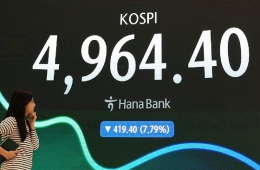
Wall Street fell sharply overnight amid persistent concerns about delays in data center construction following a Democratic landslide in the U.S. midterm elections, known as a blue wave. The previous day, the KOSPI also closed at 5,383.80, down more than 5% from the previous session. This was its lowest level in seven months, since April. The KOSDAQ also closed at 578.41, falling into the 600-point range for the first time in three months, since July.

Lee said, "Experts expect AI investment to continue." He added that the government would closely monitor global financial market conditions and proactively take the necessary measures and implement them in a timely manner to ensure that the Korean stock market does not overreact relative to the strength of the country's economic fundamentals.
The government expects that core policy priorities, including strengthening domestic industry and supply chains, will remain unchanged after the U.S. midterm elections. It plans to proactively assess and respond to changes in the conditions for advancing key U.S. policies in light of the election results.
Lee stressed, "We will monitor changes in the administration's trade measures, such as tariffs and export controls, as well as in industrial support policies that require legislative action and budget review by Congress, and proactively assess the impact on Korean companies."
Hot Picks Today
 "Two Spend 500,000 Won in a Flash, Yet Wait Two Hours?" ... 'Dreamland' Shunned by Kids and Foreign Tourists
- The Era of Getting 200 Million Won After 30 Years Is Over... A Japanese Bank's "Perpetual Department Head" Who Just Clocked In Cries Out
- Spain Hit by Its Worst Tragedy... Lee Kangin, Moreno and Real Madrid Join Soccer World in Mourning
- They Said, “Make It Your Home for Life” - Then Suddenly Kicked 200 Passengers Off... What Happened to the Around-the-World Cruise?
- "130 Rice Bowls Sold Out in a Day"... 'Unfiltered Face' Adds 8 Million Won to Night Market Sales: China's Bungeunwoo
He added, "Through close cooperation among relevant government ministries, the government will ensure the stable implementation of the existing Korea-U.S. trade agreement and strengthen communication with the U.S. administration, Congress, and state governments. Building on this, we will support stable export and investment conditions for Korean companies and identify opportunities for cooperation in strategic industries such as shipbuilding and energy."
© The Asia Business Daily. All rights reserved. Unauthorized AI training and use prohibited.