2.1 Trillion Won to Be Invested in Fusion, Marine Reactors, and Displays... Projects Pass Preliminary Feasibility Study
1.4813 trillion won for fusion technology development... Demonstration foundation to be established by 2036
R&D on marine molten salt reactors and next-generation displays to also move forward in earnest
The government will launch research and development (R&D) projects worth a total of 2.1675 trillion won to secure technologies for fusion energy, marine molten salt reactors, and next-generation displays. It plans to build a foundation for demonstrating key fusion technologies and support the development of nuclear-powered ships and next-generation display technologies to secure future growth engines.
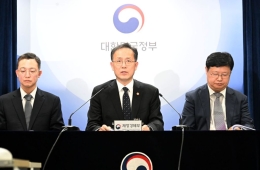
The Ministry of Science and ICT said on November 5 that it had held the 2026 9th General Committee on the Evaluation of National R&D Projects in writing from November 3 to 5, chaired by Park In-gyu, head of the Office of Science, Technology and Innovation, and finalized the preliminary feasibility study results for three national R&D projects. The projects approved this time were submitted before the R&D preliminary feasibility study system was abolished, and all were approved for implementation.

The largest project is the "Development of Key Technologies and Establishment of a Demonstration Foundation to Accelerate the Realization of Fusion Energy." A total of 1.4813 trillion won will be invested over 10 years, from 2027 to 2036, including 1.2877 trillion won in central government funding.
Fusion is a technology that replicates on Earth the process by which the sun produces energy. Unlike conventional nuclear power generation, it generates energy by combining light atomic nuclei. South Korea has conducted related research mainly through the Korea Superconducting Tokamak Advanced Research (KSTAR) device, but it lacks a demonstration foundation for verifying the key technologies needed for actual fusion power generation.
Through the project, the government plans to advance key technologies related to core plasma, heating and current drive, superconducting magnets, breeding blankets, fusion materials, and the fuel cycle. In particular, it will establish a Fusion Energy Key Technology Demonstration Center where technology performance can be evaluated in extreme conditions similar to those inside an actual fusion reactor. However, the project focuses not on building a fusion power plant, but on developing key technologies and establishing a foundation for their verification, both of which are necessary for commercialization.
317.3 billion won for marine reactors... 368.87 billion won for next-generation displays
A technology development project for marine molten salt reactors (MSRs) for use in nuclear-powered ships has also passed the preliminary feasibility study. It will be jointly pursued by the Ministry of Science and ICT and the Ministry of Oceans and Fisheries, with a total investment of 317.3 billion won over four years, from 2027 to 2030. Central government funding will amount to 225.2 billion won.
An MSR is a reactor technology that uses nuclear fuel in molten salt form. It can operate at high temperatures and low pressure, and is well suited to miniaturization, making it a candidate for ship propulsion reactors. It is attracting attention as a technology that could reduce carbon emissions in the shipping sector in response to the International Maritime Organization's (IMO) strengthened greenhouse gas reduction targets.
The government plans to develop key technologies related to the core, systems, nuclear fuel, and materials for marine MSRs, as well as technologies for integrating reactors with ships and for safety assessments. However, further challenges, including technical safety verification and related regulatory approvals, must be addressed before the technology can be used on commercial vessels.
A total of 368.87 billion won will be invested over seven years, from 2027 to 2033, in the "National Research Platform for Advanced Display Development Project," led by the Ministry of Trade, Industry and Energy. Central government funding will amount to 278.9 billion won. The project will focus on three areas: "Over OLED," which aims to overcome the performance limits of organic light-emitting diodes (OLEDs); "Cross OLED," which integrates diverse functions and technologies; and "Post OLED," which develops next-generation technologies beyond OLED.
The government plans to establish a national research platform that supports the entire R&D process, from display design to panel-level demonstrations, helping domestic companies and research institutions secure next-generation technologies.
The fusion and MSR fields that passed the preliminary feasibility study are linked to the government's "Seven SEED Projects." The projects are a strategy to develop seven fields as future growth engines: small modular reactors (SMRs), fusion, breakthrough renewable energy, quantum technology, space and aviation, advanced biotechnology, and advanced supply chains.
Hot Picks Today
 "Two Spend 500,000 Won in a Flash, Yet Wait Two Hours?" ... 'Dreamland' Shunned by Kids and Foreign Tourists
- The Era of Getting 200 Million Won After 30 Years Is Over... A Japanese Bank's "Perpetual Department Head" Who Just Clocked In Cries Out
- Spain Hit by Its Worst Tragedy... Lee Kangin, Moreno and Real Madrid Join Soccer World in Mourning
- They Said, “Make It Your Home for Life” - Then Suddenly Kicked 200 Passengers Off... What Happened to the Around-the-World Cruise?
- "130 Rice Bowls Sold Out in a Day"... 'Unfiltered Face' Adds 8 Million Won to Night Market Sales: China's Bungeunwoo
"Fusion and MSRs are key technology fields included in the Seven SEED Projects, while displays are an area in which we lead the global market," Park said, calling for the projects to be pursued at speed to secure next-generation growth engines early. "We will strengthen strategic investment in national R&D and turn it into the creation of future industries," he added.
© The Asia Business Daily. All rights reserved. Unauthorized AI training and use prohibited.