Democrats Sweep the U.S.... Is Space Now AI's Only Hope? [Tech Talk]
Data center issues amid escalating political tensions
Space data centers could address power grid and political challenges
Costs up to 100 times higher and thermal management remain obstacles
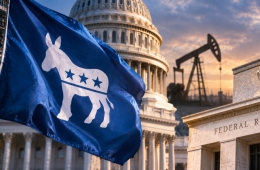
The U.S. Democratic Party's surprise sweep of both the House and Senate in this year's midterm elections is expected to bring major changes to the artificial intelligence (AI) industry. On election night, semiconductor and AI-related technology stocks plunged during trading before recovering.
Industry concerns center on the possibility that, if Democrats take the lead in Washington, data center permitting reviews will become more stringent and capital spending could slow. This has led some to argue that "space" should be considered a serious alternative for AI infrastructure.
Democrats' surge... Musk asks, "Aren't space data centers appealing?"

In the U.S. midterm elections held on November 3, Gina Hinojosa, a Democrat, was elected the new governor of Texas. It is the first time in 36 years that a Democratic candidate has won the governorship.
Hinojosa is also a politician who has publicly supported a temporary halt to the construction of AI data centers. If the expansion of AI infrastructure slows in Texas, a major data center hub in the United States, AI development could slow as well. That is why Tesla CEO Elon Musk took to his X account that day to ask, "Doesn't the idea of space data centers look pretty appealing now?"
Musk is currently developing the concept of "space data centers" through SpaceX, his space exploration company. The idea is to launch tens of thousands of computers for AI into space and connect them so they function like one enormous data center.
Space data centers could avoid bottlenecks on the ground

SpaceX has already built a vast satellite constellation through Starlink. Space data centers take this idea further. The plan is to pack small satellites with computer infrastructure, including graphics processing units (GPUs) for AI, generate power with solar panels, and exchange information between satellites using laser communications, coordinating tens of thousands of satellites as one system.
Space data centers could avoid the critical bottlenecks facing ground-based data centers: power grids, land, and political uncertainty. The rapid expansion of data centers in the United States has already reduced the amount of suitable land available. Power grid capacity is also difficult to secure, leaving projects waiting, and political uncertainty has now added to the challenges. Space, by contrast, offers virtually unlimited room. And if solar panels generate power and supply it to the GPUs, there is no need to install a separate power grid.
SpaceX and Google have already demonstrated space data center technology. Last month, through its Project Suncatcher, Google launched satellites carrying its AI chips, known as TPUs, aboard a SpaceX Falcon 9 rocket and successfully processed AI inference tasks.
Costs up to 100 times higher make it impractical

Ground-based data centers are becoming increasingly difficult to expand due to challenges involving land, power grids, and opposition from local residents. The photo shows an OpenAI data center. OpenAI
View original imageFor now, however, the limitations of space data centers are clear. The first is cost. Even though SpaceX's reusable cargo rockets have dramatically lowered the cost of carrying payloads from Earth to orbit, building space data centers still costs astronomical sums. Amanda Peterson Corio, who led Google's Project Suncatcher, said at the WTF Summit late last month, "It costs up to 100 times more to build a data center in space than on the ground."
The challenging maintenance work adds another cost. Computer chips inside data centers run around the clock, gradually wearing down and needing replacement every few years. On Earth, technicians can enter a data center, replace the chips and finish the wiring. With space data centers, however, a new satellite must be launched whenever one reaches the end of its service life, making maintenance far more complicated.
Thermal management is another challenge that remains unsolved. Unlike on Earth, heat dissipates very slowly in the vacuum of space. A complex design is essential to manage the overall heat generated while it is expelled from the satellite. For Project Suncatcher, operations were reportedly limited to 15-minute intervals to control the heat generated by the TPUs.
Musk plans to overcome the hurdles head-on with technology

An artist's rendering of SpaceX's next-generation Starship cargo rocket (left) and a massive AI data center satellite. SpaceX
View original imageCEO Musk plans to tackle these obstacles head-on through technological development. SpaceX has released an image of a massive satellite it is envisioning for space data centers. The satellite features solar panels and radiators made with new materials that are far larger than those on cargo rockets. The plan is to power AI computers with capacity of up to 1 megawatt (MW) and collect and dissipate their waste heat.
Hot Picks Today
 "Two Spend 500,000 Won in a Flash, Yet Wait Two Hours?" ... 'Dreamland' Shunned by Kids and Foreign Tourists
- The Era of Getting 200 Million Won After 30 Years Is Over... A Japanese Bank's "Perpetual Department Head" Who Just Clocked In Cries Out
- Spain Hit by Its Worst Tragedy... Lee Kangin, Moreno and Real Madrid Join Soccer World in Mourning
- They Said, “Make It Your Home for Life” - Then Suddenly Kicked 200 Passengers Off... What Happened to the Around-the-World Cruise?
- "130 Rice Bowls Sold Out in a Day"... 'Unfiltered Face' Adds 8 Million Won to Night Market Sales: China's Bungeunwoo
Cargo rockets are also continuing to improve. In a study published last year, Google research chief James Manyika predicted that if launch costs fell to $200 per kilogram, the cost of building space data centers could reach parity with that of ground-based facilities. If SpaceX's next-generation cargo rocket, Starship, is completed and becomes operational on schedule, this could be achieved around 2035.
© The Asia Business Daily. All rights reserved. Unauthorized AI training and use prohibited.