KOSPI Swept Up by Blue Tsunami... Semiconductor Stocks Crumble, 'Sell-Sidecar' Triggered [U.S. Blue Tsunami]
Concerns over data center construction delays after 'green' Democrats' landslide victory in the U.S.
Renewable energy stocks, including solar and ESS, seen as beneficiaries

After Democrats scored a sweeping victory in the U.S. midterm elections, concerns grew over regulations on AI data centers, sending South Korean stocks sharply lower, led by AI-related shares. The prospect that Democrats could slow permitting for data centers has raised concerns about potential damage to South Korea's semiconductor industry. However, some say the impact on the stock market could be short-lived, as Democrats are also aware of the importance of the AI race for global dominance and are therefore expected to avoid indiscriminate regulation.
U.S. Democrats Take Control of Both Chambers, Raising Concerns About Delays to Data Center Construction in South Korea
The KOSPI opened at 5,580.09 on Nov. 5, down 1.82% from the previous trading session, then extended its losses, plunging more than 5% after 10 a.m. The sharp drop in the index triggered a sell-sidecar, temporarily halting order quotations.
South Korean stocks were also affected by the sharp overnight declines in data center-related and semiconductor shares on the New York Stock Exchange. On concerns about data center regulations, CoreWeave and Nebius, neocloud companies that rent out AI computing capacity, fell 9.9% and 6.7%, respectively. Memory and storage companies also posted steep declines, including SanDisk (-7.9%), Micron (-7.0%) and Western Digital (-6.8%), while SK hynix American Depositary Receipts (ADRs) fell 5.1%. The Philadelphia Semiconductor Index dropped 3.1%, reaching its lowest level in about six months. Concerns that community opposition could lead to regulatory measures and delays in permits intensified after Democratic candidates won gubernatorial elections in Texas, Ohio and Georgia, where data center construction is being actively pursued.
Seo Sang-young, an executive at Mirae Asset Securities, explained, "A major factor was the increased concern about tighter regulations on grid connections, permitting and electricity costs, as Democrats also won in key data center locations such as Texas and Georgia." He added, "It has come into focus that companies building new data centers with large amounts of debt could face higher financing costs and greater pressure on profitability if their project schedules are delayed."

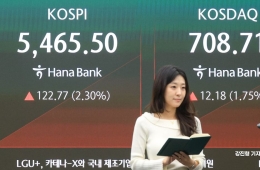
Employees work in the dealing room at Hana Bank headquarters in Jung-gu, Seoul, on the 5th. The KOSPI opened at 5,580.09, down 103.71 points (1.82%) from the previous session. Domestic semiconductor stocks also fell following a drop in the U.S. semiconductor index, with Samsung Electronics and SK hynix down around 5% and 7%, respectively, deepening the market's losses. 2026.11.5 Photo by Cho Yongjun
View original imageSemiconductor Stocks Plunge... KOSPI Sell-Sidecar Triggered
South Korean stocks also plunged, led by AI-related shares such as semiconductor and power equipment stocks. As of 10:06 a.m., Samsung Electronics was trading at 206,250 won, down 5.39% from the previous trading session. Major semiconductor stocks by market capitalization were tumbling, including SK hynix (-7.38%), SK Square (-6.56%) and Samsung Electro-Mechanics (-10.31%). On the KOSDAQ, major semiconductor equipment makers also posted sharp declines, including Jusung Engineering (-10.23%), Simmtech (-13.90%) and EO Technics (-11.72%).
Brokerages expect short-term concerns about AI-related stocks to grow as Democrats become the majority party. Lee Jae-won, a researcher at Yuanta Securities, said, "The likelihood of tighter regulations on AI data centers has increased as Democrats have taken control of Congress and won governorships in key states." He added, "In particular, restrictions on permits in major data center construction areas such as Texas, along with a greater burden from power grid costs, could delay AI capital investment and, in turn, slow demand for memory semiconductors and push down selling prices."

However, some say the impact on the stock market could be brief, as Democrats are also aware of the importance of the AI race for global dominance and are expected to avoid indiscriminate regulation. Jo Yeon-ju, a researcher at NH Investment & Securities, emphasized, "Democrats also recognize the importance of AI dominance, so they will avoid large-scale delays by offering compensation to local residents for new data centers." She added, "The impact on big tech companies could amount to a storm in a teacup."
Concerns are also high about power equipment companies, including transformer makers, beyond the semiconductor sector. The concern is that delays in data center construction could reduce demand for transformers. As of 10:10 a.m., power equipment stocks were falling across the board, including Hyosung Heavy Industries (-10.10%), HD Hyundai Electric (-7.53%) and Sanil Electric (-12.84%).
Hot Picks Today
 "Two Spend 500,000 Won in a Flash, Yet Wait Two Hours?" ... 'Dreamland' Shunned by Kids and Foreign Tourists
- The Era of Getting 200 Million Won After 30 Years Is Over... A Japanese Bank's "Perpetual Department Head" Who Just Clocked In Cries Out
- Spain Hit by Its Worst Tragedy... Lee Kangin, Moreno and Real Madrid Join Soccer World in Mourning
- They Said, “Make It Your Home for Life” - Then Suddenly Kicked 200 Passengers Off... What Happened to the Around-the-World Cruise?
- "130 Rice Bowls Sold Out in a Day"... 'Unfiltered Face' Adds 8 Million Won to Night Market Sales: China's Bungeunwoo
There are also potential beneficiaries. Stocks related to clean and renewable energy, including solar, wind, nuclear power and energy storage systems (ESS), are considered among the main beneficiaries of the "Blue Tsunami." With Democrats securing majority status, expectations are set to rise for the resumption of policies supporting renewable energy. Ahn Joo-won, a researcher at DS Investment & Securities, explained, "As the Democrats' stronger negotiating position following their landslide election victory shapes related legislation in the future, demands concerning renewable energy such as solar and wind power will be strongly reflected." He added, "Related stocks, including wind power and fuel cell companies, will benefit."
© The Asia Business Daily. All rights reserved. Unauthorized AI training and use prohibited.