Lee Visits Jangwi-dong Redevelopment Site: "Boost Incentives, Including Floor Area Ratios and Financial Support, for Early Projects"
"Plunge in permits since 2022 has created a supply cliff," he says
Urges faster redevelopment projects
"Redevelopment taking 20 to 30 years is unacceptable"
Calls for faster legislation and expanded LH workforce
On Nov. 4, President Lee Jae-myung described stabilizing housing prices in the Seoul metropolitan area as "a key task more important than any other policy agenda" and called for redevelopment and reconstruction projects to be expedited. His remarks came as a supply cliff has become a reality following a sharp decline in housing construction permits since 2022, while the effects of the recent recovery in permits may not be felt until 2028 at the earliest. He also instructed officials to draw up measures to strengthen various incentives, including floor area ratios and financial support, when housing improvement projects are carried out early.

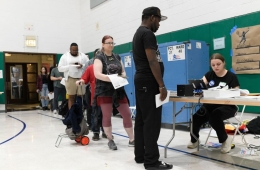
President Lee Jaemyung visits the public redevelopment project site in Jangwi District 9, Seongbuk-gu, Seoul, on Nov. 4, 2026. Yonhap News Agency
View original imageAfter visiting the public redevelopment site in Jangwi District 9, Seongbuk-gu, Seoul, President Lee made the remarks at a meeting on housing improvement projects. "Housing prices in the Seoul metropolitan area are a major issue of national concern," he said.
President Lee identified the concentration of population in the Seoul metropolitan area as a structural cause of housing price instability. "Because of the fundamental problem of concentration in the Seoul metropolitan area, land is limited while the population keeps growing, so it clearly has a negative impact on housing prices," he said. In particular, he explained, "The number of housing construction permits has plunged since 2022, and that is creating a supply cliff now. Although permits have increased substantially recently, people in the field say it will be 2028 at the earliest before the effects are felt in reality."
He again stressed that the fallout from the past contraction in housing supply is now being felt in the housing market, and that, in addition to securing new sites, existing housing improvement projects must be accelerated to minimize supply gaps. "Redevelopment projects take far too long. Ten years is the norm, and they say some take 20 or even 30 years," President Lee said. "We need to pick up the pace."
He cited speed and transparency as advantages of public redevelopment. "The public redevelopment approach seems to have several clear benefits," he said. "There is very little risk of corruption, and since the government has decided to provide various incentives, I think it could greatly help with the speed and business feasibility of the projects."
Earlier, during his site visit, he directly pointed to delays and the potential for corruption in private redevelopment. When told that private redevelopment in Jangwi District 14 had been underway for 18 years, he asked, "Private redevelopment is done by forming an association, and it gets delayed because they fight all the time. Has it really been going on for 18 years?" He added, "If the public sector handles it, things move faster and the risk of corruption is reduced."
He also expressed concern about delays in legislation in the National Assembly. "Expediting bills pending in the National Assembly would greatly help move projects forward on the ground," President Lee said. Addressing Chief of Staff Lim Gwang-hyun, he added, "I hope the ruling party will pick up the pace. It seems things are taking much longer than expected."
He also emphasized the need to increase the number of staff working on projects at the Korea Land and Housing Corporation (LH). When told of staffing difficulties, he said, "I told you to hire more people. Housing improvement projects keep coming up. Urban redevelopment isn't just something to do in Seoul; it needs to be done across the metropolitan area and in major cities in the regions, too."

President Lee Jae-myung speaks at a roundtable on redevelopment projects in the Seoul metropolitan area at the Jangwi 3-dong Community Service Center in Seongbuk-gu, Seoul, on Nov. 4, 2026. Yonhap News Agency
View original imageHe also emphasized the principle of strict enforcement of the law. After hearing how Sarang Jeil Church in Jangwi District 10 had been excluded from the redevelopment zone, he said, "There is no such thing as being able to break the law and get away with it by holding out." He then told Seongbuk District Mayor Lee Seung-ro, "Enforce the law thoroughly from now on. In a country governed by the rule of law, how can you get away with holding out by force?"
The government plans to support the start of construction on 234,000 homes in the Seoul metropolitan area over the next five years by shortening housing improvement project procedures and improving project feasibility. According to the Ministry of Land, Infrastructure and Transport, 773 housing improvement projects are underway in the metropolitan area, but only 128 zones (16.6%) have reached the construction-start stage.
Hot Picks Today
 "Two Spend 500,000 Won in a Flash, Yet Wait Two Hours?" ... 'Dreamland' Shunned by Kids and Foreign Tourists
- The Era of Getting 200 Million Won After 30 Years Is Over... A Japanese Bank's "Perpetual Department Head" Who Just Clocked In Cries Out
- Spain Hit by Its Worst Tragedy... Lee Kangin, Moreno and Real Madrid Join Soccer World in Mourning
- They Said, “Make It Your Home for Life” - Then Suddenly Kicked 200 Passengers Off... What Happened to the Around-the-World Cruise?
- "130 Rice Bowls Sold Out in a Day"... 'Unfiltered Face' Adds 8 Million Won to Night Market Sales: China's Bungeunwoo
Jangwi District 9, which President Lee visited, is a public redevelopment project site being developed by LH, with plans for 2,270 homes. The project aims to begin housing construction in June 2029 and complete the homes and move residents in by March 2033. President Lee reiterated his call to expedite housing improvement projects, saying, "I hope administrative procedures will be shortened so that projects in other areas can also move faster, and that various incentives, including floor area ratios and financial support, will be strengthened when projects are carried out early."
© The Asia Business Daily. All rights reserved. Unauthorized AI training and use prohibited.