"If NVIDIA Cuts Off Supply, Everything Stops"... Government, Startups Set to Launch Large-Scale Homegrown NPU Demonstration
"No alternatives if a vendor halts supply for a year"
Pair Korean hardware and software with AMD's open infrastructure
The government and South Korean AI infrastructure startups are seeking to break through NVIDIA's dominant ecosystem by championing homegrown neural processing units (NPUs) and open systems.
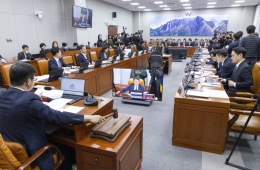
Lee Dogyu, policy chief at the Ministry of Science and ICT; Kim Jangwoo, CEO of MangoBoost; and Cho Kangwon, CEO of Moreh, took part in a panel discussion at AMD Developer Day Seoul 2026, held on Nov. 4 at The Westin Seoul Parnas in Gangnam-gu. They discussed strategies for reducing dependence on NVIDIA and building sovereign AI infrastructure.

At the “AMD Developer Day Seoul 2026,” held on the 4th at the Westin Seoul Parnas Hotel in Gangnam-gu, panelists take part in a discussion. From left: moderator Jang Jeonghui, head of commercial sales at AMD Korea; Kim Jangwoo, CEO of MangoBoost; Cho Gangwon, CEO of Moreh; and Lee Dogyu, information and communications policy chief at the Ministry of Science and ICT. Photo by Kim Jinyoung.
View original imageThe government will significantly expand support for homegrown chips in response to the market's shift toward inference. Lee said, "By 2030, the market will have shifted to the point where 60% of AI workloads are for inference and 40% for training." He added, "As inference grows dramatically, it is essential to improve efficiency through NPUs to address the enormous power and cost challenges that will arise."
The government plans to go beyond its existing chip-level support and directly develop large-scale reference systems. "Until now, demonstration projects have been limited to chip-level support, which has constrained market adoption," Lee said. "Next year, we will build a 'large-scale demonstration reference' that combines AMD central processing units (CPUs) and graphics processing units (GPUs) with homegrown NPUs. We will support public institutions and private companies, as well as global customers, so they can confidently choose homegrown NPUs." Cooperation with homegrown NPU makers was also specified in a memorandum of understanding (MOU) signed by the Ministry of Science and ICT and AMD in July.
The AI startup leaders pointed to the risks of excessive dependence on a single vendor. "If a particular vendor decided, 'We won't supply GPUs to South Korea for the next year,' the country currently would not be in a position to build a fully functioning data center on its own," Cho said. "If data centers are dependent on a particular vendor, we cannot safeguard our data sovereignty." He suggested introducing alternative semiconductors beyond NVIDIA's to stabilize supply chains, starting now.
The panelists also emphasized the need for a system-level approach to reducing AI costs. "Data sovereignty is important, but the more fundamental problem is that AI is too expensive," Kim said. "In the United States, the annual salary of an engineer who improves the performance of open-source models can exceed KRW 500 million, reflecting the enormous costs of optimizing software and hardware." He stressed, "Just as you need to build a complete car and enter it in a race to win first place, you have to build a complete 'computer system' encompassing semiconductors, software, and storage and prove that it offers value for money."
The panelists agreed that the next year would be a golden window for transitioning infrastructure. Kim called for completing a single system that could demonstrate cost-effectiveness for services. Cho urged companies to build their own data centers and test alternative semiconductors.
Hot Picks Today
 "Two Spend 500,000 Won in a Flash, Yet Wait Two Hours?" ... 'Dreamland' Shunned by Kids and Foreign Tourists
- The Era of Getting 200 Million Won After 30 Years Is Over... A Japanese Bank's "Perpetual Department Head" Who Just Clocked In Cries Out
- Spain Hit by Its Worst Tragedy... Lee Kangin, Moreno and Real Madrid Join Soccer World in Mourning
- They Said, “Make It Your Home for Life” - Then Suddenly Kicked 200 Passengers Off... What Happened to the Around-the-World Cruise?
- "130 Rice Bowls Sold Out in a Day"... 'Unfiltered Face' Adds 8 Million Won to Night Market Sales: China's Bungeunwoo
"Given how rapidly AI is advancing, it is important to make the right decisions at the right time," Lee said. "As the inference-focused market begins to take off in earnest, homegrown NPUs and an open software ecosystem will be the most economical choice from a total cost of ownership (TCO) perspective. The government will also provide full policy support."
© The Asia Business Daily. All rights reserved. Unauthorized AI training and use prohibited.