Bold Bid to End 30-Year Water-Source Dispute... Nakdong River Subsurface Water '1,000-Ton Test' Gets Underway
Moving beyond 33-ton model to near-commercial-scale testing
Success could put 650,000-ton-per-day drinking water project on track
The government has begun designing a test facility capable of extracting 1,000 tons of water per day to develop a subsurface water intake plan, seen as a potential solution to disputes over drinking water from the Nakdong River. So far, tests have been conducted using a small-scale model handling about 33 tons per day. This time, the facility will be scaled up to a size closer to one that could be used in the field, allowing the government to properly assess how reliably water can be drawn and how good its quality is.

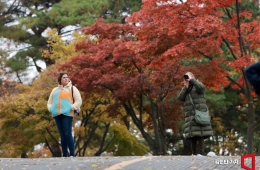
Autumn Colors the Nakdong River in Andong, Where Cosmos and Kenaf Gardens Create a Spectacle
More than 70,000 pink muhly plants beneath Yeonggadaegyo Bridge create a pink landscape through early November
The Asia Business Daily
According to the Ministry of Climate, Energy and Environment on November 4, the government recently began drawing up a design and standards for a facility capable of handling 1,000 tons per day and suited to conditions along the lower Nakdong River. Based on a comparison and analysis of domestic subsurface water intake facilities in operation and conditions at sites along the Nakdong River, the government plans to install and operate a facility directly on the river next year. Subsurface water is water that has been naturally filtered through layers of sand and gravel beneath a riverbed. It is cleaner than water drawn directly from a river. In small-scale tests conducted earlier by a joint verification team from Daegu City and the government, turbidity fell by 82% to 83%, while biochemical oxygen demand (BOD), an indicator of organic pollution, decreased by 37% to 39%. No toxins from algal blooms were detected.
However, challenges remain. The total organic carbon (TOC) level, an indicator of the amount of organic matter in water, failed to meet river water quality standards for living environments, forcing the team to reduce the intake volume from 41 tons to 33 tons. TOC measures the total amount of carbon in organic matter present in water and is a key indicator of organic pollution in water. A model handling only tens of tons of water also made it difficult to assess seasonal changes in river levels, variations in riverbed structure from one location to another, and blockages caused by fine soil accumulating in the flow paths. This is why the government is scaling up the facility. By continuously drawing 1,000 tons of water per day, it aims to assess both the facility's water purification capacity and its water collection efficiency.

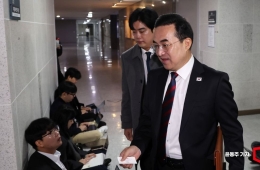
Climate, Energy and Environment Minister Kim Sunghwan announces plans to hold public deliberations on nuclear power at a briefing room in the annex of the government complex in Jongno-gu, Seoul, on Sept. 22, 2026. Photo by Cho Yongjun
View original imageIf the test is successful, the subsurface water supply project under consideration by Daegu City, which would handle 650,000 tons per day, including 588,000 tons for supply, is also expected to gain momentum. This would make it possible to secure clean drinking water directly from the main stream of the Nakdong River without bringing water in from other regions. The project is also aligned with the Lee Jae-myung administration's policy agenda, which pledges to achieve Class 1 water quality in the main stream of the Nakdong River by 2030 and resolve concerns about drinking water in the Yeongnam region. In a presidential briefing at the end of 2025, Climate Minister Kim Seonghwan proposed riverbank filtration and subsurface water as alternatives to laying new water transmission pipes, and President Lee called for swift implementation.
Hot Picks Today
 "Two Spend 500,000 Won in a Flash, Yet Wait Two Hours?" ... 'Dreamland' Shunned by Kids and Foreign Tourists
- The Era of Getting 200 Million Won After 30 Years Is Over... A Japanese Bank's "Perpetual Department Head" Who Just Clocked In Cries Out
- Spain Hit by Its Worst Tragedy... Lee Kangin, Moreno and Real Madrid Join Soccer World in Mourning
- They Said, “Make It Your Home for Life” - Then Suddenly Kicked 200 Passengers Off... What Happened to the Around-the-World Cruise?
- "130 Rice Bowls Sold Out in a Day"... 'Unfiltered Face' Adds 8 Million Won to Night Market Sales: China's Bungeunwoo
Controversy over the Nakdong River's water quality intensified after a phenol spill at the Gumi Industrial Complex in 1991, followed by repeated incidents involving hazardous chemicals over several decades. Plans were also pursued to move water intake sources upstream, including to Andong Dam and the Haepyeong intake site in Gumi. However, conflicting interests among local governments—including concerns about possible water shortages and opposition from residents in upstream areas—have left the plans at a standstill for more than 30 years. The government and local authorities plan to use the test to assess whether water can be drawn reliably throughout all four seasons and to verify the water quality improvements, with the aim of expanding the project into a large-scale drinking water supply facility depending on the results. “We will determine the optimal facility specifications and maintenance standards suited to conditions on the Nakdong River riverbed and rigorously verify whether they can be applied in the field,” a ministry official said.
© The Asia Business Daily. All rights reserved. Unauthorized AI training and use prohibited.