[Editorial] 162 Trillion Won Future Fund: Should the Minister Also Choose Its Review Committee Members?

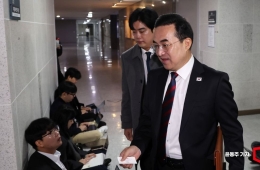
Park Honggeun, Minister of Planning and Budget, attends a closed-door meeting between the government and ruling party on the Future Response Fund at the National Assembly Members' Office Building on the 3rd. Photo by Yoon Dongju
View original imageThe government plans to establish a Future Response Fund next year with a budget of 162.3 trillion won, but its authority to change spending and its decision-making structure have become controversial. Under the bill submitted by the government, spending on major items could be increased by up to 30% without the National Assembly's approval, and the Minister of Planning and Budget would appoint the private-sector members who review the fund's management. Concerns have been raised that invoking flexibility in fiscal execution could weaken parliamentary oversight and the independence of the review process.
The Fund Management Review Committee will be chaired by the Minister of Planning and Budget and consist of 10 to 30 members. At least half must be private-sector members, but the bill does not specify key requirements for them, such as expertise or external recommendations; it only requires consideration of gender. Matters necessary for the committee's composition and operation have been left to a presidential decree.
In effect, the minister responsible for execution would also select the private-sector members who review it. This raises concerns that the committee could be reduced to a body that simply endorses government decisions. The law should establish clear standards to ensure independent, expert reviews under any administration. The bill also allows spending to be changed without a National Assembly vote by up to 30%, a broader range than the 20% permitted for ordinary non-financial funds. The government cites the fund's financial nature and the need for flexible execution. The problem is that ordinary fiscal programs, including welfare, are also included in the fund. It is necessary to examine whether the need for flexibility justifies allowing broad changes to spending on fiscal programs as well.
The Ministry of Planning and Budget says ex post oversight is possible because it will promptly report changes to the National Assembly and the fund will be subject to year-end settlement reviews and audits by the Board of Audit and Inspection. However, reporting after the money has been spent and pointing out problems cannot replace prior review of important spending decisions.
Hot Picks Today
 "Two Spend 500,000 Won in a Flash, Yet Wait Two Hours?" ... 'Dreamland' Shunned by Kids and Foreign Tourists
- The Era of Getting 200 Million Won After 30 Years Is Over... A Japanese Bank's "Perpetual Department Head" Who Just Clocked In Cries Out
- Spain Hit by Its Worst Tragedy... Lee Kangin, Moreno and Real Madrid Join Soccer World in Mourning
- They Said, “Make It Your Home for Life” - Then Suddenly Kicked 200 Passengers Off... What Happened to the Around-the-World Cruise?
- "130 Rice Bowls Sold Out in a Day"... 'Unfiltered Face' Adds 8 Million Won to Night Market Sales: China's Bungeunwoo
During its review of the bill, the National Assembly should clearly set out in law the expertise requirements for private-sector members, procedures for external recommendations, safeguards against conflicts of interest, and disclosure of review results. The scope for discretionary spending changes should also be defined according to the nature of asset management and fiscal programs. The National Assembly should be able to review major new or expanded projects, and changes in the use of funds, in advance. Before broadening the government's spending authority, the first step should be to establish independent review and parliamentary oversight commensurate with that authority.
© The Asia Business Daily. All rights reserved. Unauthorized AI training and use prohibited.