[U.S. Midterms, Day of Destiny] Trading on U.S. Midterms Tops KRW 2.5 Trillion... Prediction Markets 'Heat Up'
$1.9 Billion Traded on Kalshi and Polymarket Alone
Bets Concentrated on Democrats Winning Majorities in Both Chambers
Trading volume in prediction markets related to the U.S. midterm elections reached approximately KRW 2.5 trillion. Most of the trading was concentrated on the possibility of Democrats winning majorities in both the House and Senate.
The Washington Post (WP) reported that, as of 8 p.m. on November 3, a total of $1.9 billion (approximately KRW 2.5 trillion) had been traded on the election results through prediction market companies Kalshi and Polymarket. Of that total, $1.3 billion (approximately KRW 1.7485 trillion) was traded on Kalshi, with the remainder traded on Polymarket. Trading related to the midterms also took place on other platforms, including British betting exchange Betfair and political prediction market PredictIt, suggesting that the total trading volume is likely even higher.

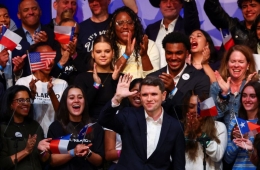
People attend an event to watch the results of the U.S. midterm elections in Columbus, Ohio, on the 3rd (local time). Columbus, U.S. = Reuters-Yonhap News.
View original imageThere were more than 7,000 markets, covering everything from predictions about what a particular candidate might say in a campaign speech to which party would control the House and Senate. Prediction markets currently favor Democrats winning majorities in both chambers. According to WP, Kalshi put the odds of Democrats taking the House majority at 93% and the Senate majority at 74%.
Large sums of money also appeared to be flowing into competitive races. Trading volume on Kalshi for the Texas Senate race had topped $88 million (approximately KRW 118.3 billion) by the morning of Election Day. Texas has traditionally been a Republican stronghold, but the race has been competitive, with Democratic candidate James Talarico leading Republican candidate Ken Paxton in recent polls.
Prediction markets allow people to buy and sell contracts, much like stocks, based on the outcomes of future events. People can trade on a wide range of topics, including midterm elections, interest rate decisions and sports results. The markets grew rapidly, particularly after the 2024 U.S. presidential election, when more than $3.6 billion (KRW 4.8 trillion) was traded on Polymarket alone on whether then-President Donald Trump or then-Democratic candidate Kamala Harris would win.
However, traders are often anonymous, making it difficult to know who is actually placing bets. As a result, controversy over insider trading and conflicts of interest has persisted. This year, Kalshi banned a trade after a North Carolina House candidate placed a bet on the election in which he was running.
Calls to regulate prediction markets are growing in the U.S. Congress. Republican Representative Blake Moore recently worked across party lines with Democratic lawmakers to co-sponsor a bill banning prediction market trading related to terrorism, war and elections.
Hot Picks Today
 "Two Spend 500,000 Won in a Flash, Yet Wait Two Hours?" ... 'Dreamland' Shunned by Kids and Foreign Tourists
- The Era of Getting 200 Million Won After 30 Years Is Over... A Japanese Bank's "Perpetual Department Head" Who Just Clocked In Cries Out
- Spain Hit by Its Worst Tragedy... Lee Kangin, Moreno and Real Madrid Join Soccer World in Mourning
- They Said, “Make It Your Home for Life” - Then Suddenly Kicked 200 Passengers Off... What Happened to the Around-the-World Cruise?
- "130 Rice Bowls Sold Out in a Day"... 'Unfiltered Face' Adds 8 Million Won to Night Market Sales: China's Bungeunwoo
WP noted, however, that “the fact that even the specific processes and outcomes of elections, the cornerstone of democracy, have become subjects of trading shows how deeply prediction markets have taken root in society.”
© The Asia Business Daily. All rights reserved. Unauthorized AI training and use prohibited.