"Dad, I'm in Pain" - Her Last Text... Another Woman in Her 20s Dies at New York City Marathon
Tragedies Strike in Succession at the New York City Marathon and Seoul Race
Raising Awareness of Long-Distance Running Safety
A woman in her 20s died after collapsing with only about 3.5 km left to the finish line while competing in the New York City Marathon in the United States. Although she was a healthy woman who had been an athlete in college, tragedy struck just as she was about to complete her first marathon. With another incident in South Korea recently in which a woman in her 20s died during a marathon, attention is turning to the health risks of long-distance running and the safety precautions runners should take.

A woman in her 20s collapsed and died at the New York City Marathon, with only about 3.5 kilometers remaining to the finish line. Reuters-Yonhap News
View original imageOn the 4th, Yonhap News Agency reported on Rachel Apa, 24, who died after taking part in the New York City Marathon held on November 1, citing The New York Times (NYT), the Associated Press and other sources. Apa suddenly collapsed during the race at about the 24-mile (38.6 km) mark in New York's Central Park, with approximately 3.5 km remaining until the finish line.
A bystander began cardiopulmonary resuscitation (CPR), and medical staff from the race, who arrived shortly afterward, provided emergency care, including using an automated external defibrillator (AED). Apa was taken to Mount Sinai Hospital in critical condition, but died at about 9:40 p.m. that day.
"I've never felt this good"...The last text she sent her father
Apa was from Lewisberry, Pennsylvania, and competed in NCAA Division I field hockey while attending Bucknell University. She continued to exercise regularly after graduating and had recently been balancing her job with a Master of Business Administration (MBA) program.
As she took on her first marathon, she told her family that she was feeling good, at least in the early stages of the race. According to her father, Steve Apa, she texted him from the 14.5 km mark to say that she was feeling great and had never run feeling this good before. But as the race went on, the situation changed. At around the 29 km mark, she began sending her father short messages complaining of pain. She continued to send messages saying that she was in pain. Her father repeatedly urged her not to push herself too hard. Since it was her first marathon, he wanted her to prioritize finishing safely over running faster.
However, the movement shown on the marathon-tracking app that her family was using to check her location stopped at around the 38 km mark. Her mother, who was waiting for her near the finish line, rushed to the scene, but Apa had already been taken to the hospital in an ambulance. Her father expressed profound sorrow, saying that he could not believe his daughter was gone. Apa had a special reason for taking part in the marathon: she joined a fundraising effort for a foundation related to Parkinson's disease to honor her grandfather, who had died of the disease. She had said that she learned the importance of taking on challenges and exercising from her grandfather.
Family says cause of death was rhabdomyolysis...What is the condition?
Apa's father said medical staff told him that the cause of his daughter's death was rhabdomyolysis. However, New York City medical examiner's officials have not yet made a final determination of the exact cause of death. Rhabdomyolysis occurs when severe muscle damage causes large amounts of myoglobin, electrolytes and other substances inside muscle cells to leak into the bloodstream.
It can result from various causes, including high-intensity exercise, prolonged strenuous physical activity, heatstroke and trauma. In severe cases, it can lead to life-threatening complications such as acute kidney injury and arrhythmias caused by hyperkalemia. Common symptoms include muscle pain more severe than the soreness normally experienced after exercise, muscle weakness, extreme fatigue, and urine that is cola-colored or brown. However, not all patients experience the typical symptoms. The U.S. Centers for Disease Control and Prevention (CDC) recommends seeking medical care immediately if severe muscle pain, unusual fatigue or dark urine develops during or after exercise.
Hot Picks Today
 "Two Spend 500,000 Won in a Flash, Yet Wait Two Hours?" ... 'Dreamland' Shunned by Kids and Foreign Tourists
- The Era of Getting 200 Million Won After 30 Years Is Over... A Japanese Bank's "Perpetual Department Head" Who Just Clocked In Cries Out
- Spain Hit by Its Worst Tragedy... Lee Kangin, Moreno and Real Madrid Join Soccer World in Mourning
- They Said, “Make It Your Home for Life” - Then Suddenly Kicked 200 Passengers Off... What Happened to the Around-the-World Cruise?
- "130 Rice Bowls Sold Out in a Day"... 'Unfiltered Face' Adds 8 Million Won to Night Market Sales: China's Bungeunwoo
The incident has drawn attention in connection with the death of a marathon participant in South Korea last month. During the half-marathon at the "2026 Seoul Race," held in downtown Seoul on October 11, Yoo Jiwon, a woman in her 20s, suddenly collapsed while running. According to the race's organizing committee, Yoo lost consciousness at about 8:49 a.m. that day at the 20.6 km mark of the half-marathon course. She was only about 500 meters from the finish line of the 21.0975 km half-marathon. People at the scene immediately called 119 and performed CPR. Yoo was taken by ambulance to a nearby hospital for treatment, but died the following day, October 12, without regaining consciousness. After news of her sudden death broke, tributes poured in from fellow runners and people who knew her. False reports that she had been discharged from the hospital and was recovering at home circulated online shortly after the incident, but a friend corrected the misinformation, adding to the sadness.
Even healthy people are not exempt...When a marathon becomes dangerous
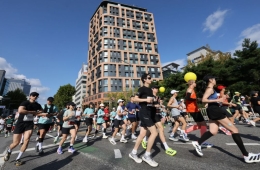
Marathons build cardiorespiratory endurance and stamina, but running 42.195 km places considerable physiological stress on the body. Running long distances without adequate training or at a pace far beyond one's usual exercise intensity can put excessive strain on the muscles and cardiovascular system. In addition to rhabdomyolysis, medical emergencies to watch out for during long-distance running include exercise-related cardiac arrest, heatstroke, severe dehydration and hyponatremia. Cardiac arrest can occur for various reasons, including underlying heart disease or arrhythmia, while heatstroke is a medical emergency in which problems regulating body temperature damage major organs, including the brain.

Marathons build cardiovascular endurance and fitness, but running 42.195 km places considerable physiological stress on the body. Running long distances without adequate training, or at a pace far beyond one’s usual exercise intensity, can put excessive strain on the muscles and cardiovascular system. Reuters-Yonhap News
View original imageRunners also need to be careful about fluid intake. They should avoid dehydration, but drinking too much water can lower the sodium concentration in the blood and cause hyponatremia. In severe cases, this can lead to reduced consciousness and seizures. If sudden chest pain, a feeling of impending fainting, severe dizziness, unusual shortness of breath or extreme muscle pain occurs during exercise, runners should stop immediately rather than fixating on their time or finishing the race. In particular, if a participant loses consciousness and is not breathing normally, promptly calling 119, performing CPR and using an AED are crucial to improving the person's chances of survival.
© The Asia Business Daily. All rights reserved. Unauthorized AI training and use prohibited.