'Super-Regional Special Zones Committee' Passes Steering Committee Under Ruling Party Lead... Ruling Party: "We'll Keep Working with the Opposition"
Steering Committee adopts special committee resolution at plenary meeting
Opposition walks out, raising concerns over handling of proceedings
Ruling party signals willingness to reflect opposition views in bill subcommittee and elsewhere
A resolution to establish a special committee on special zones for strategic industries in super-regional areas to promote locally led growth, in support of the government's three major mega-projects, passed the National Assembly Steering Committee on November 3 under the leadership of the ruling party. The People Power Party walked out before the vote in protest of what it called the Democratic Party of Korea's one-sided proceedings.
At a plenary meeting that day, the Steering Committee adopted the “Resolution to Establish a Special Committee on Special Zones for Strategic Industries in Super-Regional Areas to Promote Locally Led Growth.” The special committee will review the so-called “Special Act on Special Zones for Strategic Industries in Super-Regional Areas” (the Super-Regional Special Zones Act), which sets out matters related to the designation and operation of the zones and grants regulatory exemptions. The proposal is to form a separate special committee to discuss regulatory issues that span several standing committees, including exemptions from the 52-hour workweek for high-income and research workers.
Kim Seungsoo, the People Power Party’s senior deputy floor leader for operations, raised procedural concerns, saying, “Notice of today’s agenda and the time of the Steering Committee meeting was not given until after 6 p.m. yesterday.” He also questioned the approach of discussing the matter through a special committee, saying, “A special committee is something formed only in very exceptional circumstances,” and asking, “Has this matter even been properly discussed once by the Trade, Industry, Energy, SMEs and Startups Committee, the Political Affairs Committee, or the Climate, Energy, Environment and Labor Committee?”
Kim Mi-ae, the People Power Party’s senior deputy floor leader for policy, said, “The Democratic Party’s ranking members on the Political Affairs Committee and the Climate, Energy, Environment and Labor Committee introduced different bills on labor-related exemptions,” and pointed out that “even within the Democratic Party, the issues have not yet been reconciled.” Kim argued, “Is a National Assembly special committee a body for sorting out policy confusion within the government and the ruling party?” She added, “The more a bill is marked by disagreements and contentious issues, the more it needs professional and in-depth review by the standing committee with jurisdiction.”

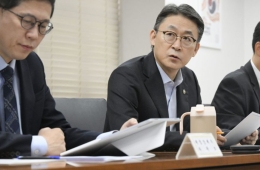
At a Steering Committee meeting held at the National Assembly on the 3rd, committee chair Han Byeongdo is voting to approve a resolution to establish a special committee on special zones for strategic industries in super-regional areas to promote locally led growth. People Power Party lawmakers opposed what they called one-sided proceedings and walked out just before the vote. Yonhap News
View original imageThe People Power Party announced its opposition to the resolution and then walked out.
Kim Han-gyu, the Democratic Party’s senior deputy floor leader for policy, said that prior discussions had taken place with the People Power Party. “We have had extensive discussions with the People Power Party,” he said. “It was only yesterday that we formally submitted the resolution to establish the special committee, but discussions between the ruling and opposition parties about forming the committee had been ongoing.” He explained, “If we wanted to handle this alone, we could do so in the Political Affairs Committee, which oversees the Prime Minister’s Office, since regulatory reform is initially handled by the Prime Minister’s Office. Nevertheless, as People Power Party members have also said, forming a special committee requires members with expertise in various fields and discussions on matters involving several standing committees. We judged that discussing the issue in the Political Affairs Committee could be inefficient, and believe that if members from several standing committees participate in the special committee, discussions can be more efficient and comprehensive.”
Hot Picks Today
 "Two Spend 500,000 Won in a Flash, Yet Wait Two Hours?" ... 'Dreamland' Shunned by Kids and Foreign Tourists
- The Era of Getting 200 Million Won After 30 Years Is Over... A Japanese Bank's "Perpetual Department Head" Who Just Clocked In Cries Out
- Spain Hit by Its Worst Tragedy... Lee Kangin, Moreno and Real Madrid Join Soccer World in Mourning
- They Said, “Make It Your Home for Life” - Then Suddenly Kicked 200 Passengers Off... What Happened to the Around-the-World Cruise?
- "130 Rice Bowls Sold Out in a Day"... 'Unfiltered Face' Adds 8 Million Won to Night Market Sales: China's Bungeunwoo
Cheon Junho, the Democratic Party’s senior deputy floor leader for operations, said, “It is no longer possible to delay forming a special committee to discuss a special bill that would enable the rapid establishment of a semiconductor cluster. I hope we can first set up a framework for discussion and then proceed with a thorough review of the details of the bill, with the participation of the People Power Party and the opposition.” He asked that the resolution to establish the special committee be adopted on the condition that “we continue consulting with the People Power Party and actively engage in discussions to ensure that it can participate in the bill subcommittee to be formed later in the manner it wants.”
© The Asia Business Daily. All rights reserved. Unauthorized AI training and use prohibited.