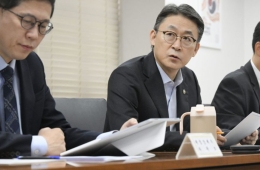
President Lee: "Housing Prices in Major Areas Falling Sharply ... Accurate Data Must Be Shared"
President Lee Jaemyung Presides over Cabinet Meeting on Nov. 3
"Some Benefiting From Rising Home Prices Are Also Steering the Market"
Amid Series of Hacking Incidents, "Review of a Cybersecurity Czar"

President Lee Jae-myung said on Nov. 3 that, to shed the stigma of being a "republic of real estate speculation," it is important to "make sure the public is well informed and can directly access accurate (real estate market) data." He instructed officials to come up with ways to actively provide objective market information, saying some with a stake in rising home prices appear to be using only selected statistics to steer the market outlook in a particular direction.
He also called for officials to consider establishing a "cybersecurity czar" body to oversee public and private sector security functions and counter increasingly sophisticated cyberattacks driven by advances in artificial intelligence (AI).
Speaking at the start of a Cabinet meeting he chaired at the Blue House that day, Lee referred to the debate over the outlook for home prices in the Seoul metropolitan area. "No one can be 100% certain about the future, but it is clear that housing prices in South Korea are abnormally high and that, for the country's future, we must shed the stigma of being a republic of real estate speculation," he said.

President Lee Jaemyung speaks at a Cabinet meeting at Cheong Wa Dae on Nov. 3, 2026. Yonhap News Agency
View original imageLee questioned in particular whether real estate statistics are being properly communicated to the public. "Statistics are published regularly, but I am concerned about whether they are being properly conveyed," he said. "It appears that those who benefit from rising home prices are using only some of the data to push the narrative in one direction."
He cited the rapid increase in apartment listings in Seoul and the sharp decline in transaction volumes. He said actual transaction prices had also fallen in some major areas, adding, "Of course, there are areas where that is not the case." His remarks were understood as a warning against interpreting the market based on a particular area or a limited set of indicators, and as a call to provide the public with a comprehensive picture based on various indicators, including listings, transaction volumes and actual transaction prices.
The major areas Lee referred to appear to be Seoul's three Gangnam districts: Gangnam, Seocho and Songpa. According to the Korea Real Estate Board, apartment prices in Seoul rose 0.09% from the previous week as of Oct. 26, extending their gains to 90 consecutive weeks. Price increases were observed in northern Seoul areas such as Seongbuk and Seodaemun, as well as in outlying districts including Geumcheon and Guro. By contrast, apartment prices in Gangnam and Seocho have fallen for 12 consecutive weeks, while Songpa has recorded declines for eight consecutive weeks.
"The most desirable outcome is for real estate prices to stabilize; neither a sharp rise nor a sharp fall is desirable," Lee said. "It is one of the government's key roles to trust the market and enable it to respond to market conditions based on accurate information."
After Series of Hacking Incidents, Lee Calls for Review of "Cybersecurity Czar"

President Lee Jaemyung enters a Cabinet meeting at Cheong Wa Dae on Nov. 3, 2026, and takes his seat after the national ceremony. Yonhap News Agency
View original imageLee also called for a sweeping overhaul of the cybersecurity system. Referring to a series of recent hacking attacks at home and abroad, he said the existing security system, which focuses on inspections and responses after incidents occur, was showing clear limitations. He added that a system should be established to detect and share signs of attacks in advance and respond proactively.
"I ask you to actively consider creating a strong and effective cybersecurity 'czar' body that can oversee and coordinate scattered security functions," he said. He called for consideration of a government-wide control tower to integrate and coordinate security functions dispersed across the public and private sectors. He also called for vulnerabilities in critical national infrastructure, including information and communications, energy and finance, to be addressed.
Lee also called for a comprehensive review of the eligibility criteria and implementation of public services for socially and economically disadvantaged people. "The national community has a duty to look after the difficulties faced by socially and economically disadvantaged people and to carefully prepare support measures for them," he said, adding that "the principles of fairness and reasonableness must also be taken into account throughout the process."
"Even a benefit that seems small and insignificant can undermine the community's trust in the system if it continues without a reasonable basis," he said, instructing officials to improve unreasonable support criteria. His remarks were understood as a renewed emphasis on fairness and reasonableness following recent controversy over priority access for multicultural families at public postpartum care centers.
On reforms to the investigation and judicial systems, Lee stressed the need for a firm response to abuses of power and financial crimes. He said the public was concerned about the separation of investigative powers and changes to the judicial system, adding that "the law enforcement function must be carried out strictly." In particular, he called for efforts to address public distrust over whether crimes committed by people exploiting their power or position, and financial crimes that harm large numbers of people, are properly investigated and punished.
Lee also said a strong response was needed to the organized spread of false information. Pointing to the practice of fabricating and systematically disseminating false claims for political purposes or financial gain, he said, "The social harm goes far beyond the personal issue of defamation resulting from the simple dissemination of false information."
Lee: "Accelerate the Establishment and Expansion of Basic Income for Rural Areas"

President Lee Jaemyung speaks at a Cabinet meeting at the Blue House on Nov. 3, 2026. Yonhap News
View original imageRegarding the 2027 budget proposal he presented to the National Assembly the previous day, Lee described it as "a stepping stone and compass toward greater growth, a more caring livelihood and a stronger South Korea." The plan aims to secure future growth engines through three livelihood projects, three mega-projects and seven seed projects, and to share the benefits of growth with all citizens.
Lee said the pilot basic income program for rural areas in Yeongyang and Cheongsong, North Gyeongsang Province, which he visited on Oct. 31, was showing results, including population growth and increased consumer spending in the region. He noted that the number of participating areas is set to double next year, but said that would still be modest compared with the country's rural areas as a whole. He urged officials to accelerate the program's successful establishment and expansion.
Hot Picks Today
 "Two Spend 500,000 Won in a Flash, Yet Wait Two Hours?" ... 'Dreamland' Shunned by Kids and Foreign Tourists
- The Era of Getting 200 Million Won After 30 Years Is Over... A Japanese Bank's "Perpetual Department Head" Who Just Clocked In Cries Out
- Spain Hit by Its Worst Tragedy... Lee Kangin, Moreno and Real Madrid Join Soccer World in Mourning
- They Said, “Make It Your Home for Life” - Then Suddenly Kicked 200 Passengers Off... What Happened to the Around-the-World Cruise?
- "130 Rice Bowls Sold Out in a Day"... 'Unfiltered Face' Adds 8 Million Won to Night Market Sales: China's Bungeunwoo
Regarding the parliamentary audit that concluded last week, Lee said, "Just as it is important to carefully review mistakes after taking a test, government administration also requires us to accurately identify what went wrong and correct it." He instructed each ministry to thoroughly implement follow-up measures.
© The Asia Business Daily. All rights reserved. Unauthorized AI training and use prohibited.