"Please, Show Some Restraint": 35,000-Runner Marathon Sparks Outcry... "Bread Expires Today, Trash Everywhere"
Use-by date on finisher gift bread: "race day"
Company responds to suspicions of clearing out inventory
Roadside trash and traffic restrictions spark public frustration
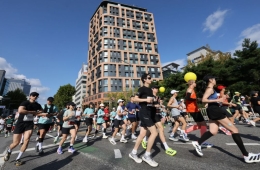
The 2026 JTBC Seoul Marathon, held in downtown Seoul with 35,000 participants, has faced a series of controversies since the event. Questions have been raised about whether bread given out as a finisher's gift was leftover stock because of its use-by date. Trash left around the event venue and the inconvenience caused to residents by extensive road closures have also drawn criticism.

The product at the center of the controversy is the "Nutty Salt Chewy Cream Bread," sponsored by Mirukku Coffee. It is a chewy bread filled with cream and topped with crushed nuts. Social media
View original imageAt the JTBC Seoul Marathon held on Nov. 1, participants received protein drinks, bottled water, bananas, chocolate, cream bread, medals and other items as finisher's gifts. The product at the center of the controversy was the "Nutty Salt Chewy Cream Bread," sponsored by Mirukku Coffee. It is a chewy bread filled with cream and topped with crushed nuts.
The issue was that the use-by date printed on the bread given to participants was Nov. 1, the day of the marathon. Some participants questioned whether the organizers had given them products that were only good through that day in order to clear out leftover stock. Others pointed out that there had not been enough information about the use-by date, even though the bread was given to participants after they finished the race.
As the controversy spread, Mirukku Coffee issued an explanation through its official social media accounts. The company said that when it first sponsored a marathon last year, it packaged a large quantity of bread in advance and received feedback that its texture deteriorated over time. It added that at a race in March this year, it introduced a system of injecting cream into the bread when participants brought it to the finish line. However, the queues grew so long that some participants left without receiving the product.
Trash near Jamsil Station and 190 bus routes diverted... Residents voice frustration
The company said that to address these issues, it developed a product specifically for participants in this year's marathon and introduced a rapid-freezing process. It said the bread was made several days before the event and stored at around minus 45 degrees Celsius. The company also explained that it printed Nov. 1 as the use-by date to recommend that participants eat the bread on the day of the event, in line with its guidance that the thawed product be consumed within 24 hours. "This is a high-quality product developed exclusively for marathon participants and made without preservatives or additives," the company said, adding that it had CCTV footage from production through shipment on the day of the event. "We are sorry for causing so much concern through this controversy and misunderstanding. We will do better in the future," it added.
After hearing the company's explanation, some online users said, "There might not have been any misunderstanding if they had separately advised people to eat it that day instead of listing a use-by date," "It's a shame that the effort put into making the product has been overshadowed," and "It was the best bread I had at a marathon."
The controversy was not limited to food. After the event, images emerged showing trash left scattered across downtown Seoul, raising questions about participants' civic awareness and the organizers' management of the event site. On Nov. 2, a post titled "The area near Jamsil Station after the marathon" spread across online communities. The photos showed paper cups, snack wrappers, drink containers, plastic bags and other items strewn across the road near Jamsil Station.

The controversy was not limited to food. After the event, images emerged showing trash left scattered across downtown Seoul, raising questions about participants' civic awareness and the organizers' management of the event site. Social media...
View original imagePaper cups apparently used by participants were also seen piled along the roadside near Jongno 5-ga Station. Online users responded, "There should be limits to how many marathons are held," "Shouldn't the organizers be responsible for cleaning up the area after the event?" and "Exercise is good, but causing problems for residents is an issue."
Others noted that disposable cups are inevitable around water stations at large marathons, and said the issue should not be blamed solely on individual participants. They argued that the organizers' provision of waste collection facilities and post-event cleanup arrangements should also be considered.
Prolonged closures of major roads worsen travel disruptions for residents
Disruptions caused by extensive road closures also fueled the controversy. The event included a full marathon starting at Gwanghwamun Square and finishing at Olympic Park, as well as a 10-kilometer course from Sangam World Cup Park to Yeouido Park. According to the Seoul Metropolitan Government, a total of 35,000 people took part in the event, including about 30,000 runners and around 5,000 staff members.
On the day of the marathon, vehicle traffic was restricted in sections of the full-marathon course from 7:20 a.m. to 1:54 p.m., and along sections of the 10-kilometer course from 5 a.m. to 11 a.m. Traffic restrictions began even earlier, at 4 a.m., around Sejong-daero, the starting point. The police deployed 1,825 personnel and installed 1,770 guide signs and banners to minimize traffic congestion. The Seoul Metropolitan Government also temporarily adjusted some city bus routes.
Hot Picks Today
 "Two Spend 500,000 Won in a Flash, Yet Wait Two Hours?" ... 'Dreamland' Shunned by Kids and Foreign Tourists
- The Era of Getting 200 Million Won After 30 Years Is Over... A Japanese Bank's "Perpetual Department Head" Who Just Clocked In Cries Out
- Spain Hit by Its Worst Tragedy... Lee Kangin, Moreno and Real Madrid Join Soccer World in Mourning
- They Said, “Make It Your Home for Life” - Then Suddenly Kicked 200 Passengers Off... What Happened to the Around-the-World Cruise?
- "130 Rice Bowls Sold Out in a Day"... 'Unfiltered Face' Adds 8 Million Won to Night Market Sales: China's Bungeunwoo
Despite these measures, the prolonged closure of major roads disrupted residents' travel. In particular, complaints were raised that large marathons held repeatedly on weekends interfered with residents' daily lives. As the controversy spread, Seoul Mayor Oh Se-hoon also announced plans to make improvements. In a Facebook post on Nov. 2, Oh acknowledged that major roads in Seoul had been extensively closed for the marathon and said he took the inconvenience experienced by residents seriously. He added that the course and schedule would be reconsidered from the ground up starting with next year's event.
© The Asia Business Daily. All rights reserved. Unauthorized AI training and use prohibited.