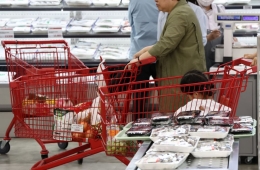
Government: "Prices Are Judged by What's in Shopping Baskets"... Record-High 64 Billion Won Kimchi-Making Support Package Prepared
Kwon Daeyeong, First Vice Minister of Finance and Economy, said, "The impact of cumulative price increases means consumers still feel that prices are high, and upward price pressures and risks remain. We will stay vigilant and focus all our efforts on managing prices."
On the morning of November 3, Vice Minister Kwon chaired a vice ministerial meeting on price-related issues at the Government Complex Seoul. Participants discussed October consumer price trends and key characteristics, measures to stabilize the supply and demand of kimchi-making ingredients, and an assessment of and response to supply and demand risks for major agricultural, livestock, and fishery products ahead of winter.

Kwon Daeyeong, vice minister of the Ministry of Finance and Economy, delivers opening remarks while chairing the 73rd Vice Ministerial Meeting on Price Stability at the Government Complex Seoul in Jongno-gu, Seoul, on the 3rd. Ministry of Finance and Economy
View original imageOctober inflation slows to 2.8%... "We will keep working until consumers feel prices have stabilized"
The Ministry of Data and Statistics reported that consumer prices rose 2.8% in October, remaining in the 2% range for the second consecutive month.
Vice Minister Kwon said, "Consumer prices rose 2.8% in October, a slower increase than in the previous month, as prices of processed foods and other items went up while prices of agricultural, livestock, and fishery products fell year over year." He added, "Despite uncertainty over the war in the Middle East and high oil prices, prices have remained relatively stable compared with those in major countries, thanks to policy efforts such as the price cap system for petroleum products."
The government's assessment is that, despite the slowdown in measured inflation, people still feel that prices are high. "Prices are judged not by statistics but by what goes into people's shopping baskets," Vice Minister Kwon said. He added, "We will keep working until government support translates into actual price stability in people's daily lives."
Ongoing monitoring of essential household items... Strengthening structural price stability and maximizing its impact on consumers
The government plans to manage prices with a focus on three pillars: intensive management of items closely tied to people's livelihoods, strengthening the foundations for structural price stability, and maximizing the impact of government support as felt by the public.
The government will continuously monitor items essential to daily life, including agricultural, livestock, and fishery products and petroleum products, and respond swiftly to any signs of unusual price movements. It also plans to consistently pursue greater efficiency in distribution and respond firmly to unfair practices such as price fixing, thereby strengthening the foundations for structural price stability. The government will carefully monitor whether tax and fiscal support, including tariff-rate quotas and discounts, leads to actual price stability for consumers, while also stepping up communication with businesses.

Record-high 64 billion won kimchi-making support package... Discounts of up to 50% on napa cabbage, seasonings, and other items
With the kimchi-making season and winter approaching, the government is stepping up measures to ease the burden of buying agricultural, livestock, and fishery products and to proactively assess and address winter price risks.
The government has prepared a record-high kimchi-making support package worth about 64 billion won to ease the burden of preparing kimchi. In particular, it will allocate 44 billion won to discounts on agricultural and livestock products, offering discounts of up to 40% on key kimchi-making ingredients. It also plans to flexibly supply stockpiled products and goods from contract farming in response to market conditions.
Some kimchi seasonings that have risen in price, including salted shrimp, and key fishery products will be sold at discounts of up to 50% through the 20 billion won "Korea Fisheries Sale: Special Kimchi-Making Season Promotion."
Hot Picks Today
 "Two Spend 500,000 Won in a Flash, Yet Wait Two Hours?" ... 'Dreamland' Shunned by Kids and Foreign Tourists
- The Era of Getting 200 Million Won After 30 Years Is Over... A Japanese Bank's "Perpetual Department Head" Who Just Clocked In Cries Out
- Spain Hit by Its Worst Tragedy... Lee Kangin, Moreno and Real Madrid Join Soccer World in Mourning
- They Said, “Make It Your Home for Life” - Then Suddenly Kicked 200 Passengers Off... What Happened to the Around-the-World Cruise?
- "130 Rice Bowls Sold Out in a Day"... 'Unfiltered Face' Adds 8 Million Won to Night Market Sales: China's Bungeunwoo
The government also plans to ensure thorough winter biosecurity measures against livestock diseases, including highly pathogenic avian influenza (AI), and to activate a proactive response system that includes securing stockpiles and bringing products to market early, in order to prepare thoroughly for extreme weather events such as El Nino and cold waves.
© The Asia Business Daily. All rights reserved. Unauthorized AI training and use prohibited.