AI Handles Video Production and Transmission; People Make the Calls
Park Inseo, Head of News Production at SK Broadband
"A system built to do more"
Staff who once produced one evening newscast can now produce five a day
Minimal disclosure to viewers; guidelines expected next year
SK Broadband uses artificial intelligence (AI) in local news production for video production and broadcasting. People still decide what makes the news. The system was introduced from the outset to expand the functions of local broadcasting, not to cut costs.

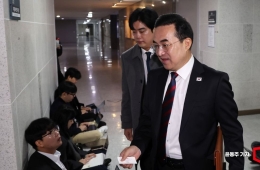
Park Inseo, Head of the News Production Division at SK Broadband, met with The Asia Business Daily on November 2 at Namsan Sowol Tower on Toegye-ro in Jung-gu and cited staffing constraints at local broadcasters as the reason for adopting the system. Producing local news requires at least seven to eight people, including staff in the control room and studio and an anchor, to gather in one place. "Given the circumstances, we were only able to produce one broadcast a day," Park said. "Even when there was a good story or breaking news in the morning, it was difficult to get it on air."
The solution to the staffing constraints was AI-based, one-person production. The company began creating AI anchors in 2023, then discussed the process with producers and shifted the production environment itself to AI. As a result, it completed the cue sheet-based solution "B tv AI Studio" last year and began using it this year.
The most difficult part of setting this direction was building internal consensus. "Broadcasting is a system in which people from different areas of expertise come together to work as a team, so it was not easy to adapt," Park said. He established guidelines for using AI and first divided responsibilities between people and AI. AI was designated as a tool for repetitive tasks such as video production and broadcasting, while people continued to handle writing news stories and producing the evening news. It took a full quarter just to reach agreement with staff on these standards.

Asked whether the system could be expanded to news writing, Park said, "That will not happen," adding, "News has value only when people contribute effort throughout the entire process." However, he said the company was considering using AI to analyze data for investigative reporting and gather audience feedback.
Errors are caught through checks before the news is broadcast. Since content produced with AI Studio is not live, there is sufficient time to review it. Once production is complete, a producer reviews the entire process, followed by another check in the broadcast control room. "All three stages involving human oversight must be clear of any problems before the content can go on air," Park said. "AI simply arranges, in order on a cue sheet, news stories written by people and reports made by people. It has no role in the reporting content."
It is not easy for viewers to tell from the screen alone whether an anchor is AI-generated. Even so, disclosure that AI was used in production is currently kept to a minimum. Under the AI Basic Act, viewers are briefly told at the start of the news that AI participated in its production. The government is providing a grace period through the end of this year. Guidelines for AI-generated content may be introduced next year. Park said one proposal is to display a watermark in the upper-left corner of the screen while AI-produced segments are on air. "Considering that content may be re-edited and distributed, I agree that all videos made by AI should be labeled," he said.

The reason for using AI despite the review and disclosure procedures is to increase output, not cut costs. "AI Studio does not offer economic benefits. We built the system not to reduce work, but to do more of it," Park stressed. In other words, someone who used to produce one news segment in the evening can now make more than five a day. While this might be seen as cost-cutting at a terrestrial broadcaster, expanding capabilities is a more important priority for local broadcasters with limited resources.
SK Broadband plans to devote the increased productivity to in-depth reporting in the evening news and programs that involve local residents. The initial goal of introducing scheduled news broadcasts was to deliver breaking news promptly; now, the company wants to focus on differentiating its evening news. Specific plans are expected to emerge in next year's business plan. "We want to create a public forum for the local community by expanding programs that involve local residents, such as discussions," Park said.
Hot Picks Today
 "Two Spend 500,000 Won in a Flash, Yet Wait Two Hours?" ... 'Dreamland' Shunned by Kids and Foreign Tourists
- The Era of Getting 200 Million Won After 30 Years Is Over... A Japanese Bank's "Perpetual Department Head" Who Just Clocked In Cries Out
- Spain Hit by Its Worst Tragedy... Lee Kangin, Moreno and Real Madrid Join Soccer World in Mourning
- They Said, “Make It Your Home for Life” - Then Suddenly Kicked 200 Passengers Off... What Happened to the Around-the-World Cruise?
- "130 Rice Bowls Sold Out in a Day"... 'Unfiltered Face' Adds 8 Million Won to Night Market Sales: China's Bungeunwoo
AI Studio could also be used by other broadcasters, not just SK Broadband. Several cable broadcasters have reviewed the system and expressed interest in adopting it. "Since cable broadcasters do not have overlapping service areas, I think it could work to divide its use by region," Park said. "Once development is complete, we plan to consider offering it on a subscription basis, with support available without an initial investment." He added, "AI could play a role in revitalizing local communication and participation, the core goals of local broadcasting."
© The Asia Business Daily. All rights reserved. Unauthorized AI training and use prohibited.