Trump Makes All-Out Push in Republican Strongholds; Democrats Face Michigan Rift [U.S. Midterm Elections]
Trump Pledges $5,000 Payments at Final Campaign Rallies
Bracing for Election Loss, He Hints at Vetoes if Democrats Win
Democratic Rift Exposed in Michigan, Sparking Uproar
With the U.S. midterm elections just two days away, Republicans and Democrats are stepping up their final push in a fierce battle for majority control. As it has become more difficult for Republicans to retain their congressional majority, U.S. President Donald Trump has begun making personal appearances even in traditionally Republican strongholds. Democrats, meanwhile, are working to resolve power struggles within the party as they seek to win back the majority.

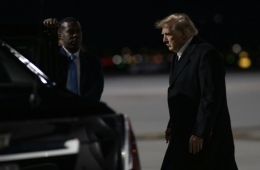
According to the Financial Times (FT), the Associated Press and other outlets on Nov. 1 (local time), Trump held his final in-person campaign rallies before the midterm elections that day in Dubuque, Iowa, and Salina, Kansas. In Dubuque, Iowa, he reiterated his pledge to pay $5,000 (about KRW 6.7 million) to each adult if Republicans gain control of both the House and the Senate.
He also stipulated that the money would have to be spent within the United States. Citing the hypothetical example of a married couple each receiving $5,000, for a total of $10,000, Trump said, "We shouldn't say, 'We've got $10,000, so let's go spend it in China. Let's go to Japan. Let's go to Korea.'"
Iowa is a Republican stronghold where Trump won by a double-digit margin in the 2024 presidential election. Kansas is similarly Republican-leaning, but as voters' cost-of-living concerns have boosted support for Democrats, Trump has stepped in to campaign there.
Trump also appears to be preparing for the possibility that Democrats will take control of Congress. In an interview with the New York Post published that day, he said that if Democrats win the midterm elections, "I will probably be Mr. Veto."
"If the Democrats send me bills, I will veto them," he said. "If they keep getting vetoed for a month or two, they'll eventually come to negotiate."
Recent forecasts suggest that Democrats could take the Senate as well as the House. Of the Senate's 100 seats, Republicans currently hold 53, while Democrats hold 47.
Signs of a rift within the Democratic Party in the final stretch of the campaign are seen as a wildcard. On that day, U.S. Representative Haley Stevens, a Democrat from Michigan, formally endorsed Republican Senate candidate Mike Rogers.
Stevens narrowly lost the Democratic Senate primary in August to progressive candidate Abdul El-Sayed.
Stevens later criticized a political ad by an outside group that linked U.S. aid to Israel with rising grocery prices, and called on El-Sayed to condemn it. El-Sayed refused, prompting Stevens to break with him.
Democratic leaders immediately pushed back against Stevens' surprise move. Democratic National Committee (DNC) Chairman Ken Martin condemned it as "a betrayal of Democratic values." Senate Minority Leader Chuck Schumer also sought to defuse the situation, saying the party's support for El-Sayed was firm.
Hot Picks Today
 "Two Spend 500,000 Won in a Flash, Yet Wait Two Hours?" ... 'Dreamland' Shunned by Kids and Foreign Tourists
- The Era of Getting 200 Million Won After 30 Years Is Over... A Japanese Bank's "Perpetual Department Head" Who Just Clocked In Cries Out
- Spain Hit by Its Worst Tragedy... Lee Kangin, Moreno and Real Madrid Join Soccer World in Mourning
- They Said, “Make It Your Home for Life” - Then Suddenly Kicked 200 Passengers Off... What Happened to the Around-the-World Cruise?
- "130 Rice Bowls Sold Out in a Day"... 'Unfiltered Face' Adds 8 Million Won to Night Market Sales: China's Bungeunwoo
The controversy led to the resignation of Stevens' chief of staff and several other aides. In the election to fill the seat being vacated by Democratic Senator Gary Peters, El-Sayed is running against Rogers, who has Trump's endorsement.
© The Asia Business Daily. All rights reserved. Unauthorized AI training and use prohibited.