Deputy Prime Minister Lee Hyeongil Meets Euisun Chung: "EV Competitiveness Plan to Be Announced This Month"
"We will actively participate in National Assembly discussions on tax credits for EV production"

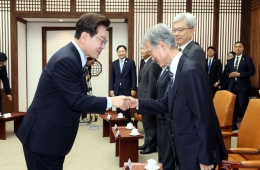
Deputy Prime Minister and Minister of Finance and Economy Lee Hyeong-il meets with Euisun Chung, Executive Chair of Hyundai Motor Group, during a visit to Hyundai Motor’s Namyang R&D Center in Hwaseong, Gyeonggi Province, on the 2nd as part of efforts to strengthen the competitiveness of the electric vehicle industry. Ministry of Finance and Economy of Korea
View original imageDeputy Prime Minister and Minister of Finance and Economy Lee Hyeongil said on November 2, regarding support for a tax credit for the domestic production of electric vehicles, "The government will actively participate in discussions in the National Assembly and engage in in-depth discussions." The government plans to announce measures to strengthen the competitiveness of the electric vehicle industry this month, reflecting the views of the National Assembly and industry.
According to the Ministry of Finance and Economy, Lee made the remarks at an industry roundtable on strengthening the competitiveness of the electric vehicle industry, held that day at Hyundai Motor and Kia's Technical Research Institute in Hwaseong, Gyeonggi Province.
Before the roundtable, Lee met separately for 20 minutes with Euisun Chung, Executive Chair of Hyundai Motor Group, to discuss ways to develop the electric vehicle industry. They reportedly also exchanged views on measures such as extending the tax credit for domestic electric vehicle production.
At the roundtable that followed, Lee reviewed the state of the electric vehicle industry and autonomous-driving technology development, and heard about areas requiring government support.
After industry representatives called for the introduction of a tax credit for electric vehicle production, Lee responded, "The government will actively participate in discussions in the National Assembly and engage in in-depth discussions."
In the tax code revision bill announced last August, the government included six major sectors, such as semiconductors and secondary batteries, as eligible for tax credits, but excluded electric vehicles. The government had decided to prioritize support for key components and materials with a weak production base and to strengthen automakers' competitiveness by supporting secondary batteries.
However, as Chinese electric vehicle brands have recently been rapidly gaining ground in the domestic market, concerns have grown that the domestic production base could be undermined. The government is therefore discussing measures to add electric vehicles to the list of recipients of tax support.
That day, industry representatives also called for expanded support to help the auto parts industry transition to future vehicles and for more specialized personnel at an agency dedicated to autonomous vehicles.
Hot Picks Today
 "Two Spend 500,000 Won in a Flash, Yet Wait Two Hours?" ... 'Dreamland' Shunned by Kids and Foreign Tourists
- The Era of Getting 200 Million Won After 30 Years Is Over... A Japanese Bank's "Perpetual Department Head" Who Just Clocked In Cries Out
- Spain Hit by Its Worst Tragedy... Lee Kangin, Moreno and Real Madrid Join Soccer World in Mourning
- They Said, “Make It Your Home for Life” - Then Suddenly Kicked 200 Passengers Off... What Happened to the Around-the-World Cruise?
- "130 Rice Bowls Sold Out in a Day"... 'Unfiltered Face' Adds 8 Million Won to Night Market Sales: China's Bungeunwoo
The government plans to reflect the industry's views raised that day and announce measures to strengthen the competitiveness of the electric vehicle industry this month. The measures will include enhancing autonomous-driving technology capabilities and expanding research and development (R&D) into key components and technologies.
© The Asia Business Daily. All rights reserved. Unauthorized AI training and use prohibited.