Experts Flag Issues to Resolve Before "Crypto Taxation"
Difficult to Define Transactions Such as Staking and Airdrops
No Loss Carryforward Deduction... Same Gains, Different Tax Burdens
"It's Shameless to Tax Without a Basic Act in Place"
With taxation of virtual assets set to take effect next January, critics have repeatedly pointed out that the tax framework is incomplete. The current law cannot cover the various ways virtual assets are traded, and the tax authorities cannot identify taxable income when overseas exchanges are used. This leaves challenges such as ensuring fair treatment between users of domestic and overseas exchanges.

Participants pose for a commemorative photo at a debate on the theme "Coin Exodus: It Can No Longer Be Left Unaddressed" at the National Assembly Library in Yeouido, Seoul, on the afternoon of the 2nd. Photo by Park Seunguk.
View original imageTaxation to Take Effect Next Year, but Many Areas Still Need Work
Ahn Sunghee, a professor at the School of Business at the Catholic University of Korea, made the remarks at a debate on the theme "Coin Exodus: It Can No Longer Be Left Unaddressed," held on the afternoon of Nov. 2 at the National Assembly Library in Yeouido, Seoul. "We need to take into account the fact that systems related to virtual assets, including the Digital Asset Basic Act, have not been established; that the tax infrastructure needs to be improved; and that six years have passed since the Income Tax Act was amended," she said.
The basis for taxing virtual assets was established through an amendment to the Income Tax Act in December 2020, but implementation has been postponed three times. Taxation is scheduled to take effect next January, but calls have emerged from the market for another delay, citing the lack of a tax framework and concerns about tax fairness. Professor Ahn also noted that "we need to consider whether the tax infrastructure is fully in place, whether the current Income Tax Act can cover the taxation of airdrops, and whether it is fair to tax only users of domestic exchanges when it is difficult to identify taxable income from overseas exchanges."
The current Income Tax Act cannot adequately cover the various types of virtual asset transactions. Examples include lending, in which virtual assets are loaned out in return for compensation, and staking, in which virtual assets are deposited on a blockchain network and additional virtual assets are received in return for validating transactions. Professor Ahn said, "There is no clear definition of virtual asset lending, and it needs to be specified in law. If it is instead set out in an administrative notice, there may be a risk of violating the principle that taxation must be prescribed by law. We need to assess whether the current framework allows staking and similar activities to be taxed."
The treatment of loss carryforwards is another issue. Even people with the same income can face different tax burdens. For example, a person who records a loss of 10 million won from transferring virtual assets in the first year and a gain of 30 million won in the second year, and a person who records a gain of 10 million won in each of the first and second years, both have total gains of 20 million won over the two years. However, the taxes they owe differ by about 2.5 million won because the tax, charged at 22% on realized income exceeding 2.5 million won, is applied separately for each year.

Professor Ahn Sunghee of the School of Business at the Catholic University of Korea presents at a forum titled “Coin Exodus: It Must No Longer Be Left Unaddressed” at the National Assembly Library in Yeouido, Seoul, on the afternoon of the 2nd. Photo by Park Seunguk
View original imageA tax gap was also highlighted for derivatives such as perpetual futures in virtual assets, which are growing mainly on overseas exchanges. Kim Jaejin, executive vice chairman of the Digital Asset eXchange Alliance (DAXA), said, "In derivatives trading, only the difference resulting from price fluctuations is settled, making it difficult to classify the transactions as lending or transfers, which presuppose the transfer of assets. Even when considering the taxation of perpetual futures, derivatives traded on overseas exchanges are difficult to classify as conventional derivatives, creating an imbalance in taxation."
Other issues raised included the fairness problem of taxing only users of domestic exchanges when it is difficult to identify taxable income from transactions on overseas exchanges, and the fairness issue of taxing the conversion of dollar stablecoins into won even though foreign-exchange gains are not taxed.
Establish a Tax Framework Covering Diverse Transactions and Address Fairness
Against this backdrop, experts stressed the need to review the tax environment. Professor Ahn advised, "We need to check whether amendments to tax requirements are needed and whether taxation is fair when taking into account taxable income that has not yet been identified. Under the current circumstances, the first tax return and payment would take place in May 2028, so we need to assess whether a tax support system can be put in place by then."
Some also argued that a capital gains tax framework should cover the entire market, including stocks as well as virtual assets. Kim Woocheol, a professor of tax studies at the University of Seoul, said a conditional postponement of virtual asset taxation was needed, premised on the introduction of a new financial investment income tax. "A capital gains tax framework needs to be in place in larger markets, such as the stock market, before it can be applied to the virtual asset market," he said. "We should take one or two years to introduce a new financial investment income tax that addresses capital gains taxation as a whole, and include virtual assets as part of that broader framework."

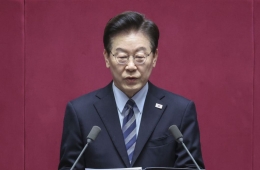
Rep. Min Byungdeok of the Democratic Party of Korea speaks at a forum titled "Crypto Exodus Must No Longer Be Left Unaddressed" at the National Assembly Library in Yeouido, Seoul, on the 2nd. Photo by Park Seungwook
View original imageThere were also calls for policies to encourage trading through domestic exchanges before taxation takes effect. Professor Ahn said, "The biggest concern when taxation is introduced is the outflow of funds overseas. Even if we tax virtual assets, we should also implement policies that encourage the formalization of trading and help identify taxable income." She proposed incentives such as applying different tax rates or offering tax credits for transactions on domestic exchanges.
There were also calls for relief measures, such as raising the deduction limit or lowering the applicable tax rate when taxation takes effect. Professor Ahn said, "The current deduction limit of 2.5 million won should be raised initially to support stable taxation, then adjusted gradually as the infrastructure is established." Moon Seonghun, a professor at Hallym University's Business School, proposed, "Rather than insisting on a 20% tax rate despite the impact of taxation, we should start at a rate around 5 percentage points lower and raise it gradually depending on the state of the infrastructure and how effectively transactions on overseas exchanges can be identified."
Hot Picks Today
 "Two Spend 500,000 Won in a Flash, Yet Wait Two Hours?" ... 'Dreamland' Shunned by Kids and Foreign Tourists
- The Era of Getting 200 Million Won After 30 Years Is Over... A Japanese Bank's "Perpetual Department Head" Who Just Clocked In Cries Out
- Spain Hit by Its Worst Tragedy... Lee Kangin, Moreno and Real Madrid Join Soccer World in Mourning
- They Said, “Make It Your Home for Life” - Then Suddenly Kicked 200 Passengers Off... What Happened to the Around-the-World Cruise?
- "130 Rice Bowls Sold Out in a Day"... 'Unfiltered Face' Adds 8 Million Won to Night Market Sales: China's Bungeunwoo
Meanwhile, support for postponing taxation is also growing within the ruling party. Min Byungdeok, a lawmaker from the Democratic Party of Korea, said at the debate, "I think it is shameless to push ahead with taxation without even having established the Digital Asset Basic Act. I believe taxation should be postponed so that, after the basic law is enacted, deadlines can be set for the measures needed to introduce taxation."
© The Asia Business Daily. All rights reserved. Unauthorized AI training and use prohibited.