Ruling and Opposition Clash at Next Year's Budget Forum: Future Response Fund a "Safety Net" vs. a "Slush Fund"
Ruling party: "We need a fiscal safety net to prepare for declining tax revenue"
Opposition: "Repaying government bonds should come first... Concerns over weakened parliamentary oversight"
National Assembly Budget Office: "No additional tax revenue expected after 2029"
Shared concern over the sustainability of funding sources
As ruling and opposition parties continue to clash over the Future Response Fund, a key feature of the 2027 budget proposal, their differences over the fund's necessity and how it should be managed were also apparent at a National Assembly forum on Nov. 2. The parties agreed that the tax revenue boost from the semiconductor boom would be difficult to sustain, but disagreed over whether to use the surplus for future investment or prioritize reducing government debt.
Jung Taeho, a Democratic Party of Korea lawmaker and the ruling party's secretary on the National Assembly's Special Committee on Budget and Accounts, said at the "2027 Budget Proposal Forum" held that day at the National Assembly Members' Office Building, "The budget proposal for next year must address three things at once: how to expand potential growth over the medium to long term, how to ease polarization, and how to restore the people's livelihoods and the economy."

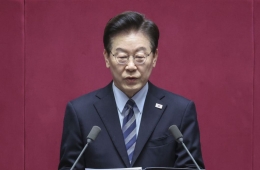
Jung Taeho, budget committee secretary of the Democratic Party of Korea, and Yoo Sangbeom, budget committee secretary of the People Power Party, talk at a debate on the 2027 government budget proposal held at the National Assembly Members' Office Building on Nov. 2, 2026. Photo by Yoon Dongju
View original imageAddressing the controversy, Jung ruled out putting all of the increased semiconductor tax revenue toward either spending or debt repayment. "We cannot spend it all or use it only to repay debt just because tax revenue is high this year and next," he said. "We also need to create a safety net to prepare for an economic downturn and a decline in tax revenue."
He explained the purpose of the Future Response Fund, saying, "We need to find an appropriate balance among three priorities: investing in future growth engines, strengthening the social safety net in preparation for a slowdown in the semiconductor sector, and managing government debt." He added, "More important than establishing the fund itself is holding in-depth discussions on what programs it should include, whether those programs can be sustained even if the budget is reduced, how much discretion the government should be allowed, and how to ensure the National Assembly's right to review the budget."
Yoo Sangbeom, a People Power Party lawmaker and the opposition party's secretary on the Budget and Accounts Committee, described the Future Response Fund as "an indiscriminate fiscal expansion policy riding on a temporary boom." Yoo criticized the government, saying, "Many forecasts suggest that semiconductor tax revenue will not remain high through 2030, yet the government is increasing spending by 12.8% from the previous year and issuing about KRW 100 trillion in deficit bonds."
"Setting aside KRW 104 trillion for the Future Response Fund and spending KRW 45 trillion from its first year could create a spending structure that will be difficult to sustain when tax revenue plunges after the semiconductor boom ends," he said. "With annual interest payments on government bonds reaching KRW 40 trillion, a substantial portion of the fund's surplus should be used to repay government bonds."
He also warned that broad budget allocations without finalized plans for specific programs could weaken the National Assembly's budget review authority. Yoo said, "The special grants for the five mega-regions and three special provinces, as well as the budget related to the southwestern region's semiconductor cluster, are opaque allocations that show only total amounts without specific details." He stressed, "We must move away from populism fueled by a temporary boom and protect fiscal democracy and the National Assembly's authority to review the budget."
The National Assembly Budget Office also identified the sustainability of the fund's revenue sources as a key challenge. Im Myeonghyeon, head of the Budget Analysis Office at the National Assembly Budget Office, forecast that additional tax revenue from semiconductors, a major source of funding for the Future Response Fund, would not materialize after 2029. "Many of the programs funded by this additional revenue involve transferring or consolidating existing programs funded through accounts and funds," he said. "We need to examine how they differ from existing programs and whether they can be sustained if funding gaps arise."
Lee Jeonghyeok, a professor at Hongik University, said, "The Future Response Fund should be viewed not simply as a new fund, but as a restructuring of the fiscal management framework to respond to rapidly changing tax revenue and industrial conditions." He added, "A budget system divided by fiscal year and ministry alone cannot support long-term growth investment. But because the fund combines two different functions - fiscal stabilization and an investment platform - its performance indicators and oversight mechanisms need to be strengthened."
Hot Picks Today
 "Two Spend 500,000 Won in a Flash, Yet Wait Two Hours?" ... 'Dreamland' Shunned by Kids and Foreign Tourists
- The Era of Getting 200 Million Won After 30 Years Is Over... A Japanese Bank's "Perpetual Department Head" Who Just Clocked In Cries Out
- Spain Hit by Its Worst Tragedy... Lee Kangin, Moreno and Real Madrid Join Soccer World in Mourning
- They Said, “Make It Your Home for Life” - Then Suddenly Kicked 200 Passengers Off... What Happened to the Around-the-World Cruise?
- "130 Rice Bowls Sold Out in a Day"... 'Unfiltered Face' Adds 8 Million Won to Night Market Sales: China's Bungeunwoo
Concerns were also raised that a mismatch between the government's expansionary fiscal policy and the Bank of Korea's tight monetary policy could fuel inflation. Kim Daejong, a professor at Sejong University, said, "Expanding fiscal spending by around 12%, far above the inflation target, could increase the money supply and drive up prices." He warned, "If fiscal and monetary policies work at cross-purposes, the burden of high inflation and high interest rates will ultimately fall on ordinary people."
© The Asia Business Daily. All rights reserved. Unauthorized AI training and use prohibited.