People Power Party Slams "Pig's Eyes" Remark; Lee: "Does Dressing It in Classical Chinese Confer Authority? ... Eyes That Pursue Only the Outer Shell"
People Power Party says he "insulted the public"; Lee hits back
Cites Zen exchange between Master Muhak and Yi Seong-gye in classical Chinese
"The dignity of words comes from the depth of insight"
When the People Power Party took issue with the quality of the president's language over his remark that "a pig sees only pigs," President Lee Jaemyung hit back, calling it "a strange sense of discernment that believes authority comes only from dressing something up in Chinese characters." He was quoting a Zen exchange between Yi Seong-gye, founder of the Joseon dynasty, and Master Muhak. His point was that the same expression is considered refined when written in Chinese characters but somehow loses its dignity when written in Korean.

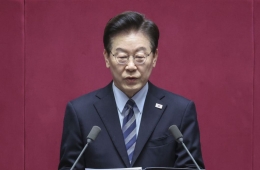
President Lee Jaemyung arrived at the National Assembly’s main building on Nov. 2 to deliver an address on the 2027 government budget, greeting People Power Party leader Jang Donghyuk in a meeting room beforehand. 2026.11.02 Photo by Yoon Dongju
View original imageThat day, President Lee posted the Chinese-character phrase "In the eyes of a pig, only pigs; in the eyes of a Buddha, only Buddhas" on his X account (formerly Twitter), explaining that it was "part of a lofty discourse between Master Muhak and Yi Seong-gye—a Zen exchange imbued with profound meaning."
He went on to say, "If I had quoted it exactly as it was, there probably would have been no fuss. But when I express the very same words in Korean as 'A Buddha sees only Buddhas, and a pig sees only pigs,' they say it sounds undignified."
"What about the expressions 'Ma-idongpung' (words falling on deaf ears), 'jojokjihyeol' (a drop in the bucket), and 'u-idokgyeong' (like talking to a wall)?" he asked. "Since they mention cows, chickens, and horses, do they also sound undignified when expressed in Korean?"
He added, "It is exactly the same saying, yet there is a strange sense of discernment that believes authority comes only from dressing it up in Chinese characters. The dignity of words comes not from the vessel—the script—but from the depth of insight they contain." He added, "Those who pursue only appearances see only appearances."
The controversy began on Oct. 29 during a National Assembly Steering Committee audit, when the People Power Party questioned President Lee's frequent overseas trips and the accompanying visits by his wife, Kim Hye-kyung. The party said he had visited 23 countries on 14 occasions since taking office and pressed him on the trips' tangible results and costs.
In response, President Lee posted on social media on Oct. 31, saying he was managing "a packed schedule of official duties, with intense preparation beforehand and long flights, without even half a day off—let alone time for sightseeing, shopping, drinking, or revelry."
He said in particular, "Even overseas trips involving such demanding work that I frequently need IV drips and get nosebleeds can look like pleasure trips. As the saying goes, a Buddha sees only Buddhas and a pig sees only pigs; people see only as much as they know."
The People Power Party immediately pushed back. In a commentary on Oct. 31, party spokesperson Cho Yong-sul said, "He has gone beyond belittling the public's legitimate questions and shown his arrogance by comparing them to pigs. Rather than responding to legitimate criticism with clear results, he raises his voice and hurls insulting words at the public. Is that truly dignified conduct for a president?"
Party leader Jang Donghyuk also asked, "Does everyone who criticizes you look like a pig to you?" In a commentary on Nov. 1, the party's senior spokesperson Choi Bo-yoon pointed to the Democratic Party of Korea's past criticism of the Yoon Suk Yeol administration's summit diplomacy budget as a waste of taxpayer money, calling the current stance a double standard.
Hot Picks Today
 "Two Spend 500,000 Won in a Flash, Yet Wait Two Hours?" ... 'Dreamland' Shunned by Kids and Foreign Tourists
- The Era of Getting 200 Million Won After 30 Years Is Over... A Japanese Bank's "Perpetual Department Head" Who Just Clocked In Cries Out
- Spain Hit by Its Worst Tragedy... Lee Kangin, Moreno and Real Madrid Join Soccer World in Mourning
- They Said, “Make It Your Home for Life” - Then Suddenly Kicked 200 Passengers Off... What Happened to the Around-the-World Cruise?
- "130 Rice Bowls Sold Out in a Day"... 'Unfiltered Face' Adds 8 Million Won to Night Market Sales: China's Bungeunwoo
The Democratic Party of Korea, meanwhile, countered that the opposition was highlighting selected cultural and social engagements to disparage the achievements of summit diplomacy. The Ministry of Foreign Affairs also said it was inappropriate to devalue the significance of overseas trips based on isolated moments, without considering the full schedule and tangible results.
© The Asia Business Daily. All rights reserved. Unauthorized AI training and use prohibited.