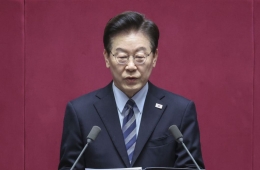
[Full Text] President Lee: "Shift to 'Growth for All'; Key Is Implementation and Speed"
President Lee Jae Myung said on Nov. 2, "We must respond to the desperate pleas of people who say that although the national economy has improved, their own household finances remain strained," adding that he would ensure the benefits of the economic recovery reach people's lives.

In his address on the 2027 budget proposal at the National Assembly that day, President Lee stressed, "We must make a major shift away from 'growth for the few,' in which opportunities and the benefits of growth are concentrated in certain regions, social classes and a small number of companies, and toward 'growth for all,' in which every region and every citizen can share equally in those opportunities and benefits."
He said the government had drawn up next year's budget proposal at KRW 820.9 trillion, a 12.8% increase from this year. He said it would reform the system so that major social security benefits are paid without requiring an application, expand support for marriage and childbirth, strengthen investment in young people and regional areas, and establish a Future Response Fund.
"The key is execution and speed," President Lee said, urging the National Assembly to pass next year's budget proposal and related bills by the statutory deadline of Dec. 2.
Following is the full text of President Lee's address on the 2027 budget proposal.
"Greater Growth, Warmer Livelihoods, a Stronger Korea: The 2027 Budget for the People"
Hot Picks Today
 "Two Spend 500,000 Won in a Flash, Yet Wait Two Hours?" ... 'Dreamland' Shunned by Kids and Foreign Tourists
- The Era of Getting 200 Million Won After 30 Years Is Over... A Japanese Bank's "Perpetual Department Head" Who Just Clocked In Cries Out
- Spain Hit by Its Worst Tragedy... Lee Kangin, Moreno and Real Madrid Join Soccer World in Mourning
- They Said, “Make It Your Home for Life” - Then Suddenly Kicked 200 Passengers Off... What Happened to the Around-the-World Cruise?
- "130 Rice Bowls Sold Out in a Day"... 'Unfiltered Face' Adds 8 Million Won to Night Market Sales: China's Bungeunwoo
Fellow citizens, National Assembly Speaker Cho Jung-sik, and members of the National Assembly,
I am here today to explain in person why we drew up the 2027 budget proposal and outline its main contents, and to ask for the National Assembly's active cooperation.
It has now been exactly one year and five months since the launch of the People Sovereignty Government.
Over the past year and five months, our government has worked tirelessly to restore the Korean economy and people's livelihoods and lay the groundwork for a fresh leap forward.
Nothing was more urgent or important than reversing the steep downturn in our economy, which had been falling so rapidly that negative growth was a concern, stabilizing people's difficult livelihoods, and improving their lives.
During this period, our government strengthened the active role of fiscal policy through two supplementary budgets and an expansionary main budget, protecting our economy and people's livelihoods from the shock of the Middle East war.
As a result, our economy is continuing a clear V-shaped recovery.
After more than 40 years, the potential growth rate is projected to rebound for a second consecutive year. The economy grew 3.8% in the first half of this year alone, and annual exports of $1 trillion are now within reach thanks to the strong performance of key industries, including semiconductors.
Gross national income per capita has also surpassed $40,000, and South Korea is projected to become the world's sixth country with a population of more than 50 million to join the "5040 Club."
By next year, we will have fully repaid the public funds used during the 1998 foreign exchange crisis.
After repaying KRW 97.2 trillion over 25 years since 2003, we will have completely overcome the IMF crisis 30 years later.
These precious achievements were made possible by all of us working together: the National Assembly, which actively cooperated for the national interest and people's livelihoods amid domestic and external crises, and the citizens, businesspeople and workers who are doing their best in their respective roles.
I would like to take this opportunity to express my deep gratitude to everyone who has trusted the government and joined forces with us.
Despite these achievements, however, the shadows of inequality and polarization still loom large over our society.
For young people, the threshold for getting their first job remains high; small business owners are increasingly burdened, and the regional economy is recovering very slowly.
People are making desperate pleas that the economy may have improved, but their household finances remain strained. It is time for us to answer the weighty question: What good is growth if it does not improve people's lives?
To overcome the limits of "K-shaped growth," which deepens inequality and polarization, we must move beyond the outdated either-or debate over growth versus distribution and present a new formula for growth suited to our changed times and circumstances.
We must make a major shift away from "growth for the few," in which opportunities and the benefits of growth are concentrated in certain regions, social classes and a small number of companies, and toward "growth for all," in which every region and every citizen can share equally in those opportunities and benefits.
We must build a fair country where not only Seoul and the capital region prosper, but regional areas prosper as well, and where everyone has access not only to the results of growth but also to opportunities for growth.
The government's "Three Major Livelihood Projects," which it is pursuing under the banner of the "Three Core Social Policies," will be the first step toward putting this vision into practice in earnest.
Our groundbreaking, large-scale policies for jobs, financial services for ordinary people and housing stability will be sustained over time. They aim to create a robust social safety net with no blind spots, going beyond the existing social safety net, and to firmly strengthen the foundations for sustainable growth.
The "Three Mega Projects" and "Seven SEEDs" will achieve even greater results on the foundation of the "Three Major Livelihood Projects."
I ask the National Assembly to give these issues careful consideration as well.
Fellow citizens, Mr. Speaker, and members of the National Assembly,
South Korea is no longer the country it once was, chasing after advanced nations.
South Korea is admired around the world, and our economy is moving beyond the stage of quantitative development and entering a new dimension.
The governance of South Korea, and our national budget, must reflect that reality.
We must ensure that the remarkable achievements we have made together shine as a source of pride for every Korean citizen.
The 2027 budget proposal prepared by the People Sovereignty Government is a forward-looking budget designed to secure an unmatchable future for South Korea and establish it as a leading nation. It is also a growth-spreading budget that will turn national growth into growth for the people.
By making focused investments in future growth engines and narrowing disparities, building on the country's greatly enhanced standing and economic strength, we will lay a firm foundation for a major leap forward and ensure that everyone can share equally in the opportunities and benefits of growth.
The newly established Future Response Fund will serve as a strategic investment platform to support a rebound in the potential growth rate and an innovative fiscal stabilization mechanism to address greater fluctuations in tax revenue.
By directing the additional tax revenue secured through the people's efforts toward four key areas—young people, future growth engines, regional areas, and education and talent—we will narrow deep-rooted disparities in our society while firmly establishing the foundations for growth and development.
Surplus funds will be used to bolster fiscal capacity when tax revenues fall short. This will help prevent the worst-case scenario of having to cut spending during a downturn, when the need for fiscal support is greatest, and will also help stabilize the market by reducing the issuance of new government bonds.
Next year's budget proposal was drawn up according to three important principles.
First, invest boldly, but do not waste money on inefficient programs. Second, prioritize fiscal spending over tax expenditures. Third, give preference to regional areas to promote balanced national development.
In line with these principles, we reviewed all fiscal spending programs from the ground up and carried out a major spending restructuring totaling KRW 107.2 trillion across 6,476 programs, including the elimination of more than 2,100 existing programs.
We converted 17 tax expenditure programs, including tax deductions for marriage and childbirth that did not benefit low-income households unless taxpayers met a certain income threshold, into fiscal support. The conversion, worth KRW 1.9 trillion, will allow more people to receive greater support.
We also significantly expanded the number of programs that give greater support to regional areas the farther they are from the capital region, increasing them to 61 to promote balanced national development and prevent regional depopulation.
Total government spending in 2027 will reach KRW 820.9 trillion, up 12.8% from this year. This represents the highest growth rate on record and the largest-ever fiscal investment.
We have expanded the budget to raise both people's standard of living and the country's future capabilities in keeping with our economic achievements.
The fundamental strength of our public finances will also improve further.
The managed fiscal balance as a share of GDP was ?3.9% this year, but will improve to ?0.1% next year, its best level in 20 years.
As a result, government debt as a share of GDP will fall from 51.6% to 48.3%.
Although we will issue government bonds, almost all of the proceeds will be used to repay existing bonds, meaning there will be virtually no net increase in government bond issuance.
International organizations such as the IMF and OECD, as well as major credit rating agencies, have also given very positive assessments of the improvement in the fiscal balance and the role of the Future Response Fund.
At a time when concerns about fiscal sustainability are growing among major advanced economies, these assessments demonstrate deep confidence in South Korea's fiscal management.
I will now explain the main contents of next year's budget proposal in detail.
First, we have substantially strengthened support for the livelihoods of vulnerable groups, regional areas and different generations to reduce social disparities.
In particular, starting next year, we will shift from an application-based system to an automatic system for major social security benefits. Anyone who qualifies will automatically receive welfare benefits without having to apply.
We have also raised the median income, which is used to determine eligibility for about 60 welfare programs and the amount of livelihood benefits, by 6.7%, the largest increase on record. This will allow more people to qualify and receive greater benefits.
The four basic livelihood security benefits—for living expenses, medical care, education and housing—will increase substantially, with the monthly livelihood benefit for a four-person household rising to KRW 2.218 million.
Low-income seniors will receive up to an additional KRW 30,000 a month in basic pension benefits.
We will also halve the reduction rate applied to low-income couples, raising their benefits from KRW 560,000 to as much as KRW 684,000.
The number of senior job positions will increase by about 30,000 to 1.18 million to support seniors' income and social engagement.
We will abolish the family-support obligation requirement for people with severe disabilities, and expand eligibility for disability pensions from 350,000 to 610,000 people.
To ensure that no one goes hungry because of financial hardship, Just Dream Centers will operate in every city, county and district nationwide, providing anyone in need with access to basic food and groceries. Households showing signs of crisis will also receive KRW 300,000 in emergency livelihood support as a priority at the township, town and neighborhood level, without a special review.
We will also substantially strengthen support for small business owners and self-employed people.
We will provide KRW 500 billion toward special adjustments of long-term overdue debt totaling KRW 5.4 trillion for small business owners affected by COVID-19 and others.
Self-employed people and freelancers who have been unable to enroll in employment insurance will newly receive KRW 1.5 million in childcare benefits.
We will issue KRW 25.6 trillion in local love gift certificates and KRW 4.5 trillion in Onnuri gift certificates to further strengthen the sales base of small businesses, self-employed people and neighborhood commercial districts.
We will expand the youth budget by a remarkable 53.5% from this year to KRW 43.3 trillion, providing close support throughout young people's lives so they can take on challenges freely and build stable futures.
We will expand the number of people eligible for work experience, training and job-seeking support from 560,000 to 720,000, including by introducing internship semesters that will provide 60,000 university students with their first work experience before graduation.
We will establish the Our Children's Independence Fund. If parents and the government each save KRW 2 million a year from a child's birth until age 18, the fund will accumulate about KRW 70 million. We will also lower the barrier to joining the Youth Future Savings Account so that anyone aged 19 to 34 can sign up without conditions, ensuring all young people have an opportunity to build up a lump sum of savings.
We will increase the number of public rental housing units for young people to 106,000 and provide 20,000 units of spacious, general-purpose public rental housing for the middle class near major transit stations to help ensure housing stability.
We will also introduce a new three-part package to support marriage, childbirth and child-rearing.
Newlyweds will receive KRW 1 million in marriage support, and parents will receive up to KRW 20 million in child welcome support after giving birth.
The Basic Child Allowance, which combines the child allowance and parental benefit, will provide a monthly base amount of KRW 200,000 for children up to age 12, rising to KRW 300,000 in designated priority areas.
Families with children aged 0 to 1 who care for them at home rather than placing them in childcare facilities will receive an additional KRW 300,000 per month.
We will expand opportunities for regional areas so they can become one of the pillars of national governance, growth and development, moving beyond the capital region's one-center system.
We will invest KRW 33 trillion in a nationwide transformation and region-led growth, more than double this year's amount.
We will shift the center of government administration to regional areas and improve living conditions, including education, healthcare and welfare.
Starting next year, we will gradually relocate 44 central government agencies from the capital region to Sejong. We will finalize a plan this year to relocate public institutions in the capital region to other parts of the country, and begin implementing it next year.
We will establish a Growth Engine Special Grant to support up to 50% of facility investment costs when anchor companies, which are key to building industrial ecosystems, make large-scale investments in regional areas. We will also create growth hubs in the five super-regions and three special regions.
We will support local governments' independent growth strategies with KRW 3.5 trillion in Regional Future Growth Support Grants.
We will fully cover tuition at 30 national universities in regional areas and establish a special account for essential regional medical care.
Local governments will take the lead in addressing gaps in medical services, and we will focus on developing national university hospitals that serve as regional hubs.
We will double the number of rural counties eligible for the basic income program to 35 and usher in an era of KRW 3 trillion in public-interest direct payments.
Second, we will expand investment in South Korea's future.
We will make bold investments in artificial intelligence and future growth engines to boost our economy's growth potential, its fundamental strength.
We will invest KRW 21.3 trillion in the "Three Mega Projects"—semiconductors, physical AI, and AI data centers—as well as artificial intelligence, nearly double this year's amount.
We will establish a special account to strengthen the competitiveness of the semiconductor industry and create a stable investment base. We will invest KRW 2 trillion in expanding production capacity, including by bringing fabs in the capital region online early and building a cluster in the southwestern region.
We will invest KRW 500 billion in on-site demonstrations of physical AI in eight key private- and public-sector fields, including manufacturing, smart factories and national defense. We will also make bold investments in AI solutions that apply skilled workers' experience and know-how—the tacit knowledge of manufacturing—to AI.
We will make an advance investment of KRW 2.1 trillion in power, water and industrial complex infrastructure to ensure that companies do not miss investment opportunities because of insufficient infrastructure.
We will provide KRW 4.7 trillion in focused support for the Frontier AI development program, which aims to make Korea's homegrown AI models globally competitive at the highest level as a strategic national asset.
We will also launch the "AI for All" initiative, including public AI agents that tell people about the public services they need and help them apply for those services.
We will also cultivate the next generation of growth engines that will follow semiconductors.
We will allocate KRW 13.8 trillion to the 10 NEXT strategic technology fields that will drive future growth, maintaining our overwhelming technological edge.
We have increased research and development investment by KRW 4 trillion, focusing on future-leading technologies such as the Seven SEEDs, bringing the R&D budget to a record KRW 39.5 trillion.
We will also accelerate the energy transition.
We will invest KRW 280 billion in expanding renewable energy, including the spread of solar income villages, and increase the number of electric vehicles eligible for subsidies to a record 430,000.
We will invest KRW 11.6 trillion to help South Korea become a cultural powerhouse, a dream cherished by the late independence activist Kim Gu.
We will help artists in the basic arts create their work in stable conditions, strengthen the global competitiveness of the content industry, and support the creation of five mega tourism zones.
We will also ensure that we nurture the talent who will lead future growth.
We will train 2,000 specialists to lead semiconductor design and regional semiconductor industries, and expand AI education tailored to each stage of life, from students to job seekers and employed workers.
Third, we will strengthen investment to protect people's lives and safety and build a peaceful South Korea.
Next year's defense budget will be KRW 73.3 trillion, an 8.2% increase.
To ensure a robust independent defense capability, we will acquire without delay powerful core assets, including those needed for an early transfer of wartime operational control, as well as nuclear-powered submarines and the KF-21. We will rapidly transform our forces into a smart, elite military by building an integrated manned-unmanned system based on AI, robots and drones.
We will raise the monthly pay of junior military officers to around KRW 3 million and increase veterans' compensation and the honor allowance for Korean War veterans to repay those who have served the country for their dedication.
We will also ensure that we build a safe society that people can feel in their daily lives.
We will support flood prevention infrastructure, including improvements to areas vulnerable to storm and flood damage, and significantly expand investment in water quality improvement with the goal of eliminating algal blooms during this administration.
We will also work to build safe and healthy workplaces by introducing specialized support for workplaces vulnerable to fires and explosions, as well as a system that guarantees industrial accident insurance benefits in advance.
We will strengthen lifelong management and support for people at high risk of suicide, from prevention through recovery in daily life.
We will establish a KRW 1.4 trillion Resource Security Fund to build an economic security system resilient to supply chain crises.
We will expand oil storage capacity by an additional 20 million barrels and strengthen efforts to secure critical minerals and invest in overseas supply chains.
We will also continue to pursue pragmatic diplomacy in the national interest and provide strong protection for Korean nationals overseas.
Fellow citizens, Mr. Speaker, and members of the National Assembly,
Over the past year and five months, we have overcome countless challenges as we worked to restore normalcy across the country after widespread dysfunction. Yet many challenges and tasks still lie ahead.
Rapidly changing global affairs and the global economic environment are constantly increasing uncertainty, while inequality and polarization within our country threaten the future of our society.
Whether we will be tossed about by high, powerful waves and ultimately founder, or rise above those waves, turn crisis into opportunity and move forward depends entirely on our choices and responses.
Now is the time for the government and the National Assembly, the ruling and opposition parties, to join forces for the future of the country and the lives of its people.
Externally, we must speak with one voice to secure the national interest in fierce competition between countries. At home, we must use our wisdom to improve people's lives by narrowing disparities and securing growth engines.
The key is execution and speed.
I ask for the National Assembly's active cooperation so that next year's budget proposal and related bills can be finalized by the statutory deadline of Dec. 2.
During the review process, the government will listen with an open mind to opinions raised by both the ruling and opposition parties and actively incorporate better alternatives.
With faith in the great people of Korea, who have turned crises into opportunities and made history through countless hardships, we will communicate actively with the National Assembly and confidently open the way to a new future for South Korea.
I ask you to join hands and move forward with strength to build a country where everyone grows together, where tomorrow holds more hope than today, and where everyone can live in peace and safety.
Thank you.
© The Asia Business Daily. All rights reserved. Unauthorized AI training and use prohibited.