"Profanity Is Up and His Speeches Have Doubled in Length": Has 80-Year-Old Trump's Speaking Style Changed with Age?
NYT Analyzes a Decade of Public Remarks
Average Speech Length More Than Doubles, from 42 to 85 Minutes
An analysis has found that public remarks by U.S. President Donald Trump, who turned 80 this year, have become harsher and more rambling than they were a decade ago, with instances of him straying from the subject or repeating the same stories also increasing significantly. As the use of definitive language and profanity has increased, controversy over his age and cognitive abilities has resurfaced.

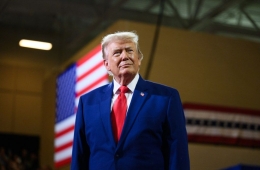
An analysis found that public remarks by U.S. President Donald Trump, who turns 80 this year, have become harsher and more rambling than they were a decade ago, with a sharp increase in instances of him straying off topic or repeating himself. AP-Yonhap News
View original imageOn November 1, The New York Times (NYT) released the findings of an analysis of Trump's speeches, interviews, social media posts and other public remarks from 2015, when he first sought the presidency, through the present. The NYT collected thousands of public remarks and schedule records and used artificial intelligence (AI) to analyze more than 6,500 speech segments. It compared the consistency and logical connections in his remarks, as well as the frequency of profanity and definitive language.
The analysis found that Trump's use of extreme or definitive words such as "always," "never," "everything" and "completely" was up 19% from 2015 and 5% from 2024. His use of profanity and vulgar language also rose sharply. Trump has recently used about 15 profanities per 10,000 words. The figure was 14 in 2024 and about 6 a decade ago, meaning the frequency has increased about 2.5-fold over the past 10 years. At the same time, his remarks have grown longer, and he has increasingly strayed from the subject or gone on in ways that are difficult to follow.
NYT: "At 80, Trump Is Harsher and More Rambling Than a Decade Ago"
The NYT's AI-based analysis found that rambling or confusing remarks appeared about 2.5 times as often in Trump's speeches during his second term as they did during the 2016 presidential campaign. However, there was little difference compared with 2024. The average length of his campaign rally speeches also more than doubled, from 42 minutes in 2016 to 85 minutes recently.

An AI-based analysis by The New York Times found that rambling or confusing remarks appeared in U.S. President Donald Trump's speeches during his second term about 2.5 times as often as in his speeches during the 2016 presidential campaign. AP-Yonhap News
View original imageAt a recent rally in Greenville, North Carolina, Trump recounted the Willie Horton case, which hurt Democratic presidential candidate Michael Dukakis during the 1988 U.S. presidential election, then brought up the same story again about 30 minutes later. Trump repeated the same anecdote to the same audience, and the NYT noted that both accounts contained factual errors.
The analysis also described instances in which he abruptly changed topics mid-speech. At a rally in Pendleton, South Carolina, he moved from discussing transgender athletes to an anecdote about a young man he had met in Israel, then went on to mention former President Abraham Lincoln, opinion polls and climate change. Trump has described this improvised speaking style as his own method of delivering speeches, which he calls "The Weave": tying together several topics before returning to the original story. However, the NYT assessed that the connections between stories have become weaker recently, with more instances in which he does not return to the original topic or his remarks are difficult to follow.
Repeats Stories and Comments on Republican Lawmaker's Body
Inappropriate remarks and personal attacks in public have also sparked controversy. At a rally in Ohio on October 12, Trump praised Republican Sen. Jon Husted's athletic ability and made remarks suggesting that he had looked at Husted's buttocks. He later repeatedly commented on the same lawmaker's body in Kentucky, North Carolina and elsewhere.
His aggressive attitude toward reporters has continued as well. When a reporter recently asked about his long-distance travel schedule and fatigue, Trump criticized the reporter's appearance and responded by suggesting that the reporter should take care of their own physical condition first. Former Republican Rep. Francis Rooney told the NYT that he criticized Trump's aggressive language, saying he had never heard such harshly aggressive remarks from a president.

Trump, meanwhile, has expressed strong confidence in his cognitive abilities. At several recent rallies, even though he had not been asked about it, he brought up the results of a cognitive test and emphasized that he has very high intelligence. At a rally in Chillicothe, Ohio, last month, he claimed to have passed a cognitive test three times and also mentioned former Presidents Barack Obama and Joe Biden.
He also described himself as a genius while explaining questions from the cognitive test. In a medical assessment released in May, White House physician Dr. Sean Barbabella said Trump had scored a perfect 30 on the Montreal Cognitive Assessment (MoCA) and had excellent cognitive and physical function. Interestingly, there was little difference from the past in Trump's vocabulary or the reading difficulty of his remarks. The NYT assessed his remarks as being at about a fourth- to fifth-grade level in the United States. The average level of remarks by modern U.S. presidents is about eighth grade, equivalent to the second year of middle school.
Hot Picks Today
 "Two Spend 500,000 Won in a Flash, Yet Wait Two Hours?" ... 'Dreamland' Shunned by Kids and Foreign Tourists
- The Era of Getting 200 Million Won After 30 Years Is Over... A Japanese Bank's "Perpetual Department Head" Who Just Clocked In Cries Out
- Spain Hit by Its Worst Tragedy... Lee Kangin, Moreno and Real Madrid Join Soccer World in Mourning
- They Said, “Make It Your Home for Life” - Then Suddenly Kicked 200 Passengers Off... What Happened to the Around-the-World Cruise?
- "130 Rice Bowls Sold Out in a Day"... 'Unfiltered Face' Adds 8 Million Won to Night Market Sales: China's Bungeunwoo
Changes have also emerged in his official schedule and online activity. Trump's weekday official schedule declined from an average of 2.1 events a day during his first term to 1.3 during his second. By contrast, he now posts an average of 21 times a day on social media, up from 13 in 2016. However, that is down from an average of 34 posts a day in 2024. Notably, during his second term he has posted on social media between midnight and 5 a.m. on about 30% of nights, and there have been 240 instances of him posting more than 10 times in a single hour. The NYT said Trump has shown the stamina to travel around the country and campaign even at age 80, but concluded that his recent repeated verbal slips, rambling remarks and inappropriate conduct have once again raised questions about his advanced age and mental stability.
© The Asia Business Daily. All rights reserved. Unauthorized AI training and use prohibited.