'KRW 821 Trillion' Super Budget... Lee: From 'Growth for a Few' to 'Growth for Everyone'
Despite economic recovery, people have yet to feel improvements in their livelihoods
"Overcoming K-shaped growth requires moving beyond outdated binary thinking"
Three major initiatives for jobs, finance and housing
Focused investment in semiconductors and AI to boost growth potential
"Growth" mentioned 35 times, followed by "support" and "investment"
President Lee: "Execution and speed are key"
President Lee Jae-myung said the government must respond to “the desperate pleas of people who say the economy has improved, but their household finances remain strained,” and named “growth for all” as the central goal of next year’s budget. The plan is to move beyond “K-shaped growth,” in which the benefits of economic recovery are concentrated in certain industries and social groups, and deliver improvements in people’s livelihoods that they can actually feel. To that end, the government will draw up a record-high budget of 820.9 trillion won and expand the role of public finances, from how welfare benefits are paid to support for young people and regional communities, as well as investment in future industries.

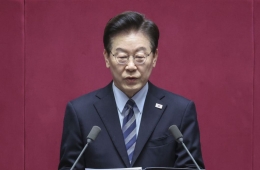
President Lee Jaemyung delivers an address on the 2027 budget proposal at the National Assembly on Nov. 2, 2026. Yonhap News.
View original imageStanding in the National Assembly plenary chamber wearing a tie that mixed navy and gray, colors symbolizing “trust” and “responsibility,” President Lee said in his address on the 2027 budget proposal that day, “It is time to answer the weighty question of what growth is worth if people’s lives do not improve.” He said, “We must make a major shift from ‘growth for a few,’ in which opportunities for growth and its benefits are concentrated in certain regions, social groups and a small number of companies, to ‘growth for all,’ in which every region and all people share the opportunities and benefits of growth more evenly.”
He also stressed that improvements in economic indicators alone, such as annual exports reaching $1 trillion and South Korea’s expected entry into the “50-40 Club” as the world’s sixth country with a population of 50 million and per capita income of $40,000, are not enough to explain a recovery in people’s livelihoods. While assessing that the economy is showing a clear recovery and that exports and national income are expected to post gains, President Lee identified youth unemployment, difficulties faced by small businesses, and regional economic stagnation as challenges to be addressed.
“The 2027 budget is a future-focused budget designed to secure an early lead and make Korea an irreplaceable country and a leading nation, as well as a growth-spreading budget that will turn national growth into growth for the people,” President Lee said. “By concentrating investment on future growth engines and narrowing gaps, we will firmly lay the foundation for a major leap forward and ensure that everyone can share the opportunities and fruits of growth more evenly.”
Support without applying for welfare... Three major livelihood projects move into full swing

President Lee Jaemyung greets lawmakers from the Democratic Party of Korea as he enters the National Assembly plenary chamber to deliver a speech on the 2027 budget proposal on Nov. 2, 2026. Yonhap News
View original imageIn response to these concerns, the government is pursuing three major livelihood projects: jobs, financial services for ordinary people, and housing stability. The aim is to build a “social safety mat” that sustains people’s lives even in times of crisis, going beyond the social safety net.
The biggest change is a shift from an application-based system, under which people must apply to receive major social security benefits, to an automatic payment system that provides benefits once eligibility is confirmed. The goal is to reduce gaps in welfare coverage for people who miss out because they do not know about available programs. Support for vulnerable groups will also be expanded, including increased basic pension benefits for low-income seniors and the removal of the family-support obligation criterion for people with severe disabilities.
In the areas of marriage, childbirth and child-rearing, the government will introduce a newlywed marriage grant and a child welcome grant for families with newborns. It will establish a basic child allowance that combines the child allowance and parental benefits, and launch the Our Child Independence Fund, to which parents and the government will both contribute. For young people, the government will introduce an internship semester that allows university students to gain work experience while enrolled, and expand the supply of public rental housing.
Balanced regional development is another key pillar of the budget proposal. The government will gradually relocate central administrative agencies from the Seoul metropolitan area to Sejong, and begin relocating public institutions to regional areas next year. Companies making large-scale facility investments outside the capital region will receive separate subsidies. The government will also pursue tuition support at national universities outside the capital region and expand the basic income program for farming and fishing communities.
Major investment in semiconductors and AI... 162 trillion won Future Response Fund to be established

The government will step up investment to develop semiconductors, artificial intelligence (AI) and data centers into national growth engines. Public funds will be concentrated on developing independent AI models, piloting physical AI at manufacturing sites, and expanding power and water infrastructure. President Lee stressed that concentrated investment in future growth engines and narrowing gaps would lay the foundation for a major national leap forward. In the defense sector, he announced plans to secure key military capabilities, including those needed for the early transfer of wartime operational control, nuclear-powered submarines and the KF-21.
A key fiscal policy measure is the Future Response Fund, which will use additional tax revenue generated by the semiconductor boom. The government plans to use the fund to invest in young people, growth engines, regional communities, education and talent, while also serving as a financial buffer to shore up fiscal capacity during economic downturns. President Lee said, “We will use surplus funds to reinforce fiscal capacity when tax revenues recover, prepare for recessions when the need for the government’s fiscal role is greatest, and help stabilize the market by reducing new government bond issuance.”
However, debate remains over the scope of the fund’s operations and the National Assembly’s oversight. The ruling party says additional tax revenue should be used for future investment and fiscal stability, while the People Power Party says repayment of national debt should take priority and has announced plans for steep cuts. Whether it is appropriate to increase ongoing welfare spending based on a temporary semiconductor boom is also a point of contention.
The marriage grant will be 1 million won, while the child welcome grant will be up to 20 million won. The basic child allowance will provide 200,000 won per month for children up to age 12, and 300,000 won in preferential regions. The budget for young people has been set at 43.3 trillion won, up 53.5% from this year, while investment in AI has been set at 21.3 trillion won, nearly double the current level.
Total spending under the budget proposal is up 12.8% from this year. The government said it had carried out spending restructuring totaling 107.2 trillion won, including the abolition of more than 2,100 programs. The deficit in the managed fiscal balance is projected to fall from 3.9% of gross domestic product (GDP) this year to 0.1% next year, while the national debt ratio is expected to decline from 51.6% to 48.3%. The Future Response Fund will total 162.3 trillion won. The government also plans to complete repayment next year of 97.2 trillion won in public funds deployed during the foreign exchange crisis.

President Lee Jae-myung speaks with attendees in a reception room before delivering his address to the National Assembly on the 2027 budget proposal on Nov. 2, 2026. Yonhap News Agency
View original imageBefore delivering his address, President Lee also stressed the need for an expansionary budget during a meeting with the National Assembly speaker, the leaders of the ruling and opposition parties, and senior officials from the country’s five constitutional institutions. At a meeting attended by People Power Party leader Jang Dong-hyeok, President Lee said, “People Power Party lawmakers argue that the increased fiscal spending should be used to pay off debt.” He added, “That argument has merit, but if we judge that spending is useful for establishing the foundation for sustainable growth, then it is right to invest in the future.” He dismissed concerns, saying, “The national debt ratio is actually falling, so there is no need to worry about fiscal issues.”
Hot Picks Today
 "Two Spend 500,000 Won in a Flash, Yet Wait Two Hours?" ... 'Dreamland' Shunned by Kids and Foreign Tourists
- The Era of Getting 200 Million Won After 30 Years Is Over... A Japanese Bank's "Perpetual Department Head" Who Just Clocked In Cries Out
- Spain Hit by Its Worst Tragedy... Lee Kangin, Moreno and Real Madrid Join Soccer World in Mourning
- They Said, “Make It Your Home for Life” - Then Suddenly Kicked 200 Passengers Off... What Happened to the Around-the-World Cruise?
- "130 Rice Bowls Sold Out in a Day"... 'Unfiltered Face' Adds 8 Million Won to Night Market Sales: China's Bungeunwoo
Meanwhile, the most frequently used keyword in President Lee’s address that day was “growth,” mentioned 35 times. “Support” and “investment” followed, each mentioned 24 times, then “people” 22 times, “future” 16 times and “regions” 15 times. The speech reflected a governing vision of spreading the benefits of economic recovery to people’s lives while securing future growth engines. At the end of his address, President Lee stressed, “What matters is execution and speed. The government and the National Assembly, the ruling party and the opposition, must join forces for the country’s future and the lives of its people,” and urged lawmakers to pass the budget proposal and related bills by the statutory deadline of December 2.
© The Asia Business Daily. All rights reserved. Unauthorized AI training and use prohibited.