U.S. Investment Terms Worse Than Japan's? ... Lee: "Just Ask the Government... Disappointed by Lack of Cross-Checking"
Blue House and Ministry of Trade, Industry and Energy Rebut Report
"Claim That South Korea Alone Is Disadvantaged Is Untrue"
President Lee Criticizes Lack of Fact-Checking
Dispute Over South Korea-Japan Investment Structures and Profit Sharing
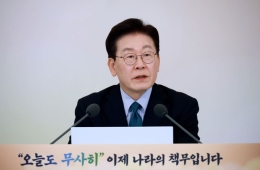
President Lee Jae-myung criticized media reports claiming that South Korea’s terms for strategic investment in the United States were less favorable than Japan’s, saying, “This is something anyone could find out just by asking the government once,” and pointing to a lack of cross-checking in the reporting process. After Minister of Trade, Industry and Energy Kim Jeong-kwan and Senior Secretary for Public Relations and Communications at the Blue House Seong Ki-hong directly rebutted the reports, President Lee also weighed in personally, intensifying the controversy over the outcome of the U.S.-South Korea investment negotiations.

On November 1, President Lee shared on his X account (formerly Twitter) rebuttal posts by Senior Secretary Seong and Minister Kim, writing, “It’s disappointing that this is something anyone could find out just by asking the government once before writing an article about government policy.” He added, “I don’t think they’re doing it deliberately, but I do wonder why they didn’t cross-check—or even ask the parties involved.” He questioned not only the accuracy of the report but also the reporting process for failing to confirm the government’s account.
The controversy began with a report aired by JTBC on October 31 titled “A Closer Look Reveals South Korea Alone Is Disadvantaged... The Decisive Difference Between South Korea’s and Japan’s U.S. Investments.” The report cited projects such as Alaska’s liquefied natural gas (LNG) project to argue that South Korea was facing less favorable investment terms than Japan. It suggested that Japan could manage risks through loans and guarantees, while South Korea could be left shouldering enormous construction costs. In particular, it raised the possibility that South Korea could bear about 67 trillion won in construction costs related to the Alaska LNG project.
That day, Senior Secretary Seong posted a rebuttal titled “Strategic Investment in the United States: Are We Alone Disadvantaged Compared with Japan?... This Is Absolutely Not True.” He argued that the report focused heavily on explanations from the Japanese side and expert opinions, while failing to properly reflect the South Korean government’s position, despite its role as a party to the negotiations, or the safeguards for its investment. He said the report distorted the outcome of the negotiations by omitting principles South Korea had secured, including the principle of commercial rationality, in its comparison of the investment terms for the two countries.
Minister Kim also issued a rebuttal in a post titled “Reports on Strategic Investment in the United States: Please Check the Facts.” He stressed that accurate reporting based on verified facts was necessary, given the significant impact large-scale investment in the United States could have on the national economy and diplomatic relations.
Hot Picks Today
 "Two Spend 500,000 Won in a Flash, Yet Wait Two Hours?" ... 'Dreamland' Shunned by Kids and Foreign Tourists
- The Era of Getting 200 Million Won After 30 Years Is Over... A Japanese Bank's "Perpetual Department Head" Who Just Clocked In Cries Out
- Spain Hit by Its Worst Tragedy... Lee Kangin, Moreno and Real Madrid Join Soccer World in Mourning
- They Said, “Make It Your Home for Life” - Then Suddenly Kicked 200 Passengers Off... What Happened to the Around-the-World Cruise?
- "130 Rice Bowls Sold Out in a Day"... 'Unfiltered Face' Adds 8 Million Won to Night Market Sales: China's Bungeunwoo
Minister Kim noted in particular that both South Korea and Japan included provisions in their memorandums of understanding (MOUs) on investment in the United States requiring consideration of consistency with domestic law, while South Korea also explicitly included the principle of “commercial rationality,” which takes into account the possibility of recovering the investment. The government’s position is that, in the distribution of returns, the U.S. share increases for Japan after the investment in each individual project is recovered, whereas South Korea’s arrangement is based on recovering the principal and interest on the total investment.
© The Asia Business Daily. All rights reserved. Unauthorized AI training and use prohibited.