Will the Future Response Fund's "Funding Source" Dry Up in 2029? Budget Office Warns of an "Additional Tax Revenue Cliff"
Additional tax revenue, a key source of funding for the government’s planned Future Response Fund, is expected to dry up after 2029, according to a new forecast. The sustainability of the government’s plan to use increased tax revenue from the semiconductor boom to overcome the limitations of annual budgeting and provide seed funding for future growth is expected to become a key issue during the National Assembly’s review of the budget bill.
Critics have warned that projects requiring continued funding once launched could increase the fiscal burden as tax revenue declines in the future. There have also been calls to prepare for the possibility that next year’s record-high budget could stoke inflation and raise interest rates, placing an even heavier burden on vulnerable groups.

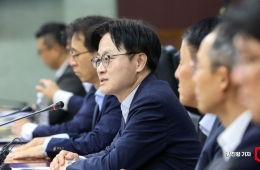
Minister of Planning and Budget Park Honggeun listens to questions from People Power Party Policy Committee Chair Lim Ija, who criticized the government’s planned “Future Response Fund,” during a parliamentary audit of the ministry by the National Assembly’s Planning and Budget Committee on the 8th. Yonhap News Agency.
View original image"No Additional Tax Revenue Expected from 2029"
A report titled "Comprehensive Analysis of the 2027 Budget Proposal," published by the National Assembly Budget Office on Nov. 1, forecast that "after 2029, the trend estimate for domestic tax revenue will exceed the projected level of domestic tax revenue, meaning no additional tax revenue will be available to fund the Future Response Fund."
The office said that no additional tax revenue would be generated from 2029 onward because the trend estimate would exceed the domestic tax revenue forecast, regardless of whether the calculation is based on the tax revenue projections in the government's "2026-2030 National Fiscal Management Plan" submitted to the National Assembly or on the office's own analysis. The bill on the establishment and operation of the Future Response Fund defines tax revenue exceeding the long-term trend estimate as additional tax revenue and allows it to be used as one of the fund's sources of financing.
Based on the National Fiscal Management Plan, the office projected that additional tax revenue would reach around KRW 57.3 trillion in 2028, but that none would be generated from 2029 onward. The trend estimate, which serves as the benchmark for additional tax revenue, is determined by domestic tax revenue results from two years before the budget year and the rate of tax revenue growth at that time. As a result, no additional tax revenue is generated if growth in domestic tax revenue stagnates or turns into a decline.
In another report, "2027 NABO Tax Revenue Forecast: 2026-2030," the office said that "additional tax revenue is closer to a temporary source of funding concentrated in 2027-2028 than a sustainable source," adding that "from 2029 onward, the Future Response Fund may have to rely on supplementary funding without additional tax revenue being set aside." It also noted that the period when no additional tax revenue is generated could coincide with a slowdown in tax revenue growth or a decline in tax revenue, when fund spending may be needed to stabilize public finances. The office advised that "the government should take into account the structural limitations of additional tax revenue as a source of funding for the Future Response Fund when drawing up an operating plan for the fund's own projects."
However, the fund can also draw on excess tax revenue, surplus funds from the settlement of accounts, and returns on the management of unallocated funds, so even if the office's analysis is accepted, it may be difficult to determine the fund's viability based solely on additional tax revenue. The office estimated that, assuming an average annual return of 4% on the entrusted assets under management, the fund would generate about KRW 3 trillion in returns on unallocated funds. The estimate was based on an average annual balance of KRW 75 trillion in entrusted assets, which the government used to calculate a KRW 22.5 billion fee for outsourcing the management of the fund's unallocated assets.
The government has not explicitly stated how long the Future Response Fund will operate. In an August YouTube broadcast, Minister of Planning and Budget Park Honggeun said that whether the fund runs out of money "depends on how much funding can continue to be secured." He said that funding could be affected by how the semiconductor cycle unfolds, but that the government expects to secure funding through 2028.

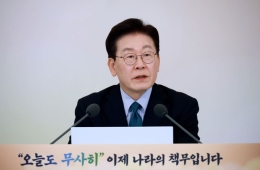
Incheon Mayor Park Chandae delivers opening remarks at the “Future Response Fund” ruling party-government consultation held at the National Assembly Members’ Office Building on the 29th. 2026.09.29 Photo by Yoon Dongju
View original imageRepay Debt or Invest? "Debt Repayment at an Appropriate Level Should Go Hand in Hand"
The National Assembly Budget Office examined three ways to allocate the large tax revenues generated by the semiconductor boom: managing national debt, investing in the future, and setting aside funds to stabilize public finances. It concluded that some funding should also be allocated to government bond repayment.
The office said, "Reducing the rapidly growing debt during a period of strong tax revenue is consistent with the intent of the National Finance Act, so government bond repayment at an appropriate level should go hand in hand with other measures, as long as it does not undermine market stability." It explained that using all additional tax revenue to repay debt could excessively reduce government bond issuance, constrict market liquidity, and amplify the impact of large-scale issuance if tax revenue conditions worsen in the future, but that repayment at an appropriate level is still necessary.
The office recommended that "the amount of repayment should be determined in stages, taking into account the annual maturity schedule and market conditions. At a minimum, the statutory level that would have been allocated to debt repayment under the current procedure for handling surplus funds—at least 51% of the balance after settlement—could be considered as a benchmark." Last month, the government used excess tax revenue to reduce government bond issuance by KRW 5 trillion from the planned amount. At an audit on Oct. 8, Minister Park also signaled openness to debt management, saying, "We will discuss the overall situation going forward with relevant ministries, including whether to use the additional excess tax revenue to further reduce government bond issuance or put it into another fund in the future."
By contrast, regarding the proposal to direct large tax revenues toward future investment, the office warned that "future investment can expand the tax base over the medium to long term, but if temporary funding is used to expand ongoing projects, spending needs may become entrenched even after tax revenue growth slows." According to its analysis, spending on "expenditures that are difficult to cut once budgeted," such as basic child allowances and youth savings accounts for the future, amounts to KRW 21.1973 trillion, or 46.7% of the KRW 45.3625 trillion allocated to the four project accounts of the Future Response Fund.
The office also assessed that setting aside funds to stabilize public finances as a safety net "can enable a swift response during a crisis, but there is a risk that the funds will remain unused for an extended period or be spent outside the National Assembly's control." Comparing the fund with major overseas funds, it noted that "unlike major funds overseas, the Future Response Fund combines fiscal stabilization and future investment functions while directly carrying out general fiscal projects through multiple project accounts, without specific rules for setting aside and withdrawing funds or standards for controlling transfers to project accounts."
It added that "the government's plan to set aside and manage funding separately for investment in the future is sound in principle," but that "there are also concerns that the fund's operation could weaken the National Assembly's fiscal oversight, expand the government's discretion in managing public finances, and lead to the loss of opportunities to improve fiscal soundness, including through repayment of national debt."

"Higher Fiscal Spending Could Raise Inflation and Interest Rates, Increasing the Burden on Vulnerable Groups"
Concerns have also been raised about the macroeconomic impact. The National Assembly Budget Office noted that "given the current economic conditions, an expansion of fiscal spending in 2027 could increase aggregate demand and, through channels such as inflationary pressures and rising interest rates, increase the burden on vulnerable groups and businesses. The government needs to consider measures to address this possibility."
The government has drawn up next year's budget with total spending of KRW 820.9 trillion, an increase of KRW 67.9 trillion, or 9.0%, from the previous year, based on the supplementary budget. The office said the budget's growth rate is "3.1 percentage points above the average annual growth rate of 5.9% for 2020-2027." It called on the government to "take into account the possibility that a restrictive monetary policy stance may continue for some time" and to "refine the spending structure and implementation plans to reduce the economic burden on vulnerable sectors."
Hot Picks Today
 "Two Spend 500,000 Won in a Flash, Yet Wait Two Hours?" ... 'Dreamland' Shunned by Kids and Foreign Tourists
- The Era of Getting 200 Million Won After 30 Years Is Over... A Japanese Bank's "Perpetual Department Head" Who Just Clocked In Cries Out
- Spain Hit by Its Worst Tragedy... Lee Kangin, Moreno and Real Madrid Join Soccer World in Mourning
- They Said, “Make It Your Home for Life” - Then Suddenly Kicked 200 Passengers Off... What Happened to the Around-the-World Cruise?
- "130 Rice Bowls Sold Out in a Day"... 'Unfiltered Face' Adds 8 Million Won to Night Market Sales: China's Bungeunwoo
In response to these concerns, Minister Park said at the parliamentary audit that "we designed next year's fiscal projects as much as possible to minimize the stimulus to aggregate demand by clearly targeting vulnerable groups and others in need of measures to reduce polarization."
© The Asia Business Daily. All rights reserved. Unauthorized AI training and use prohibited.