Lee: "Correct Problems with Multicultural Policies... This Is Not Exclusion or Discrimination"
"Improving Unfair Systems Is Inclusion, Not Discrimination"
"Unconditional Defense Leads to Distortion and Agitation"
Continues Debate for Fifth Day, Emphasizes Fair Principles
President Lee Jaemyung said on Nov. 1, addressing controversy over support policies for multicultural families, “Calling for changes to be made if there are problems cannot be a measure that excludes or discriminates against multicultural families.” He once again rejected interpretations that his call to review the criteria for priority access to public postpartum care centers amounted to discrimination against or exclusion of multicultural families.

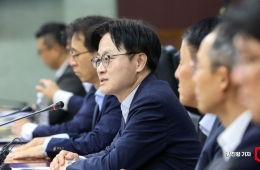
President Lee Jaemyung speaks at the second plenary meeting of the National Life and Safety Committee, held at the Blue House on October 28, 2026. Yonhap News.
View original imageOn X (formerly Twitter) that afternoon, President Lee posted under the title “If It’s Beans in Honam, It Should Be Beans in Yeongnam, Too,” saying, “Listening to voices that some aspects of support policies for multicultural families contain problems that are difficult to understand, and calling for changes to be made if there are problems, cannot be a measure that excludes or discriminates against multicultural families.”
He added, “On the contrary, this will be a strong stepping stone toward embracing them as full members of our society and completing universal welfare and a social safety net through public trust.”
President Lee said, “Our community has a duty to show consideration for socially disadvantaged groups, including multicultural families, and that duty must be upheld.” He added, “Policies should be maintained when necessary, corrected when they are wrong, supplemented when they are insufficient, and abolished when they are no longer needed.” His point was that the justification for supporting socially disadvantaged groups should be judged separately from the reasonableness of individual support programs.
In particular, he strongly criticized the tendency to label any criticism of an unreasonable system as discrimination. President Lee said, “Even when unreasonable practices and institutional blind spots are found in the administration of a system, blindly defending it solely on the basis of group identity or consistently adopting a mechanical victimhood narrative can lead to distortions that ‘make it impossible to call beans beans’ and agitation that ‘insists beans are red beans.’”
He added, “A dogmatic attitude that prevents people from calling a problem a problem could instead undermine the original purpose of embracing multicultural families in a healthy way as equal citizens of the Republic of Korea.”
He also outlined the direction multicultural policies should take. President Lee said, “Multicultural policies aimed at inclusion and openness should not separate multicultural families into a permanent sanctuary of benevolence and exemption. Instead, they should strive to enable them to live alongside others as ordinary members of the Republic of Korea’s community, enjoying equal rights and fulfilling equal obligations.”
He also warned that leaving unfair systems unaddressed could instead fuel hatred and conflict. President Lee said, “If partial unfairness in specific areas or administrative blind spots are left unaddressed in the name of ‘protecting minorities,’ those gaps will become easy targets for far-right hate-mongering and extreme public opinion polarization.”
He added, “The surest bulwark against the spread of extremism and for protecting a healthy public sphere is not blind moral defense, but transparently and proactively correcting unreasonable aspects of the system.”
President Lee also linked ensuring fairness in individual systems to the social trust needed to expand universal welfare. Emphasizing the need to build a future-oriented “social safety mat” that supports every citizen’s life without gaps, going beyond the existing social safety net, he said, “Only when ‘empathy and trust’ underpin a welfare system that is not unfairly exploited and is operated reasonably according to common-sense standards will citizens willingly extend a hand in solidarity and accept the financial burden.”
His remarks came amid continued controversy over plans to review a system granting mothers from multicultural families priority access to public postpartum care centers. On Oct. 28, President Lee questioned whether it was appropriate to grant mothers from multicultural families priority access. After some progressives criticized the policy, saying it could fuel discrimination against and hatred of multicultural families, he continued to respond directly.
On Oct. 29, the Blue House also said the aim was not to reduce support for multicultural families and announced plans to review amendments to the criteria for priority access to public postpartum care centers set out in the Enforcement Decree of the Mother and Child Health Act, established in 2016.
As President Lee has issued related messages day after day, the debate appears to be expanding beyond the appropriateness of an individual system to the question of how to balance the protection of socially disadvantaged groups with fairness in policymaking. However, whether reverse discrimination has occurred in the actual use of public postpartum care centers, and whether there is sufficient objective justification for changing the existing priority access criteria, remain issues to be examined as the system is improved.
Using the phrase “If it’s beans in Honam, it should be beans in Yeongnam, too,” President Lee stressed that “‘the facts as they are’ and ‘fair principles’ must always take precedence over factional logic or ideological bias.”
Hot Picks Today
 "Two Spend 500,000 Won in a Flash, Yet Wait Two Hours?" ... 'Dreamland' Shunned by Kids and Foreign Tourists
- The Era of Getting 200 Million Won After 30 Years Is Over... A Japanese Bank's "Perpetual Department Head" Who Just Clocked In Cries Out
- Spain Hit by Its Worst Tragedy... Lee Kangin, Moreno and Real Madrid Join Soccer World in Mourning
- They Said, “Make It Your Home for Life” - Then Suddenly Kicked 200 Passengers Off... What Happened to the Around-the-World Cruise?
- "130 Rice Bowls Sold Out in a Day"... 'Unfiltered Face' Adds 8 Million Won to Night Market Sales: China's Bungeunwoo
He concluded his post, saying, “Vigorous debate based on facts and reason not only helps society develop but is also the best preventive medicine against agitation and hatred based on falsehoods and blind obedience. Let’s debate vigorously. But let’s base it on facts and reason.”
© The Asia Business Daily. All rights reserved. Unauthorized AI training and use prohibited.