Final Monetary Policy Board Meeting of the Year: Clock Ticking on Forecasts... Growth and Inflation Offer Clues [BOK Focus]
BOK Monetary Policy Board to Make Its Final Rate Decision of the Year on the 26th
This Year's Growth Forecast Expected to Be Raised to Around 3.8%
Expected U.S. Rate Hike at Year-End Also Raises Odds of a November Hike in Korea
Inflation: I
The Bank of Korea's Monetary Policy Board will meet on the 26th of this month to decide on its final base rate of the year. Attention is focused on the Bank of Korea's specific forecasts for economic conditions this year and next, including growth and inflation, and on whether it will raise rates further. Based on figures available through the third quarter, the market has raised its expectations for this year's economic growth to around 3.8%. With the Bank of Korea still concerned that core inflation is not easily falling to near its target level, expectations are leaning toward a rate hike in November.
The market expects the terminal rate in this hiking cycle to rise to at least 3.50% per year, taking into account confidence in the economic upturn led by semiconductor exports, the possibility of a higher neutral rate, the outlook for increased consumption as income conditions improve, and still-high inflation expectations. However, some say that the sustainability of fiscal spending and the possibility that stock market corrections could have a greater impact on the real economy should be watched closely.

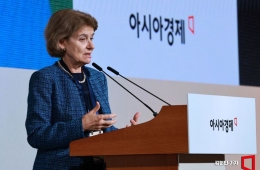
Shin Hyun-song, governor of the Bank of Korea, speaks at a press conference after a meeting of the Monetary Policy Board at the Bank of Korea in Jung-gu, Seoul, on the 22nd of last month.
View original imageThird-quarter GDP figures in; growth of around 3.8% expected this year
Since the Monetary Policy Board held rates steady last month, several major events have taken place, including the release of the preliminary figure for South Korea's third-quarter real gross domestic product (GDP) and policy rate decisions by major economies such as the United States. Given the situation so far, the market believes Bank of Korea Governor Shin Hyun-song is likely to bring out the "hoe" card - a preemptive rate hike - again this month.
Growth is the main reason. The expected upward revisions to this year's and next year's growth forecasts, signaled at last month's Monetary Policy Board meeting, have risen further now that third-quarter results are in. As of the 1st, the average forecast for South Korea's GDP growth this year from eight major domestic and foreign financial (investment) firms - Samsung, Shinhan, Daishin, Hanwha, Meritz, iM, Hyundai Motor Securities, and Citibank - is 3.76%. Five of the eight expect growth of 3.8%.
Semiconductors are, again, what underpin these expectations. Kim Jin-wook, chief economist at Citibank, said, "From the fourth quarter of this year through the second quarter of next year, solid real GDP growth of 0.8-1.0% quarter on quarter is expected to continue, driven by a prolonged memory semiconductor upcycle and spillover effects into domestic demand." He added, "At this month's Monetary Policy Board meeting, the Bank of Korea is expected to raise its growth forecasts for this year and next to around 3.8% and 3.3%, respectively." He also noted, "The forecast for nominal GDP growth this year is being raised to 26.7%, its highest level since 1978. Given the data-dependent approach recently emphasized by Governor Shin, the strong third-quarter GDP figure will further reinforce the Bank of Korea's monetary tightening stance."
Jeong Seong-tae, an economist at Samsung Securities, also expects the expansion of global investment in artificial intelligence (AI) infrastructure to continue driving South Korean exports and facility investment. He said, "From the end of next year, expanded semiconductor production driven by increased facility investment will also get underway in earnest." He forecast, "Government fiscal spending is set to increase by 12.8% next year, supported by higher tax revenue. Taking this into account, growth will be around 3.9% this year and 3.3% next year."
At the end of last month, the upper bound of the U.S. policy rate remained at 4.00%, but market expectations for a year-end hike are still high. Major U.S. investment banks (IBs) agreed that doubts about the Federal Reserve's (Fed) commitment to price stability had grown after Fed Chair Kevin Warsh made somewhat lukewarm remarks about U.S. inflation last month. However, based on the wording used in the statement's assessment of the economy, they believe the bias toward further rate hikes remains in place. A year-end hike could once again increase South Korea's sensitivity to Fed monetary policy. Some analysts say that keeping the Korea-U.S. interest rate gap at its current level of 1.00 percentage point could also be grounds for a hike this month.

Bank of Korea remains concerned about demand-side inflationary pressure...Terminal rate expectations center on 3.50%
The Bank of Korea remains concerned about inflation. It has said that next year's consumer and core inflation rates will exceed its previous forecasts of 2.3% and 2.5%, respectively, as elevated cost pressures continue to feed through and demand-side pressures gradually increase. Governor Shin has stressed, "We will continue to respond until we are confident that inflation is converging steadily toward the Bank of Korea's target level of 2.0%." The market therefore expects another hike around February next year, following a rate increase this month. The prevailing view is that the terminal rate will be 3.50%.
Kim Myeong-sil, a researcher at iM Securities, said, "On inflation, attention should be paid less to the recent short-term slowdown and more to changes in the outlook for next year." She added, "The key going forward will be whether cost shocks, such as those in energy, spread to service prices, and whether improved incomes support price increases through wages and consumption." The outlook is that if the data available through this month do not show sufficient moderation in core and services inflation, the case for further hikes will strengthen.
Cho Yong-gu, a researcher at Shinyoung Securities, said, "(The Bank of Korea) still appears wary of the spillover effects of exports on domestic demand and of demand-side inflationary pressure." He added, "The likelihood of another hike in November is high, given the Bank's emphasis on the possibility of a higher neutral rate, its commitment to addressing inflation, and the need to maintain a tightening stance." However, he said the final hike would likely come later in the cycle than the earlier preemptive moves, and put more weight on a hike in April than in February next year.
Analysis suggests that the accumulation of financial imbalances is also supporting the case for further hikes. The need for monetary tightening is also supported by the continued widening of medium- to long-term financial imbalances, driven by expectations of rising home prices in the Seoul metropolitan area and the possibility of increased leverage as asset prices rise. Min Hyeon-ha, a researcher at Hana Institute of Finance, said, "The Financial Vulnerability Index (FVI), which Governor Shin has emphasized, rose for nine consecutive quarters through the second quarter, reaching 46.5, and is also above its long-term average of 45.7 since 2008. This makes it important to watch how it develops."
Hot Picks Today
 "Two Spend 500,000 Won in a Flash, Yet Wait Two Hours?" ... 'Dreamland' Shunned by Kids and Foreign Tourists
- The Era of Getting 200 Million Won After 30 Years Is Over... A Japanese Bank's "Perpetual Department Head" Who Just Clocked In Cries Out
- Spain Hit by Its Worst Tragedy... Lee Kangin, Moreno and Real Madrid Join Soccer World in Mourning
- They Said, “Make It Your Home for Life” - Then Suddenly Kicked 200 Passengers Off... What Happened to the Around-the-World Cruise?
- "130 Rice Bowls Sold Out in a Day"... 'Unfiltered Face' Adds 8 Million Won to Night Market Sales: China's Bungeunwoo
However, it is also worth watching how financial soundness varies across sectors, as prolonged high interest rates increase debt repayment burdens for vulnerable sectors and corporate delinquency rates rise, particularly in non-bank lending and loans to small and medium-sized enterprises. Whether the recovery in private consumption will broaden is also seen as an important issue to watch amid the rate-hiking stance. Kim Jin-seong, a researcher at Heungkuk Securities, said, "Performance bonuses and dividend payments in booming industries are inherently factors that can boost household consumption. In addition, increased government spending resulting from higher corporate and income tax revenue will help spread private consumption through redistribution across income groups." However, he pointed out, "It is worth watching because income disparities are likely to widen, and differences in propensity to consume could limit the boost to consumption relative to the increase in aggregate income." He explained that redistribution through the government also takes time and may reduce the impact.
© The Asia Business Daily. All rights reserved. Unauthorized AI training and use prohibited.