[On-Site Report] KT Cloud Prepares for Next-Generation GPUs... AIDC Expansion Set to Accelerate
Inside KT Cloud's Mokdong 2 Data Center
Technology trials at the AI Innovation Center
Gunsan AIDC to adopt modular infrastructure
"1 GW of new capacity to be supplied by 2031"
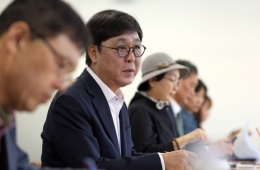
"A data center's building itself is both its specification and its product. Drawing on 25 years of operating experience, we are upgrading AI data center infrastructure in collaboration with companies such as LS ELECTRIC and Vertiv."

The AI Infrastructure Labs at the AI Innovation Center inside KT Cloud’s Mokdong 2 Data Center, featuring large black server racks and a white autonomous robot moving between them. Photo provided by KT Cloud.
View original imageAt the AI Infrastructure Labs inside the AI Innovation Center at KT Cloud's Mokdong 2 Data Center, which we visited on October 30, dozens of hoses plugged into a large server rack immediately caught our eye. AI servers equipped with NVIDIA B200 graphics processing units (GPUs) were performing training tasks. KT Cloud emphasized that it has been testing key infrastructure technologies, including cooling, power, and networking, in server environments where 72 servers are packed into a single rack and inevitably generate enormous amounts of heat.
A prime example is direct-to-chip (D2C) cooling, a liquid-cooling technology designed for high-density environments. D2C removes heat by connecting a cooling plate directly to the surface of a chip, where heat is concentrated, and circulating coolant through it. "As power density per rack, which used to have a standard of 2.2 kW, is expected to rise to 600 kW, liquid cooling is essential," said Bang Jaewon, head of AIDC Business Development at KT Cloud. "We use a load bank developed in-house to recreate server heat-generation conditions and verify coolant flow rate, pressure, and temperature."
An operational immersion-cooling system, which cools servers by submerging them in coolant, was also on display. An autonomous mobile robot moved through the space, checking equipment temperature, humidity, and illumination levels and identifying any signs of abnormalities. "This year, we are also pursuing a second-phase trial using Spot, Boston Dynamics' four-legged robot," Bang said. "Going forward, we will expand the application of physical AI-based operational automation technologies, including by linking field data collected by robots with AI-based operations platforms."
The server rooms occupied a total of six floors, and the emergency power generation room on the second basement level was operational. An air tunnel designed to channel cool air into the server rooms extended from the fourth floor all the way up to the roof. According to KT Cloud, the system operates each year from mid-November through mid-March of the following year, improving energy efficiency by 30% by blocking outside air. In the control room, which monitors these systems as well as issues at nearby data centers, multiple dashboards displayed traffic figures and other data, while employees kept a close eye on conditions in real time.

KT Cloud CEO Kim Bonggyun (left) and Paul Churchill, Vertiv vice president and general manager for Asia, pose for a commemorative photo after signing a strategic technology partnership for next-generation AI data centers. Courtesy of KT Cloud.
View original imageKT Cloud is going beyond validating infrastructure designs for the introduction of next-generation GPUs such as Rubin and is also advancing technologies for constructing the core structures of AI data centers. Its modular and prefabrication technologies involve manufacturing and testing major equipment at a factory before installing it on-site, offering shorter construction times and consistent quality control. "Building a data center takes three to four years, so we are considering how to respond to rapidly growing market demand," Bang said. "We believe rapid delivery and flexibility in scaling capacity will determine competitiveness, and plan to apply modular infrastructure starting with the construction of the Gunsan AI Data Center."
Hot Picks Today
 "Two Spend 500,000 Won in a Flash, Yet Wait Two Hours?" ... 'Dreamland' Shunned by Kids and Foreign Tourists
- The Era of Getting 200 Million Won After 30 Years Is Over... A Japanese Bank's "Perpetual Department Head" Who Just Clocked In Cries Out
- Spain Hit by Its Worst Tragedy... Lee Kangin, Moreno and Real Madrid Join Soccer World in Mourning
- They Said, “Make It Your Home for Life” - Then Suddenly Kicked 200 Passengers Off... What Happened to the Around-the-World Cruise?
- "130 Rice Bowls Sold Out in a Day"... 'Unfiltered Face' Adds 8 Million Won to Night Market Sales: China's Bungeunwoo
This is why KT Cloud is working with specialized companies in each field, including LS ELECTRIC and Vertiv, from the design stage. With LS ELECTRIC, it is jointly researching the power infrastructure needed for modular data centers and ensuring a stable supply of major power equipment in line with construction schedules. With Vertiv, it is pursuing design optimization that takes power, liquid cooling, and modular infrastructure into account together. "The AI Innovation Center is a hub for testing all these technologies," Bang said. "Through new projects in Gunsan, Cheongna, and Ansan, we will work to realize our strategy of supplying 1 GW of AI data center capacity by 2031."
© The Asia Business Daily. All rights reserved. Unauthorized AI training and use prohibited.