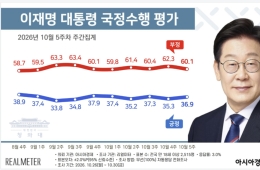
Seoul Metropolitan Area Housing Supply Expansion Pays Off... President Lee's Approval Rating Rebounds to 36.9% in a Week [Asia Business Daily-RealMeter Poll]
President Lee's approval rating rises 1.6 percentage points
People Power Party at 40.2%, Democratic Party of Korea at 38.3%... Gap narrows to within the margin of error
Rebuilding Korea Party at 8.1%, highest since November 2024
President Lee Jaemyung's job approval rating edged up to 36.9% after falling for one week. Diplomatic achievements, improving economic indicators, and policies to expand housing supply in the Seoul metropolitan area were cited as factors behind the rebound. As support for the People Power Party fell and support for the Democratic Party of Korea rose, the gap between the two parties narrowed to within the margin of error in just one week.
According to a regular poll conducted by Realmeter at the request of The Asia Business Daily and released on November 2, Lee's job approval rating stood at 36.9%, up 1.6 percentage points from last week's weekly tally (the fourth week of October). The survey was conducted over five days, from October 26 to 30, among 2,515 voters aged 18 or older nationwide. Respondents were contacted via randomly generated mobile phone numbers and surveyed using an automated response system. The margin of error was ±2.0 percentage points at a 95% confidence level, and the response rate was 3.0%. The rating comprised 24.9% who said Lee was doing a very good job and 11.9% who said he was doing a fairly good job. After falling 2.0 percentage points last week, Lee's positive rating rose 1.6 percentage points this week, recovering to a level close to that of the third week of October (37.3%).

His negative rating was 60.1% (49.7% said he was doing a very poor job and 10.4% said he was doing a fairly poor job), down 2.2 percentage points from last week's poll. The negative rating was 23.2 percentage points higher than the positive rating, a gap outside the margin of error. "Don't know" responses accounted for 3.0%.
In the daily tally, the approval rating, which stood at 34.5% at the close of October 23, rose to 37.4% on October 27, fell to 36.7% on October 28, then reached 37.5% on October 29 and 37.1% on October 30. The negative rating fell from 60.1% on October 27 to 59.6% on October 30.
By region, the rating rose by 5.6 percentage points in Jeonnam-Gwangju and Jeonbuk (from 52.0% to 57.6%), by 3.5 percentage points in Seoul (from 30.1% to 33.6%), and by 2.2 percentage points in Incheon and Gyeonggi (from 34.6% to 36.8%). In contrast, it fell by 8.5 percentage points in Daejeon, Sejong, and Chungcheong (from 39.1% to 30.6%). By age group, it rose by 6.1 percentage points among those aged 70 and older (from 32.8% to 38.9%), by 4.9 percentage points among those in their 20s (from 25.2% to 30.1%), by 4.8 percentage points among those in their 40s (from 36.3% to 41.1%), and by 4.7 percentage points among those in their 60s (from 38.4% to 43.1%). Support fell by 5.7 percentage points among those in their 50s (from 44.8% to 39.1%) and by 4.3 percentage points among those in their 30s (from 30.4% to 26.1%).

By gender, support among women rose by 3.6 percentage points (from 37.1% to 40.7%). By ideological leaning, it rose by 3.2 percentage points among conservatives (from 12.7% to 15.9%) and by 1.7 percentage points among progressives (from 52.1% to 53.8%), while support among moderates (from 39.2% to 40.0%) remained similar to last week. By occupation, support rose by 11.9 percentage points among the unemployed, retirees, and others (from 30.2% to 42.1%) and by 8.9 percentage points among those in agriculture, forestry, and fisheries (from 29.3% to 38.2%). It fell by 5.5 percentage points among sales, production, labor, and service workers (from 40.4% to 34.9%) and by 4.3 percentage points among the self-employed (from 37.8% to 33.5%).
A Realmeter official said, "We believe that the rebound in positive ratings was driven by diplomatic achievements at the South Korea-Germany summit and improvements in economic indicators, including a current account surplus and policies to boost domestic demand through the Korea Grand Festival, as well as expanded housing supply in the Seoul metropolitan area."
According to a poll on party support, conducted over two days from October 29 to 30 among 1,005 voters aged 18 or older nationwide, the People Power Party's support stood at 40.2%, down 2.4 percentage points from last week's poll. The Democratic Party of Korea's support stood at 38.3%, up 2.3 percentage points. Respondents were contacted via randomly generated mobile phone numbers and surveyed using an automated response system. The margin of error was ±3.1 percentage points at a 95% confidence level, and the response rate was 3.0%.
The People Power Party led the Democratic Party of Korea by 1.9 percentage points, within the margin of error. The gap between the two parties, which had widened to 6.6 percentage points last week, returned to within the margin of error in just one week. The Rebuilding Korea Party rose 1.4 percentage points to 8.1%, its highest rating since the first week of November 2024 (9.0%). The Reform Party stood at 2.0%, the Progressive Party at 1.2%, and other parties at 1.6%. The share of independents was 8.6%, down 0.2 percentage points.

By region, support for the People Power Party fell by 7.4 percentage points in Seoul (from 49.5% to 42.1%) and by 7.0 percentage points in Incheon and Gyeonggi (from 44.7% to 37.7%), weakening its support in the Seoul metropolitan area. It rose by 11.9 percentage points in Daejeon, Sejong, and Chungcheong (from 36.6% to 48.5%) and by 5.8 percentage points in Daegu and North Gyeongsang (from 43.9% to 49.7%).
Democratic Party of Korea support rose by 3.9 percentage points in Incheon and Gyeonggi (from 35.4% to 39.3%) and by 3.8 percentage points in Busan, Ulsan, and South Gyeongsang (from 28.1% to 31.9%), but fell by 6.7 percentage points in Daejeon, Sejong, and Chungcheong (from 43.5% to 36.8%). Although People Power Party support fell in Seoul, the Democratic Party of Korea gained only 0.3 percentage points (from 31.1% to 31.4%), failing to benefit from the shift. Over the same period, the share of independents in Seoul rose by 6.4 percentage points (from 8.1% to 14.5%).
By age group, People Power Party support fell by 13.5 percentage points among those aged 70 and older (from 60.3% to 46.8%). Among those in their 30s, it rose by 7.6 percentage points (from 43.6% to 51.2%). Democratic Party of Korea support rose by 12.9 percentage points among those aged 70 and older (from 24.4% to 37.3%), by 6.9 percentage points among those in their 40s (from 40.1% to 47.0%), and by 5.3 percentage points among those in their 60s (from 40.3% to 45.6%). However, it fell by 8.1 percentage points among those in their 30s (from 32.3% to 24.2%) and by 4.7 percentage points among those in their 50s (from 45.4% to 40.7%).
By gender, People Power Party support among women fell by 6.8 percentage points (from 42.5% to 35.7%), while Democratic Party of Korea support rose by 4.4 percentage points (from 39.5% to 43.9%). By ideological leaning, People Power Party support fell by 4.7 percentage points among conservatives (from 74.6% to 69.9%) and by 2.2 percentage points among progressives (from 13.0% to 10.8%). Democratic Party of Korea support rose by 8.2 percentage points among conservatives (from 11.1% to 19.3%) and by 2.2 percentage points among progressives (from 60.7% to 62.9%). There was little change among moderates: People Power Party support remained similar to last week (42.0% to 42.1%), while Democratic Party of Korea support fell by 1.3 percentage points (from 36.7% to 35.4%).
A Realmeter official said, "We believe that the People Power Party's rating fell as intensifying political disputes came to the fore, including its push to impeach the president, the dispute over First Lady Kim Hye-kyung's alleged golf outing, and judicial controversies involving Chief Justice Jo Hee-dae. These issues led to a loss of support among voters in the Seoul metropolitan area, those aged 70 and older, and conservatives."
Regarding the Democratic Party of Korea, the official said, "The government's and ruling party's policy initiatives, including measures to expand housing supply in the Seoul metropolitan area and policies to revitalize the people's economy, were viewed positively. This appears to have driven a rebound in support, particularly in the Seoul metropolitan area and among older voters."
Hot Picks Today
 "Two Spend 500,000 Won in a Flash, Yet Wait Two Hours?" ... 'Dreamland' Shunned by Kids and Foreign Tourists
- The Era of Getting 200 Million Won After 30 Years Is Over... A Japanese Bank's "Perpetual Department Head" Who Just Clocked In Cries Out
- Spain Hit by Its Worst Tragedy... Lee Kangin, Moreno and Real Madrid Join Soccer World in Mourning
- They Said, “Make It Your Home for Life” - Then Suddenly Kicked 200 Passengers Off... What Happened to the Around-the-World Cruise?
- "130 Rice Bowls Sold Out in a Day"... 'Unfiltered Face' Adds 8 Million Won to Night Market Sales: China's Bungeunwoo
For more information about the polls, refer to the website of the National Election Survey Deliberation Commission.
© The Asia Business Daily. All rights reserved. Unauthorized AI training and use prohibited.