[On the Ground] "Screen 86 Applications with One Command"... SKT Showcases 'AX Innovation 2.0'
Establishing a Culture of AI Use... Now It's Time to Deliver Organizational Results
Redesigning Work with Company-Wide Support
Strengthening the Foundation for AI at Work Through Security and Data Improvements
"Please finalize the 15 seller teams to be listed and register them in the system by the end of today."

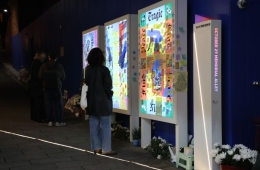
Shin Seonghan, an SKT AI Board manager, is experiencing EBB AX Club at SK Telecom’s Talent Development Center in Icheon on the 30th. Photo courtesy of SK Telecom.
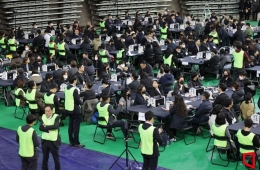
View original imageAt the SK Telecom Human Resources Development Center in Icheon, Gyeonggi Province, on October 30, an arena page displaying a hypothetical work assignment opened. The task was to select businesses to participate in the "2026 Seongsu Snack Market" and report the results to a team leader. Claude was connected to the work system and instructed: "Read the MOS work guide and then do what needs to be done." The artificial intelligence (AI) read the work guide, emails and announcement, then automatically reviewed 80 applications. It also added six applications received by fax and took into account the revised announcement and deadline. It took less than five minutes to exchange information with a screening agent, assign scores and select 15 teams. The task could be completed with a single command, without downloading and checking each application and announcement file individually.
The exercise was the first challenge in the second SK Telecom AX Challenge hackathon, which will be held at T Factory Seongsu on November 13. SK Telecom also runs EBB AX Club, a participatory AX program in which employees gather every Wednesday morning to work on artificial intelligence transformation (AX) challenges. The program aims to give employees experience achieving tangible results by connecting AI agents not only to their work systems but also to relevant data. Shin Seonghan, an SK Telecom AI Board manager who oversees the program, said, "We are looking for ways to achieve results beyond simply using AI," adding, "The key is to connect AI to work systems and create an environment in which AI can work."
AI Agent Experience Built by 4,000 Employees... Expanding to Organizational Innovation
On November 1, SK Telecom said it had entered "AX Innovation 2.0," which aims to turn individuals' use of AI into results for the entire organization. After fostering a culture in which employees create and use AI agents themselves, the company now aims to redesign its work processes and collaboration methods around AI.
During the AX Innovation 1.0 phase, more than 4,000 SK Telecom employees created AI agents themselves. The number of agents used regularly within the company also reached 1,500.
The shift to AX Innovation 2.0 came as the company determined that organization-wide support, including access to internal data and system integration, had become necessary as employees' use of AI agents spread. Kim Insoo, team leader of the SK Telecom AI Board, said, "The need for support with internal data and systems that individuals have difficulty accessing has started to emerge," adding, "Our goal is to scale individual productivity into organizational productivity."
To this end, SK Telecom is running programs including the AX Enabler Task Force, AX Sandbox and AX Catalyst. The AX Enabler Task Force addresses, at the company-wide level, common challenges employees face when using AI. It improves the education and support system, upgrades data and security technology infrastructure, and redesigns management infrastructure, including an employee ID system for AI agents and an evaluation framework.
The AX Sandbox, which was tested in the service development organization in the first half of the year, has also expanded to organizations across the company. The aim is to explore ways for multiple employees and AI agents to work together, define the respective roles of AI and people, and ensure that their work leads to results at the organizational level.
In September, the company selected 10 catalysts to lead AX initiatives internally and is supporting them with the costs of using AI models and with technology and data integration. Through regular meetings, they share their experiences and challenges, while issues involving data, permissions, systems and security are addressed together with the AX Enabler Task Force. Kim said, "We are conducting a pilot because we need to test what support the company should provide and what employees need to do," adding, "We plan to expand the program to a second cohort starting next year."
Connecting Data While Protecting Security... Creating an Environment Where AI Can Work

Kim Insoo, head of SK Telecom's AI Board team, gives a briefing on the status of AX at SK Telecom's Human Resources Development Center in Icheon on the 30th. Courtesy of SK Telecom.
View original imageTo expand the scope of agents' workplace applications, SK Telecom is establishing a foundation for data use and developing and adopting technologies that protect security. For example, it developed and filed a patent application for Zero Exposure Zone (Z.E.Z) technology, which enables AI to perform tasks without directly exposing the original data to it. Sensitive original data, including personal information, is securely managed in a separate area, and only the results needed for the task, such as metadata, comparison tokens and calculated values, are passed to the AI.
SK Telecom introduced "Data Desk" to help AI easily understand and use data. It automatically generates explanations and work-related context for various types of data, enabling AI agents to find and use the information they need.
The company is also developing "Workmap," which organizes the work of employees and the organization in a form that AI can understand. Based on existing work materials and goals, AI identifies workflows and creates a work map through conversations with employees. By organizing individual and organizational work processes, the company aims to establish standard procedures for working alongside AI and identify tasks to which AI agents can be applied.
Hot Picks Today
 "Two Spend 500,000 Won in a Flash, Yet Wait Two Hours?" ... 'Dreamland' Shunned by Kids and Foreign Tourists
- The Era of Getting 200 Million Won After 30 Years Is Over... A Japanese Bank's "Perpetual Department Head" Who Just Clocked In Cries Out
- Spain Hit by Its Worst Tragedy... Lee Kangin, Moreno and Real Madrid Join Soccer World in Mourning
- They Said, “Make It Your Home for Life” - Then Suddenly Kicked 200 Passengers Off... What Happened to the Around-the-World Cruise?
- "130 Rice Bowls Sold Out in a Day"... 'Unfiltered Face' Adds 8 Million Won to Night Market Sales: China's Bungeunwoo
Kim said, "SK Telecom's AX strategy is evolving from individuals to organizations, and from utilization to results," adding, "We expect it to lead to increased productivity at the organizational level and contribute to revenue."
© The Asia Business Daily. All rights reserved. Unauthorized AI training and use prohibited.