Semiconductors, Autos 'Join Forces' to Drive September Industrial Output to Biggest Gain in 15 Years and 6 Months; Triple Increase in 3 Months (Comprehensive)
All-industry production up 3.0%; manufacturing capacity utilization at 76.8%
Consumption up 3.6% as Chuseok effect coincides with new-car launches
Government: "All-out efforts to broaden the foundations for growth"
All-industry production rose by the most in 15 years and six months last month. The increase was driven by a sharp rebound in automobile production after the effects of strikes wore off, while strong semiconductor demand continued. Consumption and investment also rose, marking the first “triple increase” in three months.

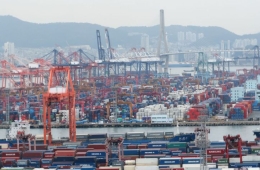
Export and import cargo is stacked high at Shinsundae Pier at Busan Port. Yonhap News.
View original imageAccording to the “September 2026 Industrial Activity Trends” report released by the Ministry of Data and Statistics on October 30, the all-industry production index rose 3.0% month over month in September. This was the largest increase since March 2011, when it rose 3.4%. The broad-based improvement was led by a 9.0% surge in mining and manufacturing production from the previous month. Automobile production in particular soared 39.9%, reflecting a base effect from declines caused by summer vacations and strikes, as well as the normalization of factory operations. This was the largest increase in six years and six months, since March 2020, when production rose 46.6%. Semiconductor production also climbed 19.2% on sustained memory demand, reaching its highest level in seven months, since February this year, when it rose 28.2%.
Service-sector production also increased 0.5% from the previous month. The rise was attributed to a 3.5% increase in wholesale and retail trade, driven by the normalization of automobile production and discount events ahead of Chuseok, as well as a 3.6% increase in transportation and warehousing. Lee Du-won, Director General for Economic Trends and Statistics at the Ministry of Data and Statistics, said, “The sharp increases in semiconductor and automobile production led the rise in overall production. The base effect from a decline in passenger-car sales in August, the effect of new-car sales, including the Avante and Grandeur, and demand for the Chuseok holiday coincided, easing temporary factors behind declines in retail sales and equipment investment and turning them upward.”
The retail sales index rose 3.6% from the previous month as sales of food and beverages and passenger cars increased. This not only ended consecutive declines in July (-2.5%) and August (-1.8%), but also marked the largest increase in three years and seven months, since February 2023, when it rose 5.1%. Durable goods, including passenger cars, increased 4.4%; nondurable goods, such as food and beverages, rose 4.2%; and semi-durable goods, including clothing, gained 0.6%.
Equipment investment increased 5.3% from the previous month, as both machinery, which benefited from expanded data-center construction, and transport equipment rose, by 4.7% and 7.4%, respectively. Construction completed also increased 5.8% month over month, with gains in both building construction, including semiconductor plants and data centers, up 5.1%, and civil engineering, up 7.4%. Construction orders (nominal), an indicator of future work, surged 49.8% from the same month a year earlier, boosting expectations. The cyclical component of the coincident composite index, which shows current economic conditions, rose 0.5 points from the previous month to 102.2, supported by increases in the mining and manufacturing production index and import value. However, the cyclical component of the leading composite index, which signals the future direction of the economy, fell 0.1 points from the previous month to 104.1. Despite gains in the domestic machinery shipments index and construction orders, it was held back by a decline in the KOSPI and a narrowing of the gap between long- and short-term interest rates.
Hot Picks Today
 "Two Spend 500,000 Won in a Flash, Yet Wait Two Hours?" ... 'Dreamland' Shunned by Kids and Foreign Tourists
- The Era of Getting 200 Million Won After 30 Years Is Over... A Japanese Bank's "Perpetual Department Head" Who Just Clocked In Cries Out
- Spain Hit by Its Worst Tragedy... Lee Kangin, Moreno and Real Madrid Join Soccer World in Mourning
- They Said, “Make It Your Home for Life” - Then Suddenly Kicked 200 Passengers Off... What Happened to the Around-the-World Cruise?
- "130 Rice Bowls Sold Out in a Day"... 'Unfiltered Face' Adds 8 Million Won to Night Market Sales: China's Bungeunwoo
The Ministry of Finance and Economy said, “Overall, all-industry production rose 1.9% in the third quarter, sustaining strong growth momentum for a second consecutive quarter following the second quarter.” It added, “With financial-market volatility increasing and pressure on people’s livelihoods persisting amid prolonged high oil prices, a global trend toward interest rate hikes, and uncertainty surrounding the U.S. midterm elections, the government will press ahead without pause with the three mega-projects, the seven SEED initiatives, the Korean-style Green Transformation (K-GX), and efforts to foster the service industry, broadening the foundations for growth in our economy.”
© The Asia Business Daily. All rights reserved. Unauthorized AI training and use prohibited.